Ukraine enters fifth year of war amid frontline attrition and pressure from Trump
The full-scale invasion marks its fourth anniversary with a stalemate on the battlefield and Washington pushing for a ceasefire agreement
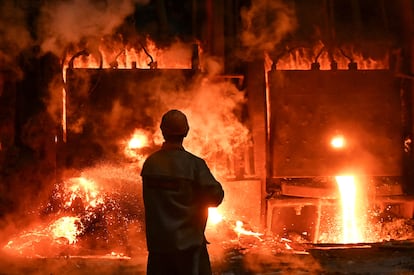
Ukraine marks the fourth anniversary of the Russian invasion at a crossroads. In addition to the military and social toll of the war, the United States is pressuring Kyiv to accept a peace deal that, on Moscow’s terms, would amount to a surrender. The main stumbling block to the three-way peace talks, scheduled to resume this Thursday, is the cession of the eastern region of Donbas.
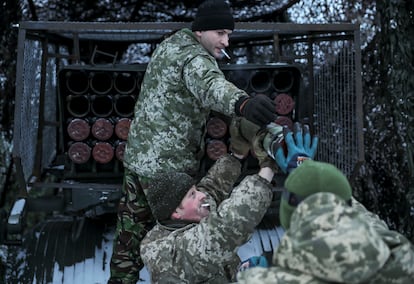
Meanwhile, the relentless winter and nearly 50 months of grueling fighting have frozen the positions of both sides on the battlefield. Drones, the undisputed masters of the skies, are dictating the pace of the conflict. Despite the dire predictions for 2022, Ukraine is holding firm against the Russian advance, which has survived sanctions and is leveraging its superior arsenal and troop numbers. This gives the Kremlin a “slight advantage,” meaning it is gradually occupying a little more Ukrainian territory, although, in reality, after these four years, one could speak of a “stalemate or balance,” according to Guillermo Pulido, a military analyst for the magazine Ejércitos.
To counter this enemy superiority, Kyiv can rely on its drone production capabilities or artificial intelligence, adds this specialist. However, there is one hurdle that Ukraine will find difficult to overcome on its own, Pulido adds: Russian ballistic missiles. In the first year of his second term in the White House, Donald Trump virtually eliminated U.S. Military aid. The most important weaponry for Ukraine, such as Patriot missile systems, comes from the U.S., but the allies must acquire them. Kyiv has found itself without the ammunition to intercept Moscow’s missiles at critical moments due to these acquisition delays.
Medical sources within the Ukrainian army have told EL PAÍS that over 90% of current casualties are caused by drones. This weaponry will continue to play an increasingly prominent role amid “a shift of historic proportions in technological warfare,” with Ukraine as the battleground, predicts Pulido. The prominence of tanks, fighter jets, and frigates is fading, he adds.
The devastating impact of war will leave its mark for years on a country of just over 600,000 square kilometers (233,000 square miles) — of which around 20% is under Russian occupation — and a population of 42 million in 2022. The total cost of reconstruction and recovery over the next decade will reach — according to 2025 figures — almost $588 billion according to Prime Minister Yulia Svyrydenko. This is equivalent to almost three times Ukraine’s 2025 GDP, according to figures announced this Monday by the government in Kyiv, along with the EU, the World Bank, and the UN.
Meanwhile, the Russian economy is struggling, but Western sanctions haven’t crippled Moscow’s military and economic machine. Pulido predicts that the next step would be to escalate the threat, even resorting to a “blockade of Russian ports,” thus causing the Kremlin to lose the war and risking a possible escalation by Vladimir Putin. “If Russia didn’t have nuclear weapons, we would have already bombed them, as we did with Yugoslavia or Libya,” the analyst concludes.
Nearly four million Ukrainians are internally displaced within the country; another 6.7 million are abroad, and authorities believe that up to a third may never return. Furthermore, while reliable official figures from Kyiv are unavailable, hundreds of thousands of Ukrainians have been killed and wounded, and several million remain under Russian occupation.
Anelia Pilkevich, 34, who works for an American technology company, moved from Kyiv to Lviv (near the Polish border) as soon as Russia launched its major invasion on February 24, 2022. A year and a half ago, realizing that the war showed no signs of ending, she decided to settle in Spain. Today, she has largely overcome the grief of emigration and has no plans to return in the short term, although she admits that her first visit home a few weeks ago was not easy.
The demographic deficit will slow the reconstruction of a country whose infrastructure in sectors such as communications, housing, commerce, industry, agriculture, and energy has been severely damaged. The energy sector alone has seen a 21% increase in attacks compared to a year ago. Demining the territory will be another challenge.

For all these reasons, Ukraine faces a long and costly postwar period for which it must continue to maintain a well-equipped army. Kyiv, however, is already suffering from a shortage of uniformed personnel due to a protracted conflict and a lack of trust in its rulers among hundreds of thousands of citizens who are fleeing mandatory conscription amid a desertion rate estimated at around 20%. Ukraine will have no choice but to continue resorting to this forced conscription, however unpopular it may be, since the only distant alternative is a salary increase, something that depends solely on aid from abroad, Pulido points out.
Donbas
Russian troops currently control virtually all of Luhansk province and 78% of Donetsk province, the two territories combined making up the Donbas region. Taking the remaining 22% at the current rate could require between one and two years of fighting and the loss of thousands of soldiers. As Ukrainian President Volodymyr Zelenskiy stated in an interview with the BBC on Monday, “I don’t look at [Donbas] simply as land. I see it as abandonment — weakening our positions, abandoning hundreds of thousands of our people who live there.”
Ukraine’s defense strategy is anchored in this disputed territory, with Kramatorsk and Sloviansk as its strongholds. It is the region of Ukraine where the precursor of the current war began in 2014 and where thousands of soldiers have died in the conflict’s bloodiest battles. “I am sure that this ‘withdrawal’ would divide our society,” Zelenskiy added. According to a poll conducted this week by the Razumkov Center and the Kyiv Security Forum, 62.7% of Ukrainians oppose ceding the territory in exchange for a peace agreement.
Pilkevich says over the phone that most Ukrainians are willing to do anything to restore peace and stability, but considers it “foolish” to reach agreements with Moscow because she notes that the Kremlin hasn’t honored its past commitments and won’t honor them now. The rest of the world — she cites the U.S. And the EU — “must wake up” and not abandon Ukraine.
Zelenskiy, oblivious to the bureaucratic pace imposed by Brussels, is pushing to accelerate Ukraine’s integration into the EU. He has already been warned from various quarters that, despite the goodwill of most of the 27 member states, this will take longer than is needed — in principle — to reach an agreement with Moscow. One of the main obstacles remains the high level of corruption, with the most serious case in years occurring in 2025, which led the president to dismiss his chief of staff and friend, Andriy Yermak.
Trump’s plans
While Europe — whose future hinges on the peace negotiations — has no say at the negotiating table, Trump is pushing for a deal. The United States is proposing as a solution meeting Putin’s demands regarding Donbas: that the Ukrainian army withdraw to create a demilitarized zone. Zelenskiy has responded that the fair thing to do in that case would be for the Russians to do the same in an equivalent area. So far, the two sides have made progress on military issues, such as ceasefire mechanisms and monitoring. At the most recent meeting, held in Geneva last week, the U.S. Pledged to participate in monitoring compliance.
The territorial issue, the most sensitive from a political standpoint, will ultimately have to be addressed by the leaders. Steve Witkoff, Trump’s special envoy, has suggested that the meeting could take place in the coming weeks. Zelenskiy’s chief of staff, Kirill Budanov, stated on Monday that “it’s difficult to organize it now” but expressed confidence that it will happen.
When Trump won the presidential election in November 2024, Ukraine hoped that if anyone could stand up to Putin, it was the Republican. The U.S. President, however, has made it clear that the war in Ukraine is a European matter, while expressing his admiration for Putin.
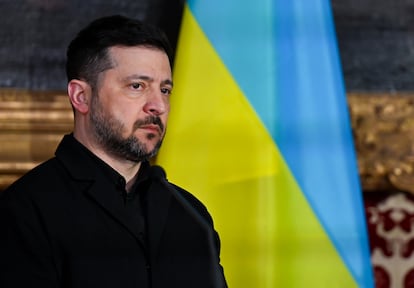
Trump faces the midterm elections in November and is pushing to resolve the conflict this spring. Zelenskiy is trying not to antagonize him, but so far he is maintaining his core demands. According to reports, there is a division within his team: one faction is worried that the opportunity to reach an agreement will close before summer, while the other is determined not to compromise.
The Ukrainians do not trust Moscow and demand firm security guarantees to deter Russia from attacking again. Zelenskiy is calling for these guarantees to be signed with the United States and the coalition of volunteers — an alliance created at the initiative of France and the United Kingdom — before agreeing to any potential ceasefire. Washington says the agreement comes first, everything else can follow.
Ukraine is trying to protect its dignity as much as possible, at the risk of Trump growing impatient and walking away from the negotiating table. Kyiv has the backing of the EU, its biggest financial supporter. But while Europe has the will — this Tuesday, the presidents of the European Commission, Ursula von der Leyen, and the Council, António Costa, are traveling to Kyiv to accompany Zelenskiy — it lacks the military capabilities of the United States, despite its rearmament plans.
There are also member states, especially Hungary, that act more as allies of Putin than of Ukraine. The ultraconservative Prime Minister Viktor Orbán, who has been undermining support for the invaded country since the beginning of the conflict — and whose continued leadership is at stake — now has the support of his Slovakian counterpart, Robert Fico.
Brussels was counting on the symbolic value of formalizing a 20th sanctions package on the anniversary of the invasion, and above all, a vital €90 billion ($106 billion) loan for Ukraine. Budapest and Bratislava accuse Kyiv of blocking the flow of oil through the Druzhba pipeline for political reasons, an infrastructure attacked by Russia in January. The unity and support for Kyiv that the EU wanted to demonstrate has once again been called into question by the blockade.
Sign up for our weekly newsletter to get more English-language news coverage from EL PAÍS USA Edition
Tu suscripción se está usando en otro dispositivo
¿Quieres añadir otro usuario a tu suscripción?
Si continúas leyendo en este dispositivo, no se podrá leer en el otro.
FlechaTu suscripción se está usando en otro dispositivo y solo puedes acceder a EL PAÍS desde un dispositivo a la vez.
Si quieres compartir tu cuenta, cambia tu suscripción a la modalidad Premium, así podrás añadir otro usuario. Cada uno accederá con su propia cuenta de email, lo que os permitirá personalizar vuestra experiencia en EL PAÍS.
¿Tienes una suscripción de empresa? Accede aquí para contratar más cuentas.
En el caso de no saber quién está usando tu cuenta, te recomendamos cambiar tu contraseña aquí.
Si decides continuar compartiendo tu cuenta, este mensaje se mostrará en tu dispositivo y en el de la otra persona que está usando tu cuenta de forma indefinida, afectando a tu experiencia de lectura. Puedes consultar aquí los términos y condiciones de la suscripción digital.