Mexico and US strengthen collaboration with high-level meeting two days after capture of El Mencho
The meeting between top officials of the Mexican Security Cabinet, Ambassador Ronald Johnson, and the US drug czar demonstrates the progress made on the bilateral agenda
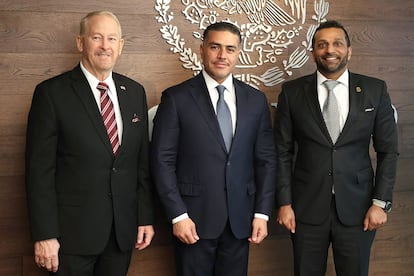

Two days after the death of El Mencho, the most-wanted drug lord on both sides of the border, Mexico and the United States staged a high-level meeting to showcase the progress in bilateral cooperation. In addition to President Claudia Sheinbaum, the senior members of the Security Cabinet attended the meeting at the National Palace on Tuesday, including the heads of the Navy and the Army, the Secretaries of Security and the Interior, and the Attorney General. Representing the United States were Ambassador Ronald Johnson and the White House’s drug czar, Sara Carter. The death on Sunday of the leader of the Jalisco New Generation Cartel (CJNG), the biggest blow against organized crime in the country’s recent history, also represents a boost to Mexico’s position in the delicate negotiations with the Trump administration, which has been threatening for months to stage a possible intervention on Mexican soil to combat drug cartels.
Since the operation against El Mencho, there has been a flurry of positive words between Mexico and the United States. On Sunday, the same day as the military raid that ended the drug lord’s life, the Mexican government acknowledged that the collaboration of U.S. Authorities was key. Sheinbaum has emphasized in recent days that the Ministry of Defense has always taken the lead, dismissing as far as possible any notion of a U.S. Intervention, even a low-intensity one. This rhetoric has been echoed by Johnson, who has referred to both countries as “sovereign partners.” The director of the Office of National Drug Control Policy, however, has been less diplomatic. During a tour of the southern border last month, Carter delivered a threatening message to the cartels: “Their days are numbered.”
Donald Trump hasn’t toned down his usual rhetoric either. During his State of the Union address Tuesday at the Capitol, the president took credit for the success of the operation that killed El Mencho and once again claimed that large parts of Mexico are “controlled” by the cartels.
The start of the year has been tumultuous, marked by the United States’ offensive in Latin America. A recent National Security Strategy document, personally signed by Trump, explicitly revives an old doctrine from the late 19th century that justified U.S. Interventionism in the rest of the Americas. It was in this context that the military attack against Caracas took place, culminating in the capture of Nicolás Maduro, and the oil embargo imposed on Cuba forced the Mexican government to halt its crude oil shipments to the island.
Under this escalating pressure, exacerbated by the search for dramatic events ahead of the midterm elections, the bilateral agenda between the two countries has tightened in recent months. The death of El Mencho, located thanks to U.S. Intelligence work, is the culmination of this collaboration and the most significant result of it. But Mexico has continued to gain ground with the third wave of prisoners linked to organized crime transferred to U.S. Prisons (bringing the total to over 100), and the capture of high-priority targets for U.S. Authorities, specifically the FBI. These include Canadian Ryan Wedding, accused of drug trafficking and several homicides in the United States, a common criminal with an outstanding warrant for extradition.
The good relationship between the Mexican and U.S. Security cabinets, particularly with the FBI and the U.S. Northern Command, has bolstered these operations. Meanwhile, military cooperation has also accelerated. Two weeks ago, the Senate approved the entry of 19 U.S. Military personnel into the country to train Mexican staff in special operations. The Mexican president offered the same justification when a military plane landed at the Toluca airport in late January. Sheinbaum explained that it was a training program for Mexican police officers within the framework of binational cooperation and “regulated by the national security system.”
Each operation, each security achievement, each arrest, each seizure and dismantling of drug labs, has been accompanied by a methodical communication strategy through which Mexico seeks to highlight its successes, both domestically and in the context of the turbulent bilateral relationship. Its statements emphasize “the coordinated work for the benefit of both nations, with full respect for sovereignty and territorial integrity,” and that “shared responsibility will continue to be the guiding principle of this collaboration.”
Sign up for our weekly newsletter to get more English-language news coverage from EL PAÍS USA Edition
Tu suscripción se está usando en otro dispositivo
¿Quieres añadir otro usuario a tu suscripción?
Si continúas leyendo en este dispositivo, no se podrá leer en el otro.
FlechaTu suscripción se está usando en otro dispositivo y solo puedes acceder a EL PAÍS desde un dispositivo a la vez.
Si quieres compartir tu cuenta, cambia tu suscripción a la modalidad Premium, así podrás añadir otro usuario. Cada uno accederá con su propia cuenta de email, lo que os permitirá personalizar vuestra experiencia en EL PAÍS.
¿Tienes una suscripción de empresa? Accede aquí para contratar más cuentas.
En el caso de no saber quién está usando tu cuenta, te recomendamos cambiar tu contraseña aquí.
Si decides continuar compartiendo tu cuenta, este mensaje se mostrará en tu dispositivo y en el de la otra persona que está usando tu cuenta de forma indefinida, afectando a tu experiencia de lectura. Puedes consultar aquí los términos y condiciones de la suscripción digital.