The disputed business interests of the Jalisco New Generation Cartel
Following the death of El Mencho, a succession process begins to control the lucrative criminal tentacles of Mexico’s most powerful cartel
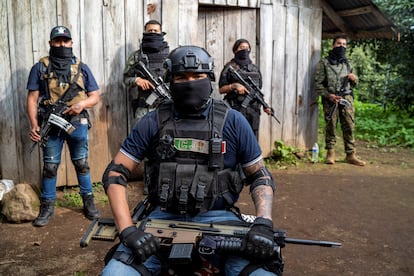

Three days after the death of Nemesio Oseguera Cervantes, “El Mencho,” leader of the Jalisco New Generation Cartel (CJNG), and with the narco-blockades and attacks against businesses and the security forces now contained, new questions arise as the week progresses. With the kingpin dead and no clear successor, the biggest unknown is who will rise to become the new head of Mexico’s most powerful criminal organization. It’s also unclear whether the succession process will be smooth and peaceful or if, as analysts predict, violence will erupt over the power struggle. What is beyond doubt is that the kingdom to be inherited is vast. The DEA defines the Jalisco New Generation Cartel as one of the most influential and ruthless mafias in Mexico, with a unique franchise structure and access to vast financial and corrupt political resources, with a presence in at least 40 countries.
According to the U.S. Agency’s 2025 National Drug Threat Assessment, the CJNG is heavily involved in the manufacture, trafficking, and distribution of illicit drugs, such as fentanyl, methamphetamine, and cocaine. In 2020, the agency conducted an operation codenamed Python, in which, after a six-month investigation, it arrested more than 600 people associated with the Jalisco New Generation Cartel across the United States and made significant seizures of cash and drugs, totaling approximately $20 million and more than 15,000 kilograms of methamphetamine. The agency stated at the time that combating one of the world’s most violent and fastest-growing cartels was its top priority.
Then came the arrests and convictions of several members of the organization, including a top commander, El Mencho’s son Rubén Oseguera González, “El Menchito,” who was sentenced in early 2025 to 30 years on various drug trafficking and firearms charges. Despite all these efforts, the CJNG’s network in the United States regenerated, as demonstrated by the DEA’s announcement last September of the arrest of another 670 members of the group in another major operation, in which it also seized 92 kilos of fentanyl, more than one million counterfeit pills, 6,000 kilos of methamphetamine, 22,000 kilos of cocaine, and 33 kilos of heroin, assets valued at $29 million, in addition to securing another $18 million in cash.
In Mexico, according to a 2020 report by the Financial Intelligence Unit, the Jalisco New Generation Cartel has a presence in 27 of the country’s 32 states. The DEA lists a series of activities parallel to drug trafficking, including hydrocarbon theft, extortion, and fraud in the purchase, sale, and rental of properties. “CJNG members increasingly participate in these activities to diversify revenue streams and protect drug trafficking assets from law enforcement seizure,” the 2025 document states.
Regarding the theft of gasoline, a practice known as huachicol, the Jensen family, business owners accused of being the Jalisco New Generation Cartel’s liaison north of the Rio Grande, is currently on trial in the United States. They allegedly laundered and distributed thousands of shipments of crude oil stolen from Petróleos Mexicanos (Pemex), the state-owned oil company. In May of last year, the Treasury Department announced sanctions against a network of fuel thieves, allegedly led by César Morfín, alias “Primito,” the cartel’s supposed leader in Tamaulipas. This network was involved in “smuggling crude oil into the United States, obtained from various sources, and extorting other operators who also move crude oil into the country in the same manner.” In September 2024, the U.S. Treasury sanctioned another fuel theft network, led by Iván Cazarín Molina, alias “El Tanque,” with operations in Jalisco and Veracruz. There, he managed storage facilities for thousands of liters of fuel and a network of service stations.
Extortion, a crime on the rise in Mexico, is another source of income for the cartel. The most recent example is the arrest of Diego Navarro, mayor of Tequila, in Jalisco. Navarro is accused of leading a corruption scheme in which public officials extorted business owners and merchants in the region’s breweries and tequila distilleries. He is presumed to be linked to the CJNG, to which he allegedly paid 40 million pesos annually. Previously, there was a case involving public transportation in the State of Mexico, and in 2022, the U.S. Treasury Department listed Sergio Armando Orozco Rodríguez, alias “Chocho,” identified as a financial operator and the person in charge of “collecting taxes” in Puerto Vallarta, Jalisco.
In that popular tourist destination lies the epicenter of another economic sector: timeshare schemes. This is a contract that grants the right to use a tourist resort for a specific number of weeks per year. It’s like buying vacation weeks in advance at a hotel or condominium. Last August, the Treasury Department described Puerto Vallarta as a lost paradise for American retirees, whom the Jalisco New Generation Cartel is targeting to steal their savings. According to the Federal Bureau of Investigation, between 2019 and 2023, some 6,000 Americans reported losses of nearly $300 million due to timeshare fraud schemes in Mexico.
Sign up for our weekly newsletter to get more English-language news coverage from EL PAÍS USA Edition
Tu suscripción se está usando en otro dispositivo
¿Quieres añadir otro usuario a tu suscripción?
Si continúas leyendo en este dispositivo, no se podrá leer en el otro.
FlechaTu suscripción se está usando en otro dispositivo y solo puedes acceder a EL PAÍS desde un dispositivo a la vez.
Si quieres compartir tu cuenta, cambia tu suscripción a la modalidad Premium, así podrás añadir otro usuario. Cada uno accederá con su propia cuenta de email, lo que os permitirá personalizar vuestra experiencia en EL PAÍS.
¿Tienes una suscripción de empresa? Accede aquí para contratar más cuentas.
En el caso de no saber quién está usando tu cuenta, te recomendamos cambiar tu contraseña aquí.
Si decides continuar compartiendo tu cuenta, este mensaje se mostrará en tu dispositivo y en el de la otra persona que está usando tu cuenta de forma indefinida, afectando a tu experiencia de lectura. Puedes consultar aquí los términos y condiciones de la suscripción digital.