Discontent in Cuba takes shape with pot-banging protests and student assemblies
The weariness of the population, subjected to constant blackouts and chronic poverty, is being exacerbated by Trump’s energy blockade
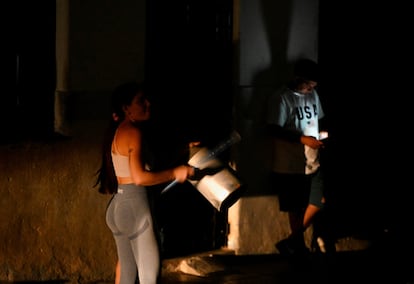
Fuel shortages continue to take their toll on a Cuba on the brink, where with each passing day, more reasons for discontent grow. The residents of the capital, more powerless than determined because they see no end to their precarious situation, have once again taken to their pots and pans to protest the prolonged power outages. Last week, blackouts hit Havana neighborhoods particularly hard — in the rest of the country, the outages have been exceeding 24 hours for some time now — alternating between about four hours of electricity and some 15 hours without. “No one can work, study, or be happy like this,” says Leandro Fernández, a young student at the University of Havana who lives in the Cerro neighborhood. He speaks, pot in hand, faithful to a custom he adopted a week ago, along with other residents, at around 9:30 p.m., when it’s now common for them to have been without electricity for about 13 hours.
Just like on Leonardo Street, other Havana neighborhoods have taken the same action, and the sound of banging pots and pans can be heard in areas of Central Havana, San Miguel del Padrón, La Lisa, and other parts of the city, almost like a cry, a catharsis, a wake-up call amid the collapse of a country plunged into darkness. More than a month after the start of the U.S. Oil embargo against the island, and given the Cuban authorities’ inability to maintain certain services, such as transportation and open universities, that would guarantee the normal flow of life, people are finding ways to demand solutions and be heard, whether by reflecting in a critical Facebook post, banging pots and pans, or organizing an independently structured university assembly to try to unblock the precarious functioning of Cuban education, especially in the last month, where classes have been taught through WhatsApp groups and online platforms.
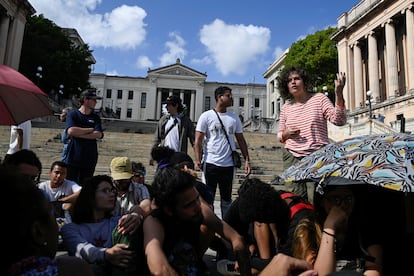
This is an open debate to “seek structural reforms in higher education,” promoted autonomously by a group of students who have called themselves University Sit-in and who the previous day starred in an unusual event, dealing with forms of collective organization, outside the control of the Cuban authorities, to expose problems in the university community.
Nearly 30 students from various faculties attended the demonstration, and their voices were finally heard by the officials in charge, amid a deployment of State Security agents, the repressive apparatus of the Cuban government.
A month after the implementation of the hybrid learning model that students and professors have been forced into, with classrooms closed and with the memory of student protests against the price hikes by Etecsa — the country’s only telecommunications company, which raised connectivity prices last June — still fresh, the collective strain is evident. But the final straw was last week’s massive call by the Federation of University Students (FEU) for students, unable to attend classes, to take on essential tasks for local authorities in their municipalities, such as garbage collection, hospital cleaning, or teaching in primary schools. The discontent was widespread, and the responses from FEU representatives were inadequate.
“This motivated us to take action,” says a communications student who participated in the peaceful sit-in on the university steps and preferred to remain anonymous. When she arrived on Monday morning, there were already about 15 students gathered at the base of the steps. From that moment, the young woman recounts, several professors were already talking with the group about their demands and trying to “persuade us to move to a less public place,” away from the foreign press present. As the number of students increased, “the atmosphere began to change.” More university officials and plainclothes officers appeared, preventing new protesters from entering, while the group already on the steps spoke with the academic authorities. “I realized we were being surrounded by state security. It was intimidating,” she recalls.
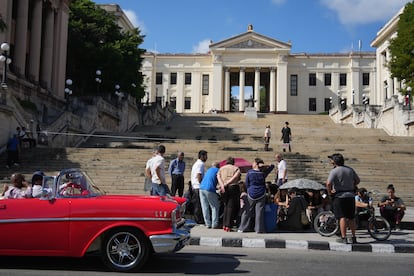
The protesters brought purely academic demands and denounced, the young woman recounts, the lack of support from their FEU representatives and the attempts made to delegitimize the protest. They spoke about practical issues hindering normal access to education in the country at this time, the proposal for community service, “which should not be a substitute for university time,” and the uncertainty imposed by the blended learning model. “The education we are receiving is quite mediocre, despite the efforts of students and professors,” protests the student, who has had to spend extra money on internet access to complete her online assignments and, along with her classmates, is demanding changes to how the semester will continue. “The authorities aren’t giving us a clear date for a return to normalcy.”
What happened this Monday on the steps of the University of Havana carries a unique symbolism, as it highlights the community’s discontent with the organization that represents them, the Federation of University Students, which has been delegitimized by its ambiguous role in responding to the Etecsa rate hike, a move that provoked widespread rejection and protests from the university community. “We made it clear that we will not tolerate being ignored, nor the bureaucratic processes that prevent us from resolving our problems,” stated the young woman, who sees this peaceful sit-in as the beginning of a path toward independent organization and the demand for rights.
The truth is that, whether it’s a university sit-in or the pot-banging protests in Havana’s neighborhoods, the discontent of Cubans, exhausted within the island, is beginning to take shape.
Sign up for our weekly newsletter to get more English-language news coverage from EL PAÍS USA Edition
Tu suscripción se está usando en otro dispositivo
¿Quieres añadir otro usuario a tu suscripción?
Si continúas leyendo en este dispositivo, no se podrá leer en el otro.
FlechaTu suscripción se está usando en otro dispositivo y solo puedes acceder a EL PAÍS desde un dispositivo a la vez.
Si quieres compartir tu cuenta, cambia tu suscripción a la modalidad Premium, así podrás añadir otro usuario. Cada uno accederá con su propia cuenta de email, lo que os permitirá personalizar vuestra experiencia en EL PAÍS.
¿Tienes una suscripción de empresa? Accede aquí para contratar más cuentas.
En el caso de no saber quién está usando tu cuenta, te recomendamos cambiar tu contraseña aquí.
Si decides continuar compartiendo tu cuenta, este mensaje se mostrará en tu dispositivo y en el de la otra persona que está usando tu cuenta de forma indefinida, afectando a tu experiencia de lectura. Puedes consultar aquí los términos y condiciones de la suscripción digital.