Cuba on the verge of paralysis: ‘I feel like this is the end of the story’
The streets of Havana are empty of traffic and tourists as the exhausted population, barely surviving day to day, awaits an outcome to Trump’s energy blockade
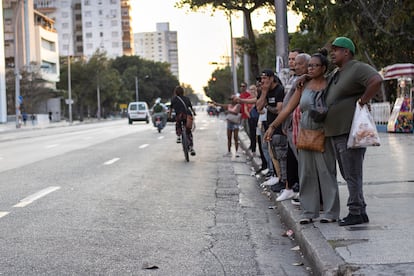

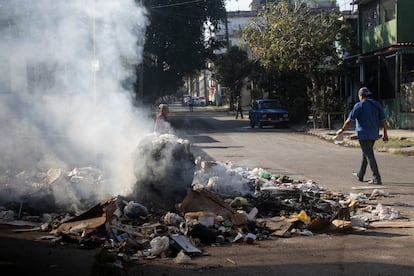
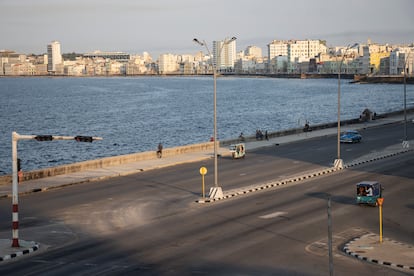
In Havana, suffocated by the oil crisis imposed by the United States, dawn breaks to the smell of smoke from burning garbage piled up in the streets. Cars barely pass along the beautiful, long Malecón, which runs alongside a sea devoid of ships, and people walk in silence. Every day, most Cubans go out into the streets to “invent,” as they call it, to find every possible way to survive the extreme conditions they have endured for years, and for the past three weeks, since U.S. President Donald Trump threatened tariffs on anyone who supplies fuel to Cuba, they have also had to get used to waiting.
Taking a taxi in Havana is an increasingly difficult mission, growing more complicated and expensive from one day to the next as drivers run out of the rationed gasoline they receive. When you say taxi, you might find an almendrón — a classic car used for public transportation — a gacela — one of the government’s yellow minibuses — a cocotaxi — a motorized tricycle with a shell — a bicitaxi — a man pedaling for tourists under an umbrella — a motorcycle, an electric tricycle, or even a horse-drawn carriage. Getting on anything that will take you to work, back home, to the doctor, or to an appointment means walking for miles or joining groups of people waiting for an indeterminate amount of time, but no fewer than 15 minutes and up to an hour or more, under a tree, next to a bridge, or on a street corner.
Cubans are hoping for transportation and food every day, entangled in a web of obstacles to find chicken, for example, at a price they can afford amid soaring prices. But they’re also hoping to get somewhere else, or that something will happen soon, or that there will be some kind of change, almost any change, because the idea that something irreversible is happening in this crisis is starting to take hold. “The old folks say this has never been seen in Cuba before,” says a 20-year-old woman who gets into a huge 1950s Chevrolet with reggaeton blasting, after gesturing to several vehicles and waiting for half an hour without knowing if any will stop. She shares it with four other passengers and the driver. “If whatever comes is even five percent better, that’s something.”
There is hardly any information about what is happening. There is no official confirmation that negotiations are underway with the United States, and if they are, no one knows on what terms or how the energy blockade will end. Cubans don’t know if they face a humanitarian crisis if the oil doesn’t arrive, a regime change, a gradual transition, or foreign intervention.
But many of those working in the sectors that first felt the shockwaves of this unprecedented situation, even by Cuban standards, have, in addition to monumental anger toward the government, one word on their lips: change. It’s not just an idle idea in a dictatorship that has been in power for 67 years, and verbalizing it carries risks. For that reason, the real names of the people speaking in this account have been withheld.
If anything hasn’t stopped, it’s the regime’s repressive apparatus, which just recently imprisoned two of the people behind the Instagram account El Cuartico for expressing political opinions. “There has to be a change,” says a vendor in the industrial building that houses the Handicrafts Market, chosen to accommodate cruise ship passengers, not to host more stalls than customers, which is the case now. “I feel like this is the end of the story, the country is at a standstill, we can’t go on like this,” says a driver overwhelmed by the fact that he’s rationing gasoline, the 20 liters they’re given, which he would normally use up in two days. Another says he can’t sleep because of the anxiety about what he’ll do when his supply runs out and avoids talking about his expectations: “Here, they’ll throw you in jail for breathing.”
Cubans have been living through crises for years. It’s a constant downward spiral in which impoverishment becomes normalized, making it difficult to distinguish one new bout of poverty from the last. Cuba is a place where you walk into a pharmacy in Central Havana asking for ibuprofen and the shelves are empty. They have nothing, not even bandages; they only offer herbs for making infusions. Where an elderly man asks a foreign woman on the central Oficio Street if she happens to have any paracetamol for his knee pain. Where there are lines for hours to withdraw cash from banks, affected by blackouts, mistrust, and a shortage of bills.
These days, the capital’s landscape is noticeably lacking in more than just traffic. Tourists are scarce, making them all the more striking, almost exotic, in a country that has poured a significant portion of its economic expectations and infrastructure into visitors — and their dollars. The sense of uncertainty and the power outages are left at the entrance of the five-star Hotel Nacional de Cuba, an enormous building erected in 1930. Seven gigantic chandeliers hang in the lobby, which opens onto a majestic garden with palm trees and views of the sea overlooking the Malecón, where roosters, hens, and peacocks roam. An American couple poses for photos next to a classic pink car at the entrance. Uniformed waiters serve drinks at the tables while a live band playing mambo, salsa, and Cuban rhythms performs every afternoon.
This hotel, where Hollywood stars, 1940s mafia bosses, and members of royal houses have all stayed, is where Cuban authorities are hastily relocating tourists who had reservations at other establishments that are closing due to fuel shortages. “I don’t have a specific explanation, but they’re trying to optimize resources; there isn’t enough income,” says a distressed receptionist from a nearby hotel, explaining the reason for the relocation. “It’s worse for us. We go home with our first month’s salary in full, the second month at 60%, but that’s not enough for anything. Luckily, I don’t have children, but those who have to support a family are having a very hard time,” she says. She earns between 4,500 and 5,000 pesos plus tips, between $9 and $10, a month. A taxi ride to Old Havana costs around 4,500 pesos these days.
“The Nacional is a symbol and will be the last to close,” says the employee. Here, one feels in a kind of haven for foreigners and wealthy Cubans where everything is running smoothly — or at least pretending to — even as the country outside grinds to a halt: for now, there’s Wi-Fi, electricity, water, buses arriving from the airport, and taxis waiting outside. At dinner, a singer performs El Manisero accompanied by a grand piano in a banquet hall where only two couples are dining.
In another part of the city, the upscale Miramar neighborhood, the halls of the five-star Meliá Hotel are empty. A couple of employees explain that they are trying to stockpile canned goods in case of emergency; “but we can’t store much food because it thaws due to the power outages,” one of them points out. They barely receive any crews from the few planes that arrive each day, after several airlines, such as Air Canada, suspended their routes and Russian tourists were repatriated.
A life lived in darkness
Starting at 7:30 a.m., children begin arriving at a small school in a residential neighborhood of the Cuban capital. A father takes his daughter to school on a motorcycle, driving down the potholed street with the engine off to make the most of the incline. A man passes by carrying two sacks of dry bread that crumbles at the first bite. María, 27, has just dropped her daughter off and is hurrying home to go to work at a food service establishment, a type of small business the Cuban regime allows for private enterprise. She’ll have to wait between 30 and 40 minutes for a shared electric tricycle to pick her up. “We go to bed without electricity and we wake up without electricity,” she explains. “I couldn’t give my daughter milk today; I brought her a soda. They eat at school here, but at home I try to make sure she has an egg for dinner.”
What she and her partner earn is spent solely on food: about 23,000 pesos, roughly $46. “You can’t have any more children here right now,” she says. She believes nothing will change due to the current situation: “If you think about change… we’ve gotten our hopes up so many times before,” she says. “Things are getting worse, and that’s the only thing that remains.” She has also considered leaving the country, which has been experiencing a massive exodus, especially of young people, since 2021. “It’s difficult, I don’t see how,” she says.
Beside the sunlit square of the Church of San Francisco de Asís, right by the sea, dozens of people are queuing at a consular office to prove their Spanish ancestry under the Democratic Memory Law, or the “Grandchildren Law” as it’s known here, in order to obtain Spanish passports. Three siblings explain that it took them 20 hours by train from their province in the east of the country, a much poorer, more agricultural region, and that they are being left with very few connections to the capital due to the energy blockade.
Although these procedures have been in place for some time, several people say that completing them is reassuring given the current uncertainty. Juan, a teacher in his twenties, is about to receive the last of the necessary documents and has decided to stop waiting. “I love Cuba, but this is chaos,” he says. He’s been sleeping at the school where he teaches, on a table, because he lives so far away and can afford so little that he would be four hours late for work. “I would like to see my country reborn,” he says, but rebuilding it “will take time; real change will take years.”
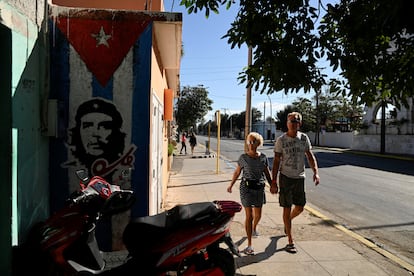
In the historic center of Old Havana, two women dressed as free mulatto women from the colonial era, complete with turbans, flowers, and large fans, pose for photos with the handful of tourists passing by in exchange for a few pesos. A short walk away, the neighborhood transforms into a labyrinth of streets lined with laundry, neighbors chatting in doorways, and half-ruined old mansions interspersed with small shops and alleyways where trash is piled up. One option for eating in this area are the paladares, small, privately run restaurants. From one of them, recommended and located in a renovated house with ironwork and tiles, wafts the aroma of sofrito. The waiter suggests grilled lobster, at around $20, as a local specialty; they are sourced as far as the fuel in the boats will take the fishermen of Havana.
During the hour-long meal, no one else enters: the crustacean is savored under the watchful eye of a waiter on one side and a singer-songwriter with his guitar on the other. There’s nothing for dessert: the one they had planned, flan, is missing an ingredient, the waiter explains, referring to the distribution problems they’re currently experiencing, and not just with seafood.
Eventually, the conversation turns to Cuba’s vibrant musical tradition and how the regime favors pro-government artists for tours and more stable opportunities. They also discuss how chicken breast is now a luxury for Cubans: last Thursday, two kilos of frozen chicken cost 2,000 pesos in a store, a third of the average salary, which is 6,830 pesos (around $13). Both see the need for change and cite China as a model. “The people want peace; they don’t want fighting, war, or invasions. They want negotiations and prosperity, they want to be paid and not cheated,” the musician states.
The feeling that something will change after the energy crisis Cuba is experiencing leads some to think that anything is better than a government that most perceive as eternal, corrupt, incompetent, and clinging to power at the expense of the population’s impoverishment and suffering. For a minority, the options include a last resort called Donald Trump. “Let’s see if the Americans come and do something. I don’t know who will end up in charge or what will happen. But let the change happen now, let them take all the Castros, like they did with Maduro,” says a 28-year-old construction worker who migrated to Havana from a rural area near Santiago de Cuba, in the east, where “there’s nothing.”
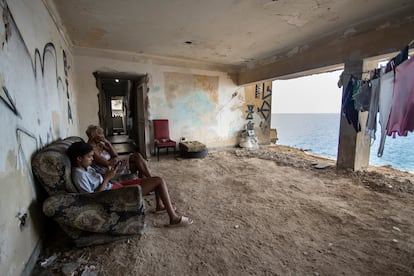
He lives in one of the many buildings in the old part of town that must have once been beautiful but are now crumbling to pieces, where families arriving in the capital in search of work settle, building makeshift rooms of wood within the ruins. Among fallen beams, you can see a cot, a throne-like chair, a cistern, and above, the creaking roof. About 70 people live with him; they have electricity they take from the street, and he says that miraculously, there are hardly any power outages in that area. They cook on a stove and get their drinking water from a nearby fountain. Many construction projects in the city have been halted due to a lack of materials. “There’s no cement,” he explains. His family is in the countryside. “When I get a little money, 1,000 or 1,500 pesos, I send it to my 10-year-old son,” he says, but now, with the power outage, he can’t do anything. “Yesterday I sold a pair of shorts I had” to buy food, he says. “As for tonight, we’ll see what I come up with.”
The most visible effects of the energy blockade aren’t always immediately apparent in a family economy forcibly accustomed to chronic shortages. Today, it’s more evident due to transportation problems and the empty classrooms at the University of Havana, where students have had to be sent home and classes are being held via WhatsApp groups and an online platform. But many questions remain about how goods and basic products are arriving or what reserves the country has to avoid a complete standstill.
María, a young entrepreneur, shares her experience as the owner of a food delivery business. Simply getting it off the ground is an achievement in an economy so constrained by the regime and dependent on foreign aid. In January, she installed solar panels at her office. She made the decision after the U.S. Attack to capture Nicolás Maduro and Washington’s subsequent takeover of Venezuelan crude, Havana’s main supplier until then. Seventy percent of her delivery fleet consists of electric bicycles or motorcycles, but the problem now is getting employees to come in: “Working from home is impossible because with the blackouts they have no electricity or internet connection,” she explains. That’s why she picks them up at their homes with the delivery vehicles.
Something as seemingly simple as sending sacks of rice to the offices in the eastern part of the country, where employees tell her they only have two or three hours of electricity a day, is an ordeal. “We’re trying to send it with a passenger bus,” but there are fewer and fewer departures. She’s also exploring the possibility of importing fuel with other business owners, since private companies can buy it from the United States without any issues, although it’s complicated.
“Do you know when I realize how absurd and complex everything is here? When I talk to friends from abroad or travel. I listen to myself and see that I normalize things that aren’t normal,” she explains. “The thing is, this [Castroism] isn’t left-wing. Even the most left-leaning people agree that it doesn’t work. The country needs comprehensive economic reform; they lead you to a point where life is just a series of resistance movements. Change is needed, which is why most people here want them [the regime] to negotiate with the United States, not a military intervention,” she reflects. “It’s very tough to swallow that Trump is an alternative, but this government hasn’t done anything — no economic opening, no kind of transition like in Vietnam or China,” she says bitterly. She and her family have Spanish passports and have the means to leave. “But I think I’m more useful in Cuba, where the solidarity among the people is incredible; it’s what makes things work,” she affirms.
Roberto was born a year before the Revolution. He is 68 and has been queuing for seven hours at two banks to withdraw his pension and at another to get cash. “I live day to day, I have no expectations,” he says, sitting in the shade of a tree. His generation and those before him make up 25% of Cuba’s population of around 8.5 million. “I defend the origins of the Revolution, but it hasn’t evolved; we’re going backward,” he reflects while denouncing the regime’s repression. He remembers the 1980s as “a good time, there was social balance, life was good. We didn’t have everything, you couldn’t travel… but oh well.” Although he describes himself as “minimalist” in his lifestyle, he admits that his pension isn’t enough to live on and that the lack of transportation severely limits him.
“With three thousand and something pesos, what can I buy? It’s a serious situation, yes, but we always look for alternatives. You can’t lose your tenderness, your smile… that’s what keeps us going, and it’s not complacency, it’s adaptation,” he affirms. He believes that people want internal change because “no one has the right to impose,” he says referring to Trump, and he believes that the pressure the Republican is exerting on Cuba “could lead to change, but it shouldn’t be abrupt, because that’s dangerous.”
Sign up for our weekly newsletter to get more English-language news coverage from EL PAÍS USA Edition
Tu suscripción se está usando en otro dispositivo
¿Quieres añadir otro usuario a tu suscripción?
Si continúas leyendo en este dispositivo, no se podrá leer en el otro.
FlechaTu suscripción se está usando en otro dispositivo y solo puedes acceder a EL PAÍS desde un dispositivo a la vez.
Si quieres compartir tu cuenta, cambia tu suscripción a la modalidad Premium, así podrás añadir otro usuario. Cada uno accederá con su propia cuenta de email, lo que os permitirá personalizar vuestra experiencia en EL PAÍS.
¿Tienes una suscripción de empresa? Accede aquí para contratar más cuentas.
En el caso de no saber quién está usando tu cuenta, te recomendamos cambiar tu contraseña aquí.
Si decides continuar compartiendo tu cuenta, este mensaje se mostrará en tu dispositivo y en el de la otra persona que está usando tu cuenta de forma indefinida, afectando a tu experiencia de lectura. Puedes consultar aquí los términos y condiciones de la suscripción digital.