Trump: ‘Cuba is going to fall pretty soon, but we’re focused on Iran right now’
The US president warned that there will be no agreement with Tehran to end the war ‘except unconditional surrender’
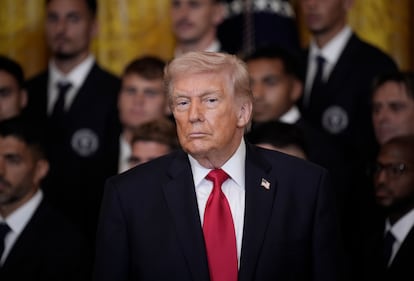

U.S. President Donald Trump continued his round of calls with some of Washington’s most influential reporters on Friday. On this occasion, it was the turn of CNN anchor Dana Bash, whom Trump told the war in Iran is “doing very well militarily — better than anybody could have even dreamed,” before, according to Bash, changing the subject without a cue. “Cuba is gonna fall pretty soon. They want to make a deal so badly,“ the Republican said in a five-minute conversation. ”I’m going to put Marco [Rubio] over there and we’ll see how that works out. We’re really focused on this one [Iran] right now. We’ve got plenty of time, but Cuba’s ready — after 50 years.”
After hanging up on Bash, Trump took to his social media platform, Truth, and wrote: “There will be no deal with Iran except UNCONDITIONAL SURRENDER! After that, and the selection of a GREAT & ACCEPTABLE Leader(s), we, and many of our wonderful and very brave allies and partners, will work tirelessly to bring Iran back from the brink of destruction, making it economically bigger, better, and stronger than ever before. IRAN WILL HAVE A GREAT FUTURE. “MAKE IRAN GREAT AGAIN (MIGA!)” the Republican posted (the capital letters are his).
The conversation with the CNN reporter also touched on the succession at the head of the Iranian regime. Trump, as in previous interviews, cited the example of Venezuela. “It’s gonna work very easily,” he said, referring to the replacement of Ali Khamenei, who was killed in an airstrike last Saturday on the first day of the joint offensive launched by the United States and Israel. “It’s going to work like [it] did in Venezuela,. We have a wonderful leader there,“ he added, referring to acting President Delcy Rodríguez. ”She’s doing a fantastic job. And it’s going to work like in Venezuela.”
The use of Rodríguez as an example for transitions in countries where the Trump administration is intervening has become a wild card. In the Venezuela plan, the first step was military intervention to capture Nicolás Maduro and his wife, Cilia Flores, who are awaiting trial in New York. After the operation, the Republican left Delcy Rodríguez, the interim leader and a prominent figure within Chavismo, along with her brother, Jorge Rodríguez, in charge. For now, Washington is prioritizing the oil business over steps toward democracy. On Thursday, diplomatic relations with Caracas, broken since 2019, were resumed. Opposition leader María Corina Machado is about to return, but there is still no timetable for elections.
“Friendly takeover”
Last Friday, the same day on which Trump greenlighted the order to attack Iran, he hinted in statements to reporters before boarding the presidential helicopter at the White House that contacts between Washington and Havana could result in a “friendly takeover” of Cuba. It was unclear what form that “takeover” might assume, but Trump has been applying pressure by blocking fuel supplies to the island while talks are underway between representatives of the two countries, with Rubio leading the Washington delegation. “The Cuban government is talking with us. They’re in a big deal of trouble, as you know. They have no money, no anything right now,” the U.S. President said a week ago.
Since Maduro’s capture on January 3, Trump has insisted that the Cuban regime is on the verge of collapse, without the oil and economic aid provided by Caracas, a suffocation that comes amid the worst economic crisis the island has experienced in decades. Trump, who has ruled out — at least publicly — military intervention in Cuba, has also threatened secondary tariffs on countries that supply oil to the Castroist regime.
Meanwhile, this week Cuban President Miguel Díaz-Canel made an “urgent” call to transform the island’s economic model. On Wednesday, the Official Gazette of the Republic of Cuba published a decree-law that opens the door to the creation of public-private companies for the first time in 67 years.
During Friday’s interview with CNN, Bash asked Trump if he thought it was a good idea for Iran to elect a religious leader. To which Trump, according to the anchor’s on-air account, replied: “Well, maybe yeah, I mean, it depends on who the person is. I don’t mind religious leaders. I deal with a lot of religious leaders and they are fantastic. I’m saying there has to be a leader that’s going be fair and just. Do a great job. Treat the United States and Israel well, and treat the other countries in the Middle East — they’re all our partners.”
The U.S. President also spoke about the Republican primaries in Texas for the Senate, in which a traditional politician, John Cornyn, and a staunch MAGA supporter, Ken Paxton, are in the running, with Trump undecided about supporting either of them; his attempts to change the rules for the upcoming November legislative elections; and the price of gasoline, which has reached its highest level since his return to the White House in January 2025. On the latter, he said, once again without offering explanations, that gasoline prices “will come down soon” in the United States.
Sign up for our weekly newsletter to get more English-language news coverage from EL PAÍS USA Edition
Tu suscripción se está usando en otro dispositivo
¿Quieres añadir otro usuario a tu suscripción?
Si continúas leyendo en este dispositivo, no se podrá leer en el otro.
FlechaTu suscripción se está usando en otro dispositivo y solo puedes acceder a EL PAÍS desde un dispositivo a la vez.
Si quieres compartir tu cuenta, cambia tu suscripción a la modalidad Premium, así podrás añadir otro usuario. Cada uno accederá con su propia cuenta de email, lo que os permitirá personalizar vuestra experiencia en EL PAÍS.
¿Tienes una suscripción de empresa? Accede aquí para contratar más cuentas.
En el caso de no saber quién está usando tu cuenta, te recomendamos cambiar tu contraseña aquí.
Si decides continuar compartiendo tu cuenta, este mensaje se mostrará en tu dispositivo y en el de la otra persona que está usando tu cuenta de forma indefinida, afectando a tu experiencia de lectura. Puedes consultar aquí los términos y condiciones de la suscripción digital.