Venezuela and Iran: Mission accomplished, again
The Middle East conflict has transformed into a war of attrition that could soon undermine Trump’s triumphalism and become a perfect storm with global consequences for his presidency
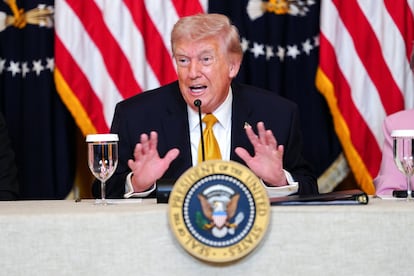
At the gas station I usually visit on Belmont Avenue, a block from my house, the price of gasoline has risen from $2.69 to $3.59, a one-third price increase in two weeks. It’s Trump’s war in Iran, translated into the everyday language Americans understand: a blow to their wallets. And this scene is being repeated all over the world. But Trump is declaring victory and boasting that his military won in the first hour of the attack: bombing thousands of targets, destroying much of Iran’s offensive capabilities, and decapitating the leadership of the theocratic regime, sending Ayatollah Ali Khamenei and his generals to their deaths. Such is the epic fury of an empire without military rival or restraint. But two weeks later, the war continues.
It hasn’t even reached its climax yet, and it has already affected nine Middle Eastern countries. Despite being the weakest link in a triangle where the United States and Israel are the major powers, Iran controls the Strait of Hormuz, while oil prices fluctuate wildly. But they rise more often than they drop. The fall of the regime, touted by Trump as a pretext for the attack, has also not materialized.
What’s more, experts warn that Iran’s theocrats have been preparing for this moment for decades, manufacturing large quantities of drones and other armaments that give them a long-term edge. The United States’ military capability is more sophisticated but slower and more expensive to produce. The most immediate example is the Patriot missile system, which helps repel air attacks. It is critical to the defensive systems of several nations, and has been key to protecting Ukraine from Russian air strikes. The Wall Street Journal has reported that the United States and Israel are in a race against time to destroy Iranian missile launch systems and drone factories before they exhaust the dwindling inventory of Patriots. Raytheon and Lockheed Martin, manufacturers of these systems, are producing only 600 per year, and even if they wanted to accelerate production, they couldn’t: the complexity of the process would prevent them from doing so. Added to this is the cost, which ranges from $2 million to $4 million per unit, which forces them to be produced only under strict orders.
What might happen, then, if the stockpile runs out? Most obviously, the conflict with Iran would be prolonged, and Ukraine’s survival would become even more precarious and complex than it already is. Or, as Bojan Pancevski of The Wall Street Journal summarizes, the depletion of the stockpile represents an existential problem for Ukraine. Moreover, not only would Russia and Iran gain an immediate and significant advantage in the conflicts in which they are involved, but so would China, which is waiting to expand its hegemony from the economic to the military sphere. And these three rivals of the United States know it.
As things stand, the conflict with Iran has transformed into a war of attrition that could soon shatter Trump’s triumphalism and become a perfect storm with global consequences for his presidency. Because it’s obvious that when the United States sneezes, the world catches a cold, but the reverse is also true: Americans cannot escape the centrifugal force of the conflicts their administration instigates.
The price of gasoline — and energy in general — is a reliable indicator that doesn’t lie. And the closure of the Strait of Hormuz means not only less oil and natural gas, but also other raw materials and products like fertilizers, essential for maintaining food supply chains around the world and in the United States. In his State of the Union address in February, Trump tried to instill optimism about the economy by repeating his tired mantra: America has never been better off. Just a few days ago, as he has so often done, he dismissed the evidence that his fellow citizens are directly suffering the economic impact of the war, insisting that “inflation is plummeting, incomes are rising, the economy is roaring back and America is respected again.”
But the reality is quite the opposite. The stubborn inflation that has been gnawing at Americans’ pockets since the pandemic has never gone away. Economic growth, however, has plummeted. Economists are once again wondering if there will be a recession. Although there are international efforts to keep oil prices under control, Trump’s own energy secretary, Chris Wright, admitted over the weekend that there are no guarantees that oil prices will fall anytime soon, even if the war ends in the coming weeks. Meanwhile, Iran’s foreign minister, Abbas Araghchi, maintained that his country has not sought to negotiate with the United States and is ready to defend itself. The most revealing thing is not the statements but the polls: even among white voters and key MAGA figures, support is beginning to erode. Trump has governed with the certainty that his base is unassailable, but that certainty is starting to crack. With the midterm elections in November and a conflict in the Middle East with no end in sight, Trump is burning through that margin quite rapidly.
And this is the crux of the matter. The regime change promised by Trump when announcing the attack has not materialized. On the contrary, the Islamic Revolutionary Guard Corps remains in control of the country and its extensive, albeit diminished, military apparatus. Civil society and the Iranian people are not freer, but perhaps less so, and this will remain the case as long as the fear that the clerical regime instilled in the population for decades persists.
The Iranian-American writer Reza Aslan, author of An American Martyr in Persia, put this into perspective in a recent essay in The New York Times. Aslan recalls that during his childhood in Iran, before migrating to the United States half a century ago, “I carried an image of America as something almost mythic. It was not just a distant superpower. It was a moral force, a place that corrected wrongs, defended the vulnerable, tipped history toward justice. In my childhood logic, America was the grown-up who suddenly appeared on the playground to put the class bully in his place.” But when it fell to President Jimmy Carter to put the Shah of Iran in his place during a visit to Tehran, what he actually did was bolster his support by calling the country an island of stability. Although Carter and Trump could not be more different as politicians, each has represented the hope of the oppressed and, at one time or another, has been seen as a potential liberation hero. Aslan’s conclusion is the same: “America will not save Iran.”
In both Venezuela and Iran, it is difficult to entrust the freedom of a people and the building of a democracy to actors whose main interest is geopolitical control or economic domination.
The comparison with Venezuela reveals a problem of objectives, not just execution. There, Trump had real regime change within his grasp and failed to secure it: he captured Maduro, decapitated Chavismo, but gave his blessing to Delcy Rodríguez, leaving the process hanging. In Iran, the mistake was symmetrical but in reverse: the initial objective was to destroy Iran’s nuclear capacity before it crossed the threshold of a nuclear bomb — an obsession Trump championed since his first term — but at some point in the White House, someone (all signs point to Netanyahu) broadened the scope and transformed it into total war against the regime. The result is a conflict that inherited the scale of a total war, but without the slightest strategic clarity.
That lesson resonates today. If the theocratic regime survives — which, two weeks after the first bombs fell, seems likely — Trump will not have reshaped the Middle East but rather consolidated one of its most dangerous actors. The only real democracy in the region, however flawed, will remain Israel. And an Iran that emerges undefeated is an Iran that demonstrates to the world that resisting the greatest military power in history is both possible and profitable. This is the prelude to more chaos and could have direct consequences for Ukraine, for Venezuela, and for the global order that the United States claims to defend.
On May 1, 2003, George W. Bush landed on the aircraft carrier USS Abraham Lincoln in a fighter jet and, dressed in a pilot’s uniform, proclaimed that combat operations in Iraq had ended. In the background was a banner that read “Mission Accomplished.” But the war lasted eight more years.
This is not the first time the empire has triumphed but failed to win. Trump should remember this and adjust his strategy, because today he faces the risk of having won battles that do not resolve wars or end conflicts: in Venezuela, an incomplete victory; in Iran, a war with no end in sight, with a domestic cost that grows every week. If there is one place where he could still make a genuine democratic bet and win, that place is Venezuela. But to do so, he would have to accept something contrary to his nature: that a true victory is not announced on day one but is built with patience, institutions, and firm allies — not complacent acolytes or intimidated partners who owe him more than just a favor. So far, the evidence points in the opposite direction.
Sign up for our weekly newsletter to get more English-language news coverage from EL PAÍS USA Edition
Tu suscripción se está usando en otro dispositivo
¿Quieres añadir otro usuario a tu suscripción?
Si continúas leyendo en este dispositivo, no se podrá leer en el otro.
FlechaTu suscripción se está usando en otro dispositivo y solo puedes acceder a EL PAÍS desde un dispositivo a la vez.
Si quieres compartir tu cuenta, cambia tu suscripción a la modalidad Premium, así podrás añadir otro usuario. Cada uno accederá con su propia cuenta de email, lo que os permitirá personalizar vuestra experiencia en EL PAÍS.
¿Tienes una suscripción de empresa? Accede aquí para contratar más cuentas.
En el caso de no saber quién está usando tu cuenta, te recomendamos cambiar tu contraseña aquí.
Si decides continuar compartiendo tu cuenta, este mensaje se mostrará en tu dispositivo y en el de la otra persona que está usando tu cuenta de forma indefinida, afectando a tu experiencia de lectura. Puedes consultar aquí los términos y condiciones de la suscripción digital.