Trump ramps up military pressure on Iran despite European challenge and the ravages of war on the global economy
The Strait of Hormuz, an essential waterway effectively closed by Tehran, has become the biggest obstacle for the US president to declare victory in the Middle East


One of the great paradoxes of Donald Trump’s war in Iran is that the U.S. President has been pressuring his main European allies, as well as China, South Korea and Japan, to form a military coalition to reopen the Strait of Hormuz, while at the same time arguing that he doesn’t need them for anything.
He said this on Monday in Washington, at an event in the White House, where he repeatedly contradicted himself and presented these pressures and threats as a kind of loyalty test: “We’re the strongest nation in the world. We have the strongest military by far. I’m almost doing it, in some cases, not because we need them, but because I want to find out how they’ll react. I’ve been saying for years that if we ever did need them, they won’t be there,” he asserted. “They should be jumping to help us, because we’ve helped them for years stay out of wars.”
Trump’s self-fulfilling prophecy materialized Monday when individual capitals, the European Union as a whole, and NATO all rejected any plans to join an adventure with unpredictable consequences: unblocking Iran’s stranglehold on the Strait of Hormuz, a waterway that carries approximately 20% of global oil traffic and a quarter of liquefied natural gas.
The U.S. President stated in Washington that several countries were “on the way” to lend a hand. He didn’t specify which ones, but promised them it would be easy because “very few shots will be fired.” It also can’t be ruled out that those currently refusing to participate might change their minds and join a hypothetical alliance.
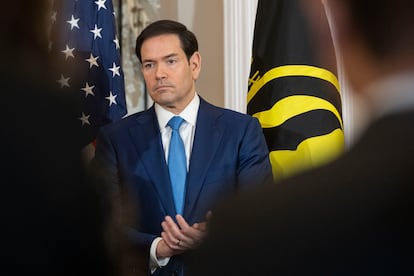
The Republican also added that Secretary of State Marco Rubio, Trump’s go-to man for all foreign policy matters, would provide details about the agreement. It wasn’t clear when that would happen because, Trump said, it “takes time to reach” some of those countries. “In some cases, you have to travel an ocean,” he stated, without providing any specifics.
Trump was speaking at a press conference called to address another matter: the future of the Kennedy Center, Washington’s cultural landmark, which has been in turmoil for a year and which he plans to shut down for another two after its board of trustees approved a closure he himself announced weeks ago. White House Chief of Staff Susie Wiles shared the spotlight at the event, despite having been diagnosed with breast cancer with a “wonderful prognosis,” as Trump announced minutes before the meeting.
Amid so much uncertainty surrounding the war, one thing seems clear: Trump is determined to continue the military offensive in Iran, which has entered its third week with no end in sight. He reiterated this on Monday, stating that his planes would “continue to hit [Iran] hard.” He also indicated that, faced with a choice between declaring victory and touting the gains achieved so far — the destruction of more than 7,000 targets, as well as a 90% reduction in Iranian missile capacity and a 95% reduction in drones, he claimed — or continuing an offensive that has upended the global economy and international diplomacy, Trump is currently opting for the latter.
The Strait of Hormuz is now their biggest headache in this war. Above all, because the crisis was so predictable. Only a clumsy failure to foresee the range of retaliatory measures available to Tehran in response to the bombs from Israel and the United States could have ignored this possibility. On Monday, true to his aversion to admitting mistakes, Trump said: “I knew about the strait — that it could be a weapon, which I predicted a long time ago.”
To try to rectify the situation, the United States launched an attack last Friday on Kharg, an island at the mouth of the strait where Iran concentrates its crude oil refineries. According to Trump, who announced the operation on his social media platform, Truth, it did not target those facilities but rather other military installations.
On Saturday, again on Truth, Trump called on “China, France, Japan, South Korea, the UK, and others” to send “ships to the area” to keep the Strait of Hormuz open. The blockade has driven up gasoline prices in the United States, a country heavily reliant on cars, with the price of a barrel now above $100, representing an increase of almost 25% since the conflict erupted.
During this time Trump has not eased his pressure on allies, which brings another paradox to the table: Washington is now asking for cooperation from countries that it did not count on at the beginning of the war, and neither did it warn them in advance of its intentions to kick the hornet’s nest in the Middle East.
On Sunday, Trump told reporters aboard Air Force One that he had spoken with seven countries over the weekend — he did not specify which ones — to try to forge a coalition to restore shipping traffic through the strait. “I’m demanding that these countries come in and protect their own territory, because it is their own territory,” he said. “We will not forget if you do not help us,” he added, looking directly at the camera, hours before declaring that he needed no one’s help.
In an interview with the British newspaper Financial Times, the U.S. President referred specifically to his Atlantic allies. “If there’s no response or if it’s a negative response I think it will be very bad for the future of NATO,” the president noted. “We’ve been very sweet. We didn’t have to help them with Ukraine. Ukraine is thousands of miles away from us … But we helped them. Now we’ll see if they help us, because I’ve long said that we’ll be there for them, but they won’t be there for us. And I’m not sure that they’d be there,” he declared.
“It’s not our war”
Trump has been threatening to withdraw the U.S. From NATO since before his return to power. So far, he has forced its partners to increase defense spending to 5%. Only Spain has refused, which has placed it in the Republican’s crosshairs. The recent refusal to allow U.S. Use of the Rota and Morón military bases has contributed to heightened tensions between the two governments.
German Defense Minister Boris Pistorius rejected any potential involvement in the Middle East conflict on Monday. “This is not our war; we did not start it,” he stated. Countries such as Italy, Japan, and Australia also declined to send ships. British Prime Minister Keir Starmer also has no intention of joining the conflict. London, Starmer warned, will take measures to defend its allies, but will not become involved in the “wider” conflict. The EU High Representative for Foreign Affairs, Kaja Kallas, reiterated that “this is not Europe’s war.”
Trump also pressured China on Sunday, which, like Europe, depends on Gulf oil. The United States, however, has become the world’s largest crude oil exporter in the last decade thanks to its investment in fracking. “I think China should help, too, because China gets 90% of its oil from the straits,” the Republican said.
Early Monday morning, White House Press Secretary Karoline Leavitt dismissed concerns that the upcoming summit between Trump and Chinese leader Xi Jinping in Beijing, scheduled for late March or early April, was in jeopardy. However, she did warn that it could be postponed if the trade war continues. Meanwhile, Lin Jian, spokesperson for the Chinese Foreign Ministry, stated in Beijing that both capitals “maintain open lines of communication regarding the visit to China.”
Hours later, Trump said in another appearance that he had asked Xi to postpone the meeting “for a month.” “I’d love to [go], but because of the war, I want to be here. I have to be here, I feel,” the U.S. President declared in the Oval Office midway through another day that Washington spent hanging on his every word.
Sign up for our weekly newsletter to get more English-language news coverage from EL PAÍS USA Edition
Tu suscripción se está usando en otro dispositivo
¿Quieres añadir otro usuario a tu suscripción?
Si continúas leyendo en este dispositivo, no se podrá leer en el otro.
FlechaTu suscripción se está usando en otro dispositivo y solo puedes acceder a EL PAÍS desde un dispositivo a la vez.
Si quieres compartir tu cuenta, cambia tu suscripción a la modalidad Premium, así podrás añadir otro usuario. Cada uno accederá con su propia cuenta de email, lo que os permitirá personalizar vuestra experiencia en EL PAÍS.
¿Tienes una suscripción de empresa? Accede aquí para contratar más cuentas.
En el caso de no saber quién está usando tu cuenta, te recomendamos cambiar tu contraseña aquí.
Si decides continuar compartiendo tu cuenta, este mensaje se mostrará en tu dispositivo y en el de la otra persona que está usando tu cuenta de forma indefinida, afectando a tu experiencia de lectura. Puedes consultar aquí los términos y condiciones de la suscripción digital.