A Cuban mother’s odyssey against leukemia: ‘Is there blood for my son in this hospital?’
Bringing in oxytocin for childbirth or cancer treatments is a near-impossible task in a country without fuel and with a very weakened healthcare system
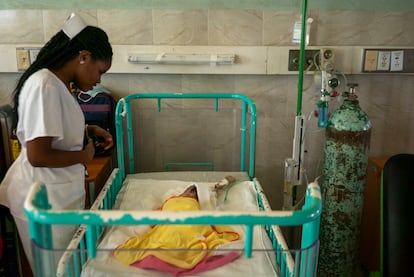

Aniurmat Padilla had been crossing her fingers for days, hoping the bone marrow test would come back negative. On Thursday, her worst fears were confirmed: her 18-year-old son, Eduardo Manuel Guillermo Padilla, has leukemia and will have to spend some time hospitalized at the Juan Manuel Márquez Pediatric Hospital in Havana. At this medical center, which treats children with cancer and psychiatric conditions from all over the country, they are preparing his weakened body with red blood cells and platelets for the upcoming treatment. Minutes after receiving the results, his mother desperately asked the nurses, “Is there blood for my son at this hospital? And do you have the medicines, or will I have to buy them elsewhere?” On the island, coming to terms with bad news comes with a host of additional worries.
Saturdays are visiting days at the hospital, a seven-story building with high ceilings and large windows that was once grand. Today it’s a medical center with areas closed for renovations, broken elevators, and unused equipment because they can’t find replacements for imported parts that broke or wore out years ago. It’s also a place where nurses greet the mothers with a kiss and their names and use their own motorcycles (those who have one) to go and pick up blood donations from the blood bank or cytostatic drugs they find at another hospital. The mothers sigh with relief when they see them. They smile with broken hearts and dark circles under their eyes and quickly turn to look at their children’s faces again. On the table: shampoo, a toothbrush, toothpaste, and some food “in case they get hungry later.”
The island has been mired for years in a health crisis encompassing a lack of state investment and a U.S. Economic blockade that, since January, has been compounded by a fuel embargo. This combination has deepened the crisis like never before. According to data shared by Tania Margarita Cruz Hernández, First Deputy Minister of Health, 96,000 people are waiting for surgery, 11,193 of them minors. This medical center alone has 141 minors admitted. The Cuban healthcare system, whose decline accelerated as a result of the Covid pandemic, is now receiving what many fear could be a final blow.
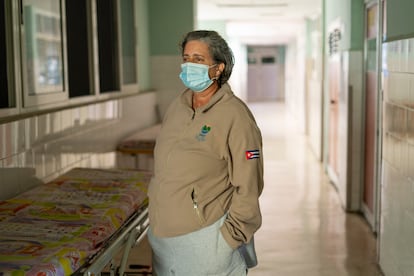
These moments, healthcare workers say, are even more heartbreaking than the pandemic, when the U.S. Government denied entry to vaccines and ventilators into the Caribbean nation. “Now this isn’t a global issue. This is intentional and specifically directed at us,” criticizes Araiz Consuegra, director of the Juan Manuel Márquez Hospital and a staunch supporter of the Revolution and the current government. “We are doing everything in our power, and even things that are not, to prevent children from dying, but it would be absurd to deny that the situation is very complex and affects our patients, their families, and the healthcare staff.”
Padilla knows this well. This isn’t the first ailment that Dado, a young biology student and a diving and climbing enthusiast, has suffered. A decade ago, he was diagnosed with Sjögren’s disease, an autoimmune disease known as dry eye and dry tongue syndrome, which also causes his hands to tense up and his legs to freeze.
When he was first admitted, she remembers there was no cotton, no alcohol, no adhesive bandages. Much less Imuran, the medication he needed. In a Cuban pharmacy, it would normally sell for 11 pesos, just a few cents of a dollar, if it weren’t for the fact that it hasn’t been imported for years. And it’s certainly not being produced on the island. His mother, who is the director of the National Aquarium of Cuba, was forced to buy it on the Cuban black market for 2,000 pesos ($4), half her salary. Right now, his mother says, Dado is receiving the treatment he needs. “Tomorrow, nobody knows. This is the bitterest thing there is, but we have to get used to it,” she says.
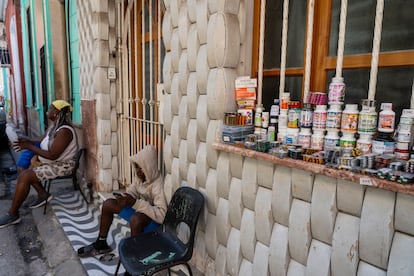
Mebendazole for 2,000 pesos ($4). Salbutamol for 3,500 ($7). Amoxicillin for 7,000 pesos ($14). Diclofenac for 1,500 pesos, ($3)... Seven months ago, Saray Griego set up a makeshift pharmacy in the barred window frame of an empty house in the heart of Old Havana. Here she has everything from adhesive bandages, cotton, and gloves to medicines for depression, cancer, bacterial infections, and traditional Chinese remedies.
This, she acknowledges, is the best business in the country right now. Three entire families depend on it for their livelihood. Among them is Regla, an elderly woman who spent her whole life serving food in schools across the country until her salary was no longer enough. “We hear all kinds of stories here, my dear. There was a woman who came to buy catheters for her mother’s operation, desperate because she’d searched the entire neighborhood and couldn’t find them anywhere. Many people keep coming back to see if we’ve got the medication they need,” she recalls. The anecdotes they share are frequently interrupted by a new customer. “What do you have for allergies?” Asks a woman with a red nose and a crumpled handkerchief in her hand. “How much is ceftriaxone?” Inquires another. “I’ve practically got a pharmacy degree,” jokes this former cleaning woman.
Both women have a dozen suppliers who stock this small stall, which is hastily cleaned up every time an inspector passes by. The “suppliers” are friends who travel to Panama, the United States, or Spain and return with suitcases full of pills and medicines. One of them, Griego reveals, is part of the medical team at a Cuban hospital. “Some steal to resell, but I understand. It’s not enough for them either,” she says. “Everyone finds a way to survive.” Healthcare workers earn less than $20 a month in a country with high inflation that imports practically 80% of its basic goods. “Seeing empty state pharmacies isn’t just a recent phenomenon because of the embargo. It’s been going on for years,” she laments.
“I live wondering if the pill will last until tomorrow”
Dulce María Cruz, 57, wanders through the warehouse, hands on her hips, a worried expression on her face. Her almond-shaped eyes fix on the meager shelves of raw materials that Juana or Virgen María will use to make the pristine white guayabera shirts of the Quitrín brand. Of the thirty or so compartments in the warehouse, only four contain a few reams of fabric, a couple of boxes of buttons, and bags of fasteners. “I’ve never seen it this empty before,” she says in the echoing room. In her hand, she holds inventory papers with the words “almost no cotton left” written in capital letters.
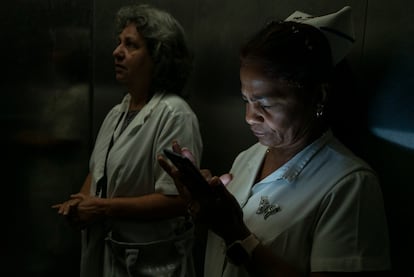
Normally, the employees of this women’s cooperative—most of them retired from state jobs—earn around 10,000 pesos (about $20), three times the minimum wage on the island. Since Trump announced his fuel embargo and tourist arrivals plummeted, this factory stopped selling. And each worker’s salary was cut by 2,000 pesos. Cruz still remembers it with a chill in her bones.
But it’s a different kind of cold than her colleagues’. She suffers from polycythemia vera, a life-threatening condition also linked to the bone marrow, which causes it to produce an excessive amount of red blood cells, white blood cells and platelets, leading to bleeding and certain types of blood cancer. The Cuban healthcare system couldn’t sell her hydroxyurea either, the antimetabolites recommended to slow or stop the growth of cancerous cells in the body. So she had to ask a friend who lives in Spain for a favor. “I’m constantly worried about having enough for tomorrow.” A few days ago, she started taking one a day, instead of two, to make them last longer.
On the fourth floor of the González Coro Gynecology and Obstetrics Hospital, the sounds offer clues about the patients they care for. In the left wing, there is complete silence. The mothers’ anxieties simmer in their minds or are whispered in the room they share with two other women, also suffering from intrauterine growth restriction. On the other side of the floor, there are the cries of dozens of tiny babies (some weighing barely a kilogram) as they struggle to survive, some dependent on ventilators. Here, the mothers speak loudly so their children will recognize their voices, pleading for a little more milk.
There are currently 32,000 pregnant women at risk in the country. This is due to factors such as the inability to obtain the eight recommended ultrasounds during pregnancy, the substitution of misoprostol for oxytocin used to induce labor, the extremely poor nutrition of a large portion of the population, or the inability to reach a hospital due to fuel shortages.
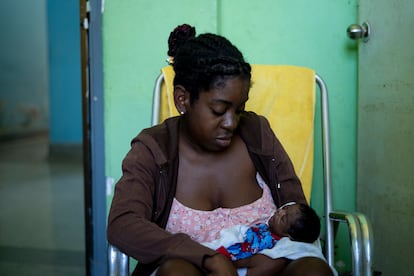
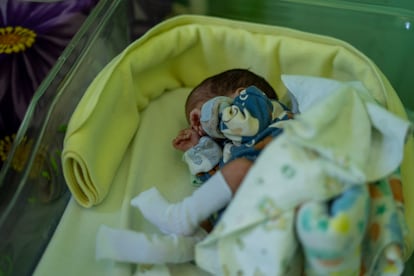
One of them is 24-year-old Suleidys Cairo. She’s a first-time mother to Alara, a beautiful 23-day-old baby girl who was born 500 grams smaller than recommended. One of the medical reasons behind her slow growth is her diet. “They told me not to eat carbohydrates, and I didn’t listen,” she says sadly. “But that’s what I normally eat: pizza or bread.” She’s a self-employed worker, and says she earns “more than the minimum wage” in Cuba. “But sometimes, even with the money in hand, I can’t easily get meat or eggs. And the times I have bought them, they go bad during the power outages.”
Alara’s crib seems gigantic for that frail little body wrapped in a rolled-up onesie and enormous socks for her tiny feet. This hospital has its own generator that withstands almost all the power outages the country suffers daily. Others are affected every time the electricity goes out. Sometimes, the generator itself fails, and it falls to Dr. Nalvys Rodríguez, head of the anesthesia and surgery department, and her entire team to come to the most critical babies, those dependent on ventilators, and give them oxygen by manually pumping a valve. “The pressure is horrendous,” explains Leonor González León, director of the González Coro Gynecological and Obstetrical Hospital. “We are receiving complaints and many problems due to the stress on the medical staff. It’s not easy to endure this day after day.”
Stories like these are piling up in every corner of the country. Mariana took expired paracetamol (acetaminophen) for chikungunya because it was her only option; Aurelio fears that the power outages will heat up the medicine his daughter buys in Panama and keeps in the refrigerator; Doña Dignora doesn’t have any bandages for her foot wound; and Olga writes every day, worried, in the neighborhood chat group, asking for blister packs for the elderly in her community. That’s why the few tourists who stroll along the Malecón sooner or later stumble upon a woman—it’s almost always women—begging for any leftover medication. “Everything helps,” they exclaim. “The United States isn’t the only bad guy. The government knows what’s going on and doesn’t help us,” criticizes Mariana, who took to the streets to protest last Sunday because of the lack of water in her community.
Today’s reality is a far cry from what was once one of the country’s greatest sources of pride: its public healthcare, which has always been free and universal, though it has been falling apart in recent years. That’s why Consuegra’s stomach churns when she compares her own time in medical school, when Cuba was a medical leader in Latin America and the Caribbean, with the moment her daughter began her medical training. “This is also a lesson for her. She’s going to learn to do as we did: leave our problems behind and put on a brave face for our patients. For everyone, whether they support the system or not,” she concludes beneath the portraits of Fidel and Raúl Castro and Miguel Díaz-Canel. “Fidel taught us never to give up, and that’s what we do.” Aniurmat Padilla, ‘Dado,’ and thousands of other Cubans can’t give up either.
Sign up for our weekly newsletter to get more English-language news coverage from EL PAÍS USA Edition
Tu suscripción se está usando en otro dispositivo
¿Quieres añadir otro usuario a tu suscripción?
Si continúas leyendo en este dispositivo, no se podrá leer en el otro.
FlechaTu suscripción se está usando en otro dispositivo y solo puedes acceder a EL PAÍS desde un dispositivo a la vez.
Si quieres compartir tu cuenta, cambia tu suscripción a la modalidad Premium, así podrás añadir otro usuario. Cada uno accederá con su propia cuenta de email, lo que os permitirá personalizar vuestra experiencia en EL PAÍS.
¿Tienes una suscripción de empresa? Accede aquí para contratar más cuentas.
En el caso de no saber quién está usando tu cuenta, te recomendamos cambiar tu contraseña aquí.
Si decides continuar compartiendo tu cuenta, este mensaje se mostrará en tu dispositivo y en el de la otra persona que está usando tu cuenta de forma indefinida, afectando a tu experiencia de lectura. Puedes consultar aquí los términos y condiciones de la suscripción digital.