Ghana is pursuing a UN resolution that considers African slavery ‘the most serious crime against humanity’
The text, which has the support of much of the Global South, including the 55 countries of the African Union and the Caribbean Community, represents a ‘legal claim’ and ‘accountability’ for the abuses committed by colonizers, according to the Ghanaian government
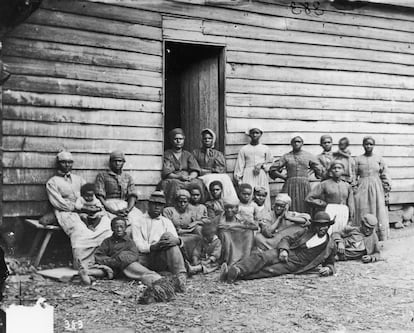

Ghana is promoting a resolution at the United Nations, with the support of the 55 member states of the African Union (AU), to declare “the trafficking of enslaved Africans and racialized slavery of Africans” as the “most serious crime against humanity.” This action, which has been described as an “unprecedented” initiative by legal experts and reparations specialists, comes at a time of re-examination of the colonial past and abuses committed by the West in various parts of the Global South. In Africa, at least 12.5 million people were victims of trafficking and slavery over a period of 300 years.
Over the past year, the Ghanaian government has been working on this project, with support from the African Union and the Caribbean Community (CARICOM). Ghanaian President John Dramani Mahama stated in an opinion piece published in The Guardian that the intention is not to “reopen old wounds,” but rather to acknowledge them and “work collectively toward healing and justice.” “Rather, it is about understanding how historical injustices have shaped contemporary inequalities, and how a more honest reckoning can contribute to a fairer, more inclusive global order,” the president wrote.
Ghana’s Foreign Minister Samuel Okudzeto, in a letter published on Sunday, clarified that the campaign “is not a humanitarian appeal,” but a “legal claim” and an “accountability” for the violation of international law.
The 193 members of the UN General Assembly will vote on the draft resolution on March 25, the International Day of Remembrance of the Victims of Slavery and the Transatlantic Slave Trade. If adopted, the text would be the first comprehensive resolution on slavery and the transatlantic slave trade in UN history.
The resolution seeks recognition of a crime considered systemic. “This was not the crude work of individual cruelty,” the minister stated in his letter. “It was architecture. Codified in law. Institutionalised by States. Sanctified, in certain quarters, by religious authorities who lent theological cover to the reduction of Africans to perpetual servitude. Made profitable across continents and across generations.”
According to Ghana, recognition will pave the way for “formal apology, restitution, compensation, rehabilitation and guarantees of non-repetition.” The Brattle Group consultancy estimated in 2023 that reparations would amount to between $100 billion and $130 billion, covering both damages incurred during the colonial era and subsequent harm.
This was not the crude work of individual cruelty. It was architecture. Codified in law. Institutionalised by StatesSamuel Okudzeto, Ghanaian Foreign Minister
But the negotiations have not been easy, the minister explained. “It is unfortunate that our friends in the United States and the European Union have said they will not vote for this resolution,” he stated on March 22 in Bogotá, during the CELAC-Africa summit.
Despite this, experts celebrate the fact that the issue has been brought before the UN. “It’s unprecedented,” says lawyer Martin Okumu Masiga, secretary general of the Africa Judges and Jurists Forum and advisor to the AU on reparations. “It’s a step beyond symbolism toward the recognition of the slave trade [as a crime] in international law and in the eyes of the majority of the world,” he states in a video call with this newspaper.
Adekeye Adebajo, a professor and senior researcher at the University of Pretoria, considers this a further step in the institutional efforts that began in 1993 with the signing of the Abuja Declaration, which recognized slavery as a crime and called for reparations from countries that had profited from this practice. In the following years, there were other developments, such as the 10-point plan presented by CARICOM in 2014 for seeking reparations. Then came the Durban Declaration of 2021 and the Accra Declaration of 2023. The latter established several commissions and programs within the African Union to document and promote reparations and explore legal mechanisms for achieving them. Two of the commissions that provided legal advice to Ghana for its draft resolution before the UN emerged from these efforts.
And, since 2025, the AU has been developing initiatives to achieve recognition of these events and reparations for the descendants of the victims. Last year, they declared the period from 2026 to 2035 the Decade of Action on Reparations. This February, they adopted a resolution recognizing slavery, deportation, and colonialism as crimes against humanity. This was a key step before taking the project to New York.
The resolution itself has already elevated the debate to a global level, so even a rejection wouldn’t erase the momentumMartin Okumu Masiga, secretary general of the Africa Judges and Jurists Forum
“These are long struggles, like the abolition of slavery, which took four centuries,” Adebajo points out in a video call interview with EL PAÍS. For lawyer Masiga, approval could “pave the way for a series of measures.” A rejection “will be disappointing,” he admits, but he adds that “it by no means signifies the end of the campaign.” “The AU and Caricom will continue to press. The resolution itself has already elevated the debate to a global level, so even a rejection wouldn’t erase the momentum.”
“Europeans, and I suppose Americans, would like to argue that these acts are subject to a statute of limitations or even that they weren’t crimes at the time they were committed,” Adebajo adds, noting that the consequences of slavery are still ongoing. “The fact that Africa has a debt of $1.1 trillion and has to spend, on average, 45% of its income on it, instead of developing its health and education sectors, is, for many Africans, a direct consequence of the slave trade,” he explains.
One of the objections raised during the negotiations, according to the Ghanaian minister, was that declaring these crimes as “the most serious” could create a hierarchy of atrocities committed throughout history. Doubts were also raised about the statute of limitations for these crimes. For Masiga, this is an “escapist argument from the West.” “Crimes against humanity are not subject to a statute of limitations. The UN has maintained that they remain prosecutable and demand recognition regardless of when they were committed,” he argues.
What has transpired in the seven rounds of negotiations is yet another episode in the difficult history of reparations claims, which, until now, has yielded only a handful of successful cases. While there have been formal apologies and financial reparations in the past from European countries that participated in colonization and the slave trade, these have been isolated incidents and not a general response to the harm done to the continent.
In 2013, for example, the United Kingdom was compelled by a court order to provide reparations to 5,000 Kenyan survivors who suffered torture during the Mau Mau uprising in the 1950s. In 2021, the German government acknowledged its responsibility for the genocide of the Herero and Nama peoples in the early 20th century and announced reparations of €1.1 billion. A year later, the Dutch government apologized and established a €200 million fund to address the consequences of the genocide and finance social initiatives.
The Ghanaian government asserted that Wednesday’s debate goes even further than addressing the historical debt owed to Africa. “A world that does not formally reckon with a crime of that magnitude does not merely fail Africans and people of African descent. It fails humanity,” the Foreign Minister wrote in his letter.
Sign up for our weekly newsletter to get more English-language news coverage from EL PAÍS USA Edition
Tu suscripción se está usando en otro dispositivo
¿Quieres añadir otro usuario a tu suscripción?
Si continúas leyendo en este dispositivo, no se podrá leer en el otro.
FlechaTu suscripción se está usando en otro dispositivo y solo puedes acceder a EL PAÍS desde un dispositivo a la vez.
Si quieres compartir tu cuenta, cambia tu suscripción a la modalidad Premium, así podrás añadir otro usuario. Cada uno accederá con su propia cuenta de email, lo que os permitirá personalizar vuestra experiencia en EL PAÍS.
¿Tienes una suscripción de empresa? Accede aquí para contratar más cuentas.
En el caso de no saber quién está usando tu cuenta, te recomendamos cambiar tu contraseña aquí.
Si decides continuar compartiendo tu cuenta, este mensaje se mostrará en tu dispositivo y en el de la otra persona que está usando tu cuenta de forma indefinida, afectando a tu experiencia de lectura. Puedes consultar aquí los términos y condiciones de la suscripción digital.