Paramedics under bombs in southern Lebanon: ‘I’m not leaving here’
Hezbollah promises a battle ‘without limits’ after Israel declared its goal of militarily occupying 10% of the country

“They say we transport missiles, but in reality, we transport the wounded and basic supplies,” Ali says in front of his ambulance. This volunteer paramedic, who asks to be identified by a pseudonym for fear of reprisals, is a farmer in his sixties, wears glasses, and has a white beard. The calm tone he uses as he hands out cigarettes to those who approach him in a town in southern Lebanon contrasts sharply with the state of his ambulance. It has hardly any windows left, after an Israeli airstrike at the beginning of the recent escalation in the war against Hezbollah killed three people inside. “Why would I be afraid? What am I supposed to do, leave my country? I’m not leaving here,” he declares without hesitation.
Ali collaborates with the Islamic Health Association (IHA), a medical entity affiliated with Hezbollah — a political and social organization in addition to being a militia — which works in coordination with the Lebanese Ministry of Health. Israel has repeatedly accused IHA personnel and ambulances of serving the organization’s armed wing. Many of the more than 130 Israeli attacks Beirut has recorded against healthcare facilities and workers since March 2, when Hezbollah fired on Israel for the first time since 2024, have targeted this group. Health Minister Rakan Nasseredine and the IHA have denied that the ambulances carry ammunition.
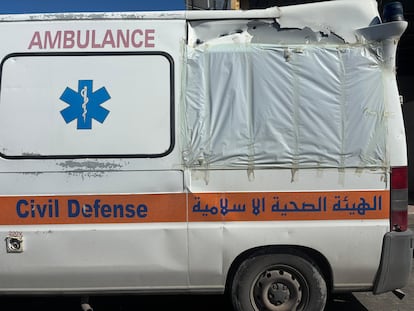
Ali, a native of the southern municipality of Jouaiya, speaks to EL PAÍS from Mazraat Al Yahoudiyeh, within the southern territory of Lebanon that Israel has declared a war zone. It lies south of the Zahrani River, 40 kilometers (25 miles) from Israel. Since the beginning of the offensive, the Israeli army has demanded the evacuation of the entire population south of this waterway and has warned that any vehicle movement in the area could be targeted. “I don’t know anything about weapons,” Ali says. Because the damage to his vehicle prevents him from using it for medical work, he now transports fuel, food, or firewood “for the people who are still” in Bint Jbeil, a border area.
On Wednesday, Israeli tanks advanced toward Dibil, a Christian town in the region that has been the target of attacks by both Israeli forces and Hezbollah, suggesting ongoing fighting. Incursions were also reported at other points along the 120-kilometer (75-mile) border, including Al-Qawzah (on a 750-meter elevation) and Ayta ash-Shaab. “The army is close,” a Dibil resident told the Lebanese newspaper L’Orient Le Jour. “We don’t dare stick our heads out.”
These are the final throes of an escalating battle. On Tuesday, Israeli Defense Minister Israel Katz, a former classmate of Benjamin Netanyahu, stated that his army aims to extend the occupation to the Litani River, whose furthest point from Israel lies 30 kilometers (18.6 miles) from the border. Days earlier, Katz warned that Israel would prevent the return of residents to the area — a quarter of a million people — as long as it perceives Hezbollah as a threat. This Wednesday, the secretary-general of Hezbollah, Naim Qassem, vowed a war to the death. He warned that Hezbollah’s “young fighters” would fight “without limits” and sacrifice themselves “without reservation.”
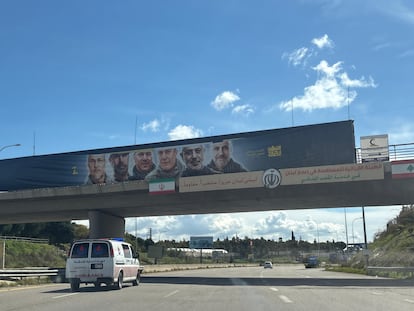
The ferocity of the Israeli offensive, which has killed 1,094 people in three weeks, and the prospect of a protracted conflict are gradually emptying southern Lebanon, a country where the government has registered more than a million internally displaced persons. Ambulances from the IHA or the Red Cross — many with their sirens blaring — and vehicles of the Lebanese regular army — often with their cargo covered — make up a significant portion of the sparse traffic in Mazraat Al Yahoudiyeh. This doesn’t mean everyone has fled, but it suggests that those who remain are avoiding unnecessary travel and are increasingly isolated in their homes, where supplies and humanitarian aid from the capital are scarce.
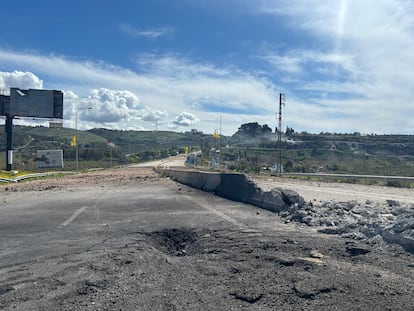
Vehicles are traveling on the outskirts of Mazraat Al Yahoudiyeh across one of the few bridges over the Litani River that Israel has not yet bombed, in what it presents as a strategy to prevent Hezbollah’s movement toward the border. On that bridge, whose southern side overlooks the municipality of Qasmieh (where the Israeli army reiterated evacuation orders this Wednesday), and on other bridges that remain over the Zahrani River, the Lebanese army has reinforced military checkpoints, monitoring vehicles traveling south.
A war that never ended
Although the Lebanese government accuses Hezbollah of dragging the country into a new conflict with Israel on behalf of Iran, many residents of the south argue that the war against their territory never ended, and that the current escalation is a continuation of the conflict fought in 2024. Following the truce signed in November of that year, the pro-Iranian militia halted its attacks for 15 months. Its supporters, who are the majority in this region of Lebanon, describe it as a missed opportunity for peace. The Israeli army, on the other hand, maintained its attacks, justifying them as a fight against Hezbollah’s rearmament.
Ash is a common sight along the roadsides south of the Zahrani River, still-visible scars from the bombings of vehicles and homes in which Israeli troops killed 397 people during the ceasefire. These hostilities plunged southern Lebanon into a kind of economic depression, a place where rebuilding lives, homes, and businesses was impossible.
“If you give me money, I’ll leave!” Says Mahmoud, the manager of a small fast-food restaurant. He lives and works in Sarafand, a town marked in red by the Israeli army. Like many others, he can’t afford to flee to a safer place. He says that since 2024, when they already spent everything they had on a previous forced displacement, they haven’t recovered financially. He has sent his wife and daughter to Chouf, further north, while he remains at his restaurant, without a single customer this Wednesday, so he can send them money.
Israel, which unlike in previous occupations has set itself the goal of completely emptying southern Lebanon, is expanding the list of targets it considers legitimate. On Tuesday, an Israeli airstrike killed two paramedics, aged 16 and 23, in the town of Nabatieh, between the Litani and Zahrani rivers. The Lebanese Ministry of Health, which has recorded 42 healthcare workers killed since March 2, protested, claiming that they were “properly identified with their full uniforms and warning lights.”
This Wednesday, Israel launched new airstrikes on gas stations belonging to Al Amana, the fuel distribution group associated with Hezbollah, which has been under U.S. Sanctions since 2020. Although the gas station where he refills a large jerrycan of gasoline aboard his ambulance does not belong to that company, paramedic Ali asks not to be photographed for fear that Israel will bomb it. “If there were a state that protected the borders, we wouldn’t need to maintain the resistance,” he says, referring to Hezbollah. As he gets into the vehicle, he asserts that he doesn’t mind dying if it’s defending his land. “What matters is that the country remains,” he concludes, as he begins his journey toward the border area.
Sign up for our weekly newsletter to get more English-language news coverage from EL PAÍS USA Edition
Tu suscripción se está usando en otro dispositivo
¿Quieres añadir otro usuario a tu suscripción?
Si continúas leyendo en este dispositivo, no se podrá leer en el otro.
FlechaTu suscripción se está usando en otro dispositivo y solo puedes acceder a EL PAÍS desde un dispositivo a la vez.
Si quieres compartir tu cuenta, cambia tu suscripción a la modalidad Premium, así podrás añadir otro usuario. Cada uno accederá con su propia cuenta de email, lo que os permitirá personalizar vuestra experiencia en EL PAÍS.
¿Tienes una suscripción de empresa? Accede aquí para contratar más cuentas.
En el caso de no saber quién está usando tu cuenta, te recomendamos cambiar tu contraseña aquí.
Si decides continuar compartiendo tu cuenta, este mensaje se mostrará en tu dispositivo y en el de la otra persona que está usando tu cuenta de forma indefinida, afectando a tu experiencia de lectura. Puedes consultar aquí los términos y condiciones de la suscripción digital.