The war that Israel never loses: its secret services once again carry out assassinations in Iran
Years of preparation and reams of information have made it possible to conduct successful ‘targeted killings’ such as those that took out the supreme leader Ali Khamenei and the heads of Hezbollah and Hamas
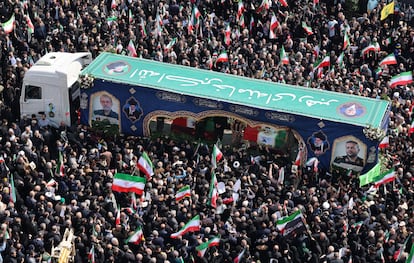

Benjamin Netanyahu’s government launched its previous war against Iran in June 2025 with a surprise wave of so-called “targeted assassinations.” Most of the victims were inside their homes, heavily guarded by a special unit of the Revolutionary Guard. These guards had been assigned by the then Supreme Leader, Ali Khamenei (whom Israel killed at the beginning of the current conflict), who feared that Mossad agents would show up on motorcycles and shoot them, as they had done with nuclear scientists. The members of this unit were forbidden from using electronic devices to prevent anyone from tracking their location, but not so the bodyguards, increasing the risk of human error and infiltration. And so it happened: one bodyguard even shared his geolocation on Facebook while on duty. After the 2025 war, Iranian authorities addressed the security breach and removed the tracking devices from the bodyguards as well.
Israel, however, has been able to pinpoint with complete accuracy (partly by tapping Tehran’s security cameras and by using algorithms) the leaders it wanted to kill in the conflict it launched almost a month ago in tandem with the United States. “Their intelligence services knew who they were meeting with and where. Morning and evening,” says Ronen Bergman, a prominent Israeli journalist specializing in intelligence and author of the book Rise and Kill First: The Secret History of Israel’s Targeted Assassinations, in a phone interview.
Bergman recounts these details to illustrate how Israel’s intelligence services have not only carried out targeted assassinations at the highest levels (including, for the first time, a head of state, Khamenei) since the Hamas attack of October 2023, but also maintain such a robust network of capabilities that they can continue to do so, even though each attack provides clues, exposes methods, and burns through agents. “The only reason Israel can operate with such precision just eight months after [the previous war] is because it spent many years preparing for all these wars and developed overlapping infiltrations, so that if you lose one, you don’t need years to infiltrate again,” he points out.
“Well in advance”
It’s part of their history and intelligence approach, which leads to special operations such as sabotage, cyberattacks, or assassinations. “If you believe that one day you will go to war, or have a limited confrontation, you understand that you need to prepare well in advance and in a way that goes beyond simply gathering information,” Bergman explains.
Israel proved it last week, taking out four big names in just a few days: Ali Larijani, a key figure in the regime; Gholamreza Soleimani, head of the Basij militia; Esmail Khatib, Minister of Intelligence; and Ali Mohammad Naini, spokesman for the Revolutionary Guard.
They are the latest in a long list that extends beyond this war and includes targets previously considered too ambitious, sometimes out of fear of reprisals. Since Netanyahu decided to transform the Middle East with fire and sword following the Hamas attack, he has killed, among others (based on precise intelligence), Hezbollah leader Hassan Nasrallah; his deputy, Fuad Shukr; and Hamas leader Ismail Haniyeh, precisely in the Tehran hotel room to which he had been invited by Iranian authorities.
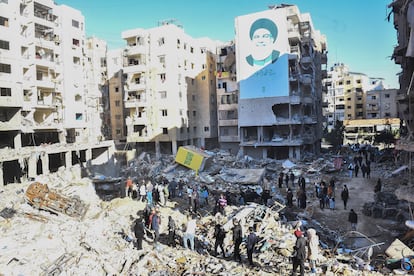
Broadly speaking, and although they sometimes overlap, cooperate, or compete, Mossad is the intelligence agency for foreign affairs, and Shin Bet is its equivalent for Israel and Palestine. The recent assassinations in Iran—and in general in the Middle East in recent years—have more to do with the third, less well-known component: military intelligence. “Since 2023, this is where the most substantial intelligence for targeted operations has come from. As a general rule, 90% was obtained through military intelligence, sometimes transferred to operations subsequently carried out by Mossad or Shin Bet,” Bergman points out. In particular, Unit 8200, the agency dedicated to digital surveillance, cyber warfare, information technologies, and the mass management of wiretaps.
Although it wasn’t only their doing, the Mossad received the most attention for the most talked-about operation: it planted explosives, through front companies, in thousands of pagers and walkie-talkies that Hezbollah had ordered and distributed among hundreds of members of its various branches, not just the military. In September 2024, it detonated them remotely, leaving faces and hands bloodied and an undisclosed number of people blinded.
The attack plunged Hezbollah into a state of panic. In those days, every electronic device—especially in the hands of foreign journalists—was considered a potential explosive. And the surveillance cameras Hezbollah had installed in the streets (sometimes cheap models ordered online) were so deeply hacked that footage of the attacks reached Telegram groups in Israel before it reached journalists in Lebanon. Shortly afterward, military aircraft killed Nasrallah.
Years of covert war
It was an operation prepared over years of covert warfare. Like Khamenei’s, on the 28th.
In Tehran, almost all traffic cameras had been hacked for years. The images—encrypted, transmitted to servers in Israel, and combined with artificial intelligence—allowed intelligence services to determine, from 2,000 kilometers away, the “life patterns” (as they are known in the jargon) of the Iranian leaders’ bodyguards: their addresses, work schedules, and usual routes, according to the Financial Times’ reconstruction of the assassination.
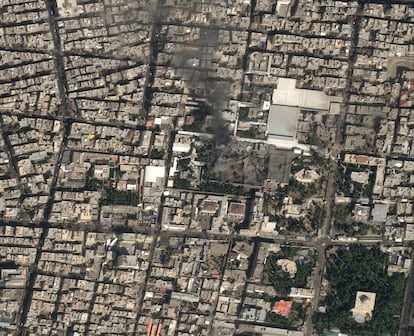
Israeli intelligence services had also gained access to tens of thousands of other cameras that the regime had hastily installed in the capital, particularly in the wake of the January protests, which were brutally suppressed, leaving at least 3,000 dead, according to the Associated Press. Even so, before dropping the bombs, Israel also disabled components of about a dozen cell phone towers near Pasteur Street, where the bodyguards were located. They were unable to receive warnings, and their phones rang as busy, even though they weren’t.
Despite Khamenei’s symbolic, political, and religious importance, Nadav Eyal, one of Israel’s leading commentators, attributes greater significance to the assassination of Larijani, which occurred two weeks later. The former, he argued in the newspaper Yediot Aharonot, “demonstrated the profound extent of Israeli intelligence infiltration into the Iranian regime,” but also relied “on a stratagem and the element of surprise.” Larijani’s assassination, on the other hand, highlighted Tehran’s “vulnerability” to such attacks.
Israel killed the Secretary of the National Security Council and a key figure in the regime in one of the various residences he frequented to sleep undetected. On the night of Monday the 16th, Israeli intelligence received information that Larijani was in a house on the outskirts of the capital, a place he rarely visited, according to leaks to the local press. The air force simultaneously dropped 20 one-ton bombs (which destroy everything for dozens of meters around them), also killing one of his sons.
Israel planted the seeds that made this possible two decades ago: between 2006, when 34 days of war with Hezbollah left a decidedly unvictorious feeling in Israel (it lost 121 soldiers), and 2008, with the first of its offensives in Gaza, which seemed large at the time: the death toll was over 1,400, the same as in just two days of strikes in the recent campaign.
Israeli intelligence then began preparing “for a war it believed would certainly happen sooner or later (with Hezbollah); another that might happen, with Iran; and one that would never happen, with Hamas. And successes or failures are judged based on this,” Bergman notes. The result: Hezbollah, severely weakened in just 11 days; Iran, infiltrated, but still standing despite the assassinations; and Hamas, capable of surprising Israel and causing 1,200 deaths. Its political and security establishment had been trying to downplay the internal warnings.
Consensus
In Israel, these targeted assassinations mostly generate satisfaction, pride, and a sense of redemptive revenge, despite their illegality and ethical problems. And despite their (moral dimension aside) questionable usefulness, they have been used for decades in numerous locations: from Gaza to Dubai, where Mossad agents disguised as tennis players killed Hamas leader Mahmoud Mabhouh, or Jordan, where they ended up handing over the antidote to the poison they had used to try to kill another Hamas leader, Khaled Meshaal, in one of their biggest fiascos.
Avi Issacharoff, an Israeli journalist specializing in Palestinian affairs, former member of an elite unit, and co-author of the popular television series Fauda, points out that, despite being “a source of great satisfaction for the Israeli population and even for the media,” they “have failed to bring about tangible changes.” He cites the Lebanese militia Hezbollah as an example: Nasrallah’s successor, Naim Qassem, lacks his authority and aura. His stilted oratory and lack of charisma have, in fact, been the subject of ridicule. But he has “managed to stabilize Hezbollah” in just over a year, and these days it is launching dozens of rockets and drones against Israel.
Even outside of Israel, everything related to its espionage evokes a mixture of fascination (for the most daring operations) and revulsion, including because of the many collateral victims who remain outside the headlines. This is especially true when Mossad is involved. Books, films, and television series have contributed to this perception that it is present in everything that happens on all five continents, feeding both those who benefit from its fearsome image of ubiquity and the anti-Semites who always see a mysterious Jewish hand behind everything.
Sign up for our weekly newsletter to get more English-language news coverage from EL PAÍS USA Edition
Tu suscripción se está usando en otro dispositivo
¿Quieres añadir otro usuario a tu suscripción?
Si continúas leyendo en este dispositivo, no se podrá leer en el otro.
FlechaTu suscripción se está usando en otro dispositivo y solo puedes acceder a EL PAÍS desde un dispositivo a la vez.
Si quieres compartir tu cuenta, cambia tu suscripción a la modalidad Premium, así podrás añadir otro usuario. Cada uno accederá con su propia cuenta de email, lo que os permitirá personalizar vuestra experiencia en EL PAÍS.
¿Tienes una suscripción de empresa? Accede aquí para contratar más cuentas.
En el caso de no saber quién está usando tu cuenta, te recomendamos cambiar tu contraseña aquí.
Si decides continuar compartiendo tu cuenta, este mensaje se mostrará en tu dispositivo y en el de la otra persona que está usando tu cuenta de forma indefinida, afectando a tu experiencia de lectura. Puedes consultar aquí los términos y condiciones de la suscripción digital.