Maduro’s sweatsuit and the triumph of the ‘poor image’
The sports outfit that the Venezuelan leader was wearing at the time of his capture has become news and a source of satirical material repeated to the point of nausea
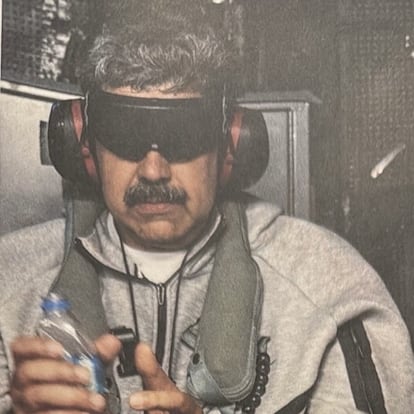

The photo had all the makings of a meme: terrible framing, poor resolution, a recognizable consumer item, and a subject striking an odd pose. “Nicolás Maduro on board the USS Iwo Jima,” Donald Trump wrote when he shared it last Saturday on his social media platform, Truth Social. The snapshot, which would go viral in seconds, graphically confirmed the capture of the Venezuelan leader. It was a historic image, and anything but innocent.
Nicolas Maduro on board the USS Iwo Jima. Pic.twitter.com/omF2UpDJhA
— The White House (@WhiteHouse) January 3, 2026
Dressed in a gray Nike tracksuit, Maduro is seen standing, immobilized by handcuffs and unable to see or hear due to a blindfold and noise-canceling earplugs. This vulnerable and helpless pose of the Venezuelan leader sought the same effect as the viral photos of other imprisoned leaders in the internet age. Fallen men, weak men: men stripped of all power.
Maduro’s image is reminiscent of Saddam Hussein’s capture in 2003: disheveled, his beard caked with dirt, lying on the ground, and displayed like a hunting trophy by U.S. Soldiers in an amateurish, poorly framed photo. Or the pixelated, bloody snapshots distributed by Reuters of Osama bin Laden’s three bodyguards killed in May 2011 during his capture at his home in Abbottabad, Pakistan. Those would be the only images available of that military operation because Obama refused to use the photo of the Al-Qaeda leader for political propaganda: “This isn’t something to celebrate like we scored a goal; that’s not who we are,” the then-president said, explaining why the White House wouldn’t release the photos of the Al-Qaeda leader’s capture.
By 2025, the world may have normalized the use of sweatsuits and sportswear in everyday life, but the photo of Maduro in handcuffs is pure ideology within the masculinist and reactionary semantics of Trumpian power, ready to be replicated infinitely. It’s an image meant to symbolize that infamous quote popularized by Karl Lagerfeld: “You lost control of your life so you bought some sweatpants.”
In a matter of hours, that outfit, recognizable by its logo, became news and satirical material reproduced to the point of nausea. From AI showing famous actors wearing it to websites scraping together some traffic with headlines like “Where to buy the tracksuit Nicolás Maduro was wearing when he was arrested. On Instagram, the Argentinian publishing house Caja Negra interpreted the absurd craze for tracksuits by quoting one of the authors in its catalog, Guy Debord: “Under the shimmering diversions of the spectacle, banalization dominates modern society the world over and at every point where the developed consumption of commodities has seemingly multiplied the roles and objects to choose from.”
In her essay “In Defense of the Poor Image,” video artist, professor, and theorist Hito Steyerl reflected on why images with a crude aesthetic work so well within the production and circulation systems of digital images. Nothing appeals to the internet more than a sloppy image, ripe for endless reproduction and dissection. So it makes sense that, in times of war, where disorder and decontextualization reign, propaganda is supplied with poor images. And with a tracksuit available in stores and online for around $200.
Sign up for our weekly newsletter to get more English-language news coverage from EL PAÍS USA Edition
Tu suscripción se está usando en otro dispositivo
¿Quieres añadir otro usuario a tu suscripción?
Si continúas leyendo en este dispositivo, no se podrá leer en el otro.
FlechaTu suscripción se está usando en otro dispositivo y solo puedes acceder a EL PAÍS desde un dispositivo a la vez.
Si quieres compartir tu cuenta, cambia tu suscripción a la modalidad Premium, así podrás añadir otro usuario. Cada uno accederá con su propia cuenta de email, lo que os permitirá personalizar vuestra experiencia en EL PAÍS.
¿Tienes una suscripción de empresa? Accede aquí para contratar más cuentas.
En el caso de no saber quién está usando tu cuenta, te recomendamos cambiar tu contraseña aquí.
Si decides continuar compartiendo tu cuenta, este mensaje se mostrará en tu dispositivo y en el de la otra persona que está usando tu cuenta de forma indefinida, afectando a tu experiencia de lectura. Puedes consultar aquí los términos y condiciones de la suscripción digital.