Norwegian influencer buys failed property development in Spain to build ‘self-sufficient’ eco-community
The Modern Eco Village plans to erect 500 homes, schools and shops in a pristine mountain spot near the protected reservoir of Beniarrés, in Alicante province. The plan builds on an earlier attempt that flopped due to the 2008 financial crisis
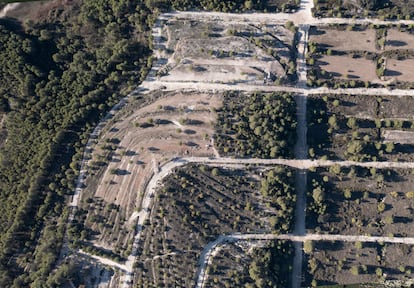

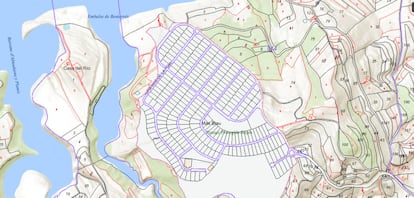
It was going to be a huge success: the homes would be built on a 500,000 square meter (123-acre) tract of land nestled in the mountains of Alicante, in the Spanish Mediterranean, on the idyllic shore of a water reservoir and close to a friendly village of just 700 residents. The original project, which began in 2006, was dubbed La Joya de Planes (The Jewel of Planes) and envisioned as a large residential development of 435 homes facing the Beniarrés reservoir, a few miles from the existing village of Planes. The plot of land had previously been owned by the family of Esteban González Pons, a politician with Spain’s conservative Popular Party (PP) and a member of the European Parliament between 2014 and 2023. The plot was rezoned and approved for building before the surrounding area received protected status in 2007 due to its high environmental value.
Machines rushed into the area to open up paths that would later become roads. Neighboring municipalities protested because they didn’t want the area around the reservoir to be used for residential purposes. And then Spain’s property bubble burst. The developer could no longer afford to keep going, local authorities revoked the license, and the area was left half-finished, like so many others in 2008.
It remained that way for 16 years until May 2025, when a Norwegian influencer named Belinda Jakobsen and her husband bought the enormous plot of land to build a “self-sufficient” community of like-minded people that they’ve named The Modern Eco Village (MEV).
Jakobsen and her husband Iancu Ilies, who is from Romania, are the driving force behind the project, which they are promoting on social media. Their posts, some with millions of views, began two years ago when, as they explain in numerous messages, they decided to build a housing development and, with it, a community that would be self-managed, with “smart homes, EMF and toxic free.”
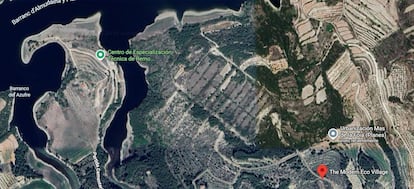
This has resulted in the purchase of a 640,000 square meter (158-acre) tract of land—larger than the one originally planned for Joya de Planes—where the first show house is already under construction. The goal is to transform one of the banks of the Beniarrés reservoir into a residential complex of approximately 500 homes—107 villas and around 350 townhouses—as well as ecological parks, farms, sports facilities, a kindergarten, a school, community centers, and even a medical clinic. The promise is that everything will be sustainable and will include solar panels and water recycling systems.
Essentially, it’s being marketed as a custom-built village with private security, primarily aimed at a foreign clientele. All its social media communications are in English, although the website is available in Spanish, English, Finnish, Norwegian, Romanian and Dutch. The developers also promise to create 150 or more jobs, prioritizing residents of the “village,” but also considering external staff.
But is it possible to build a whole village from scratch? José Manuel Escobedo, the architect behind the project, explains that the MEV is the reactivation of a PAI (Integrated Action Program) that was left unfinished. A PAI is an urban planning tool widely used in the Valencia region to transform developable land into a new urban settlement. “The previous development was only about 20% complete, and over the years, the area was practically abandoned. However, the properties existed and were properly registered,” he points out.
Now the existing project must be adapted to the current legislation. To do so, it will go through a “long, complex and bureaucratic” urban planning process. “The project will be officially submitted to the City Council next week, and within approximately six months, they can obtain the necessary permits to become a developer and begin construction. The legislation allows for simultaneous construction of the homes once the civil works have begun. Overall, the entire process could take around two years,” Escobedo explains.
The MEV will be built in phases, and the first phase is expected to be completed by the spring of 2027. There will initially be only 15 houses, including those for the founders and the project manager, Ilies explains via email. By the end of next year, they plan to expand to 40 homes and anticipate the development will be fully completed by 2030. Following the financial crisis, the land was acquired by a bank and two other private owners. “We began negotiations almost two years ago with these three entities, the agreement was signed a year ago, and it was recently formalized before a notary,” he explains.
Before focusing her social media content on the ecovillage, Jakobsen posted recipes, plant care tips, and glimpses into her daily life. Her husband, Ilies, is a co-founder and director of Pikant Media, a digital marketing and advertising agency registered in Norway, according to his LinkedIn and Facebook profiles. The first video they posted about the project is from March 2024, and it begins: “Guys, it’s happening, we’re going to build a village.” A year later, they acquired the land for above-market value. The company behind the development is not mentioned anywhere, and Ilies says they prefer not to disclose the purchase price. The construction company is Blues Simon Group, located in the coastal town of Altea and specializing in exclusive homes.
Can anyone buy a house in the MEV off-plan? It depends. To reserve—which is not the same as purchase—one of the houses, you must first become a member of this “holistic” community. The price: €10,000. This payment guarantees a spot in the project and will be deducted from the final price of the home or, if you decide not to proceed, will be fully refunded, they promise. It also offers other benefits, such as locking in the price of the house at the time the reservation is paid, and priority in choosing a job or starting a business in the village.
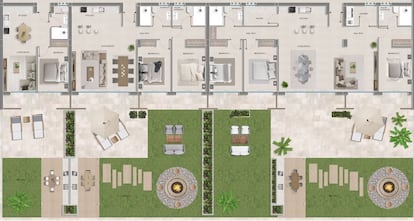
Once you become a member of MEV, it’s time to choose your home. There are four types, and the modular townhouses are the cheapest option: from one bedroom and 50 square meters (538 sq ft) starting at €165,375, to four bedrooms and 150 square meters (1,614 sq ft) for €479,588. You can also add empty modules as desired for €84,000 each. Then there are the villas: the standard, two-story villa costs €770,000, and the most luxurious one is €1.4 million. However, there is some fine print: because they are still in the early stages of the project, they explain, prices at this time are lower than the actual market value of the homes, but as the project progresses, they will naturally adjust to reflect their full value.
So far, Jakobsen explains in one of the latest videos, they have received over 30,000 inquiries and more than 100 people from 27 different countries have already paid the fee to become MEV members. Twenty-five villas and 38 modular homes have been reserved. “All the attention we’ve received so far is due to Belinda’s videos on social media, which went viral several times and have been seen by millions of people,” says Ilies.
The mayor of Planes, Javier Sendra, who has held the position for 23 years, visited the site last September and stated his full support for the development project: “It will enhance the environmental value of the municipality. Happiness is guaranteed here,” he stated. Planes has around 700 inhabitants, and if the project is completed, it will at least double its population. “We had 800 residents, but a factory closed, and we are experiencing depopulation. If this project revitalizes the area and creates jobs, it will be positive for the community,” he said. Besides serving as the mayor of Planes, Sendra is also the deputy chief of the Infrastructure department in the regional government of Valencia.
Anna Climent lives in Alcoy, about 25 kilometers (15 miles) from the reservoir, but she’s originally from one of the hamlets that are attached to Planes, and is a member of the non-profit environmental group Coordinadora d’Estudis Eòlics del Comtat. She says that the MEV project isn’t talked about much in the village. “It should be a recurring topic of conversation. 500 homes in a town of fewer than a thousand people?” She complains over the phone. She believes it’s “very easy” to convince people by appealing to money, “because they have the feeling that rural is synonymous with degraded.” “If you’re socially depressed, it’s in your interest to put infrastructure in a place where there won’t be any social backlash,” she adds.
In the coming weeks, the mayor explains, they will hold a meeting with residents to explain the project. “They [the project developers] have to be respectful, create roads with the least possible impact, and ensure integration with the landscape. They also have to take care of the maintenance work, because we can’t afford it,” he says. On the land, for example, there is an old farmhouse, and Sendra hopes to negotiate its restoration. “We will provide the essential services, such as drinking water. As for streets and streetlights, if they can do the maintenance themselves, all the better, because the cost would skyrocket for us.”
The reservoir area is part of the Serpis River Protected Landscape, which flows through Valencia and Alicante provinces. Both the riverbed and its surroundings are considered a “unique space due to their landscape, ecological, and cultural values” and as such they were protected in 2007. But that document also states that “urban and developable land within the Protected Landscape may maintain its current urban zoning status.”
By 2007, the land where the MEV is located had already been rezoned. This rezoning occurred in 2004, the year that the property was sold by the family of González Pons — who was at that time serving in Valencia regional politics as head of the Culture department and would later serve as head of the Territory and Housing department. The sale took place a week after the Planes City Council, then governed by the PP, approved the Vicens Ash company’s original proposal to develop the area. The selling price was €721,214.53, but two days later it was revised upwards to €901,518.46. When the project fell through due to the economic crisis, local authorities retained the €600,000 fee from the construction company. Now, the story has begun all over again. “Welcome to the world’s first MODERN ECO-VILLAGE!” The project’s website exclaims. “A project that started with us and continues with you.”
Sign up for our weekly newsletter to get more English-language news coverage from EL PAÍS USA Edition
Tu suscripción se está usando en otro dispositivo
¿Quieres añadir otro usuario a tu suscripción?
Si continúas leyendo en este dispositivo, no se podrá leer en el otro.
FlechaTu suscripción se está usando en otro dispositivo y solo puedes acceder a EL PAÍS desde un dispositivo a la vez.
Si quieres compartir tu cuenta, cambia tu suscripción a la modalidad Premium, así podrás añadir otro usuario. Cada uno accederá con su propia cuenta de email, lo que os permitirá personalizar vuestra experiencia en EL PAÍS.
¿Tienes una suscripción de empresa? Accede aquí para contratar más cuentas.
En el caso de no saber quién está usando tu cuenta, te recomendamos cambiar tu contraseña aquí.
Si decides continuar compartiendo tu cuenta, este mensaje se mostrará en tu dispositivo y en el de la otra persona que está usando tu cuenta de forma indefinida, afectando a tu experiencia de lectura. Puedes consultar aquí los términos y condiciones de la suscripción digital.