Carved up and neglected, Route 66 continues to fascinate as it turns 100
This long, long road was crucial for the movement of troops during World War II before becoming the road trip par excellence in the 1960s and 1970s thanks to hippies and beatniks
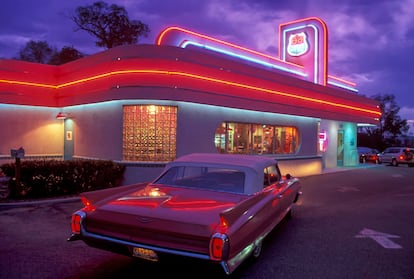
“If you ever plan to motor west, travel my way, take the highway that is best. Get your kicks on Route sixty-six” was Nat King Cole’s advice. But the highway John Steinbeck labeled the Mother Road in The Grapes of Wrath (1939), was not built for kicks. The so-called Main Street of America was established in 1926 to connect Chicago, Illinois, with Santa Monica, California, through the states of Missouri, Kansas, Oklahoma, Texas, New Mexico and Arizona.
During World War II it was crucial for the movement of troops; in the 1950s and 60s it attracted families on vacation, then featured on TV with the series Route 66. In the 1960s and 1970s, hippies and beatniks turned it into the road trip par excellence. In the 1980s, the express highway plan rendered it all but obsolete. It has only survived thanks to local associations keen to preserve the Historic Route 66 together with travelers from all over the world.
On November 11, 2026, Route 66 will turn 100 years old, carved up and neglected. Some sections have been expanded while others have disappeared or are closed, and the signs are confusing. Establishments open late and close early; you travel miles and miles without seeing a soul. All in all, though, the journey is still fascinating.
Days 1 and 2: Chicago
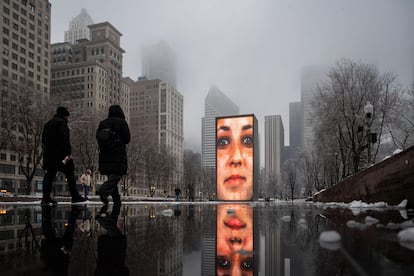
Windy Chicago, on the shores of Lake Michigan, seems to shiver as you walk along the skyscraper-studded Riverwalk. The city assumes a cultured air at the Art Institute and a modern vibe at Millennium Park, with Anish Kapoor’s Cloud Gate and Jaume Plensa’s Crown Fountain. It also boasts its own pizza, the deep dish, and is home to the starting point of Route 66.
Day 3: Chicago - Springfield (218 miles)
If you wake up in the city of Joliet, you could be forgiven for thinking you’re in Mexico. In El Ranchito, we bought a cooler and stocked up on groceries; we also passed by the Rialto Square Theatre and the prison, immortalized in The Blues Brothers.
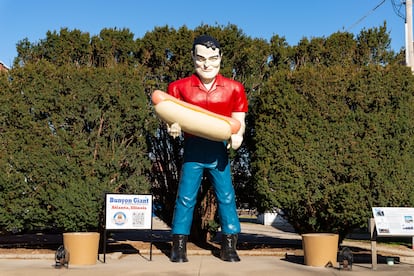
We leave the bustle behind and enter a huge green plain of corn and soybeans, as though immersed in a theme park of nostalgia. Wilmington preserves the Gemini Giant, a fiberglass colossus that is the result of a commercial strategy of which there are numerous examples such as Muffler Man and Uniroyal Gals, both related to the car industry.
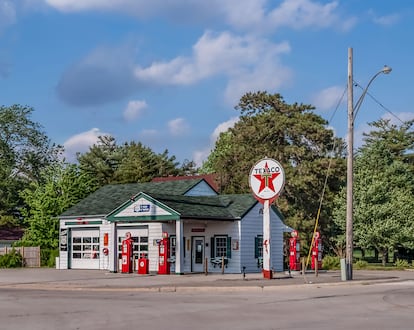
The iconic gas stations, for example in Dwight, such as the Ambler-Becker Texaco, are also still standing. Pontiac’s façades are reproduced, along with the map of the route designed by Bob Waldmire. We realize that murals are the new neon lights. We barely stop until we get to Atlanta, home of the Hot Dog Giant, where Abraham Lincoln sits reading a lawbook in the largest wagon in the world. In Springfield, we had dinner at the Cozy Dog Drive In, where the hot dog has been served breaded and skewered since 1949.
Day 4: Springfield - Carthage (402 miles)
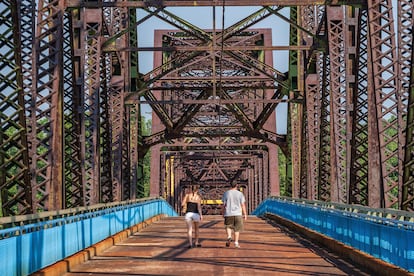
Before leaving the city where Lincoln lived for 17 years before becoming president, we walk through his neighborhood, now a park-museum, and visit his mausoleum. Then, in Auburn, on the way to Carlinville, we wander along an original cobblestone pavement. Knowing that the Chain of Rocks Bridge across the Mississippi was closed to traffic in 1970, we decide to walk it to see its characteristic 22-degree bend.
Back behind the wheel, and already in Missouri, we leave Saint Louis behind, and stop in Cuba, which is awash with murals and exhibits the largest rocking chair in the world. On the way to Carthage we pass through another of the country’s many Springfields.
Day 5: Carthage - Stroud (204 miles)
The medieval style of Carthage’s main administrative building blows us away as we approached the 66 Drive-In. We stop in Joplin, like Bonnie and Clyde, to get a map of the Route 66 Tri-State Corridor – Missouri, Kansas and Oklahoma share this mining region. And crossing a band of yellow cobblestones, we enter Kansas and the world of cars. Everyone here is very grateful to Pixar. The owner of the ‘Cars on the Route’ attraction in Galena invited us for coffee and suggested we say hello to Dean “Crazy Legs” Walker in Baxter Springs, whose legs turn backwards and who inspired the character Tow Mater from Pixar’s Cars. We did it. From now on, we would see hundreds of cars with eyes. And scrapyards.
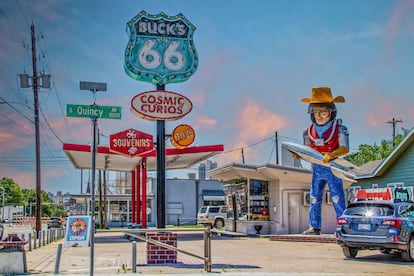
With its undulating landscape, the route through Oklahoma pays homage to the comedian Will Rogers. We visited the Coleman Theater in the town of Miami, a relic of past grandeur; we drove through Vinita, home of Cyrus Avery the man responsible for the building of Route 66, and looked out over the open underpass in Chelsea when traffic makes it difficult to walk.
In Foyil we learned about the young Cherokee Andy Payne, winner in 1928 of the Intercontinental Race – Los Angeles-Chicago-New York – designed to promote the route; and in Catoosa we spotted the Blue Whale, the incredibly famous landmark on the route that Hugh Davis made in 1972 for his wife. We entered Tulsa, whose art deco buildings testify to the fact that it was once the oil capital of the world. This is where to find the Woody Guthrie Center, author of the song Will Rogers Highway, an alternative name for Route 66. As there was no nightlife, we left for Stroud.
Day 6: Stroud - Oklahoma City (113 miles)
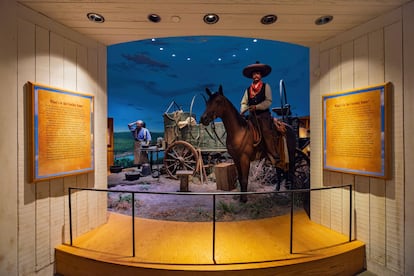
A few sunny-side-up eggs at the Rock Cafe and we head to Oklahoma City. The National Cowboy & Western Heritage Museum takes us on a movie-like tour of the conquest of the Far West, and tries to do justice to the Native Americans while recreating a rodeo. It is the complete opposite of the memorial erected in memory of the 168 victims attacked in 1995 by white supremacists. For dinner, we opted for the onion burger at Sid’s Diner in El Reno.
Day 7: Oklahoma City - Tucumcari (388 miles)
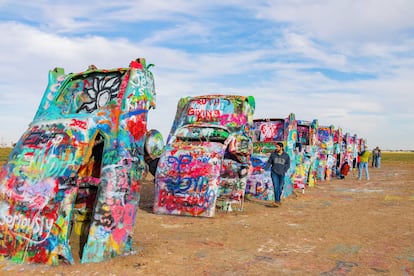
By dusk, we aim to get to Tucumcari, reputed for its neon lights. On the way, we stop at the wonderful Clinton Trail Museum and wander through a typical recreated village in Elk City, then have coffee at the art deco gas station in Shamrock. We enjoy a steak at The Big Texan Steak Ranch while watching two twenty-somethings wrestle with the 72-ounce beef challenge. Still in Amarillo, we sketch the 2nd Amendment Giant (pro-gun) and graffiti one of the 10 cars planted at the Cadillac Ranch. Tight for time, we get to Adrian, the official midpoint of Route 66, just as the Midpoint Café closes its doors. We get the photo though and head for New Mexico. Tucumcari is not the neon paradise it is cracked up to be, but it preserves remarkable lights plus some thirty murals.
Day 8: Tucumcari - Santa Fe (193 miles)
We cross the bathroom in the Blue Hole in Santa Rosa off our to-do list and, feeling very relaxed, make our way to Santa Fe via Los Pecos. Santa Fe is the oldest state capital in the United States (1610). Its bars, squares and artisans, after passing a stream of deserted towns, make us feel more welcome in New Mexico.
Day 9: Santa Fe
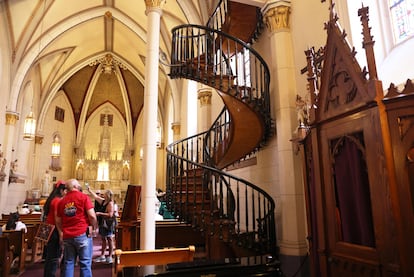
The city’s past is explained in the New Mexico History Museum and is expressed in the Georgia O’Keeffe Museum and the Museum of Art; also in the Palace of the Governors, the Mission of San Miguel, the Shrine of Guadalupe, the Basilica of St. Francis of Assisi and the miraculous staircase of the Chapel of Loreto consisting of 33 steps that rotate 360 degrees, with no central support.
Day 10: Santa Fe - Gallup (258 miles)
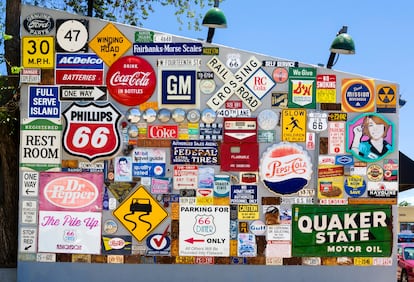
We started the day in Santo Domingo, attracted by its old trading post and a Spanish mission that Native Americans did not allow us to access. We were also unable to travel through sections of Route 66 marked as the Private Property of the Laguna People. In Albuquerque, where the Breaking Bad series was shot, the colonial district is imposing. We eat, of course, at Los Pollos Hermanos which is featured in the Breaking Bad series. Further on, in Grants, the Continental Divide is flagged up; the lakes to its west drain into the Pacific; those to the east, into the Atlantic. By nightfall we are in Gallup. There, the motel receptionist, a woman from India, checks us in virtually.
Day 11: Gallup - Holbrook (127 miles)
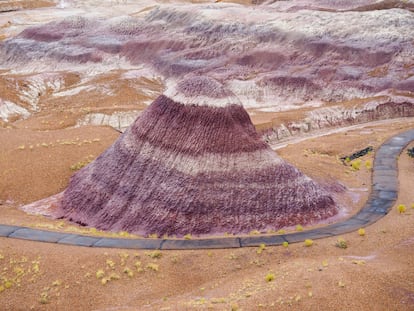
We get up early to cross into Arizona and admire the Painted Desert, the prelude to the Petrified Forest, the largest concentration of petrified wood in the world and a spectacular ecosystem more than 200 million years old.
Day 12: Holbrook - Williams (130 miles)
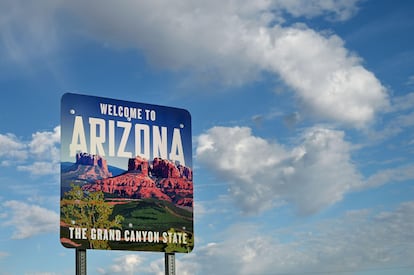
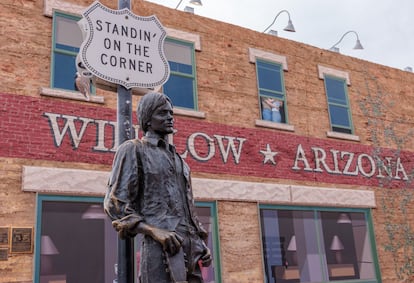
There are dozens of potential pit stops en route, each one boasting just one feature. In Joseph City, we see the Jack Rabbit Trading Post with its rabbit silhouette logo a thousand times, prompting us to keep singing “Well, I’m a-standin’ on a corner in Winslow, Arizona”, from Take It Easy, by the Eagles. A statue of Jackson Browne, sculpted by Ron Adamson, does just that. In another flashback, at La Posada (The Resting Place) you can almost see the famous 1930s Harvey Girls – waitresses who worked at the the crown jewel of the Fred Harvey series of luxury railroad hotels. The freight convoys, some with as many as 100 wagons, are another roadside attraction.
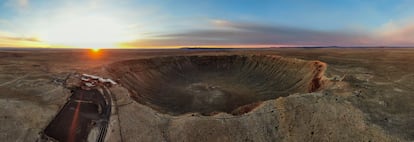
And who can resist catching a glimpse of the 173-meter-deep Meteor Crater, from a meteorite that crashed into the Earth 50,000 years ago? Or the first Muffler Man, a six-meter lumberjack housed on the campus of the coquettish Flagstaff? We sleep in Williams, the gateway to the Grand Canyon, the last city on Route 66.
Day 13: Williams - Needles (193 miles)
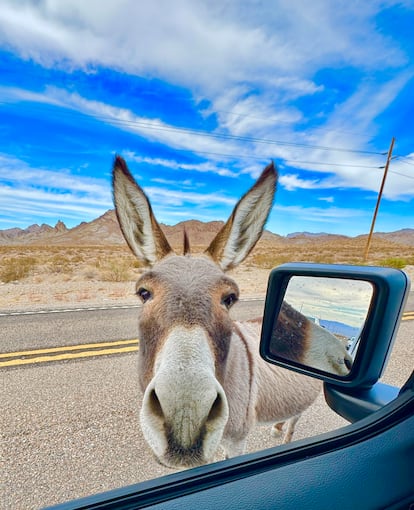
The Delgadillo brothers began their crusade to recover Route 66 in Seligman. Angel Delgadillo became known as the guardian angel of Route 66 and is the main founder of the Historic Route 66 Association of Arizona. While unable to save the entirety of Route 66, they did manage to save their businesses – Ángel’s barbershop and Juan’s bar are obligatory stops. Around the old mining town of Oatman roam the Oatman donkeys, descendants of the beasts of burden from the gold rush era. From there, we head to Needles and California.
Day 14: Needles - Pasadena (257 miles)
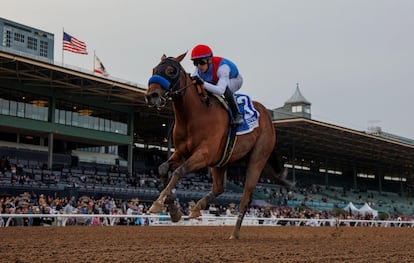
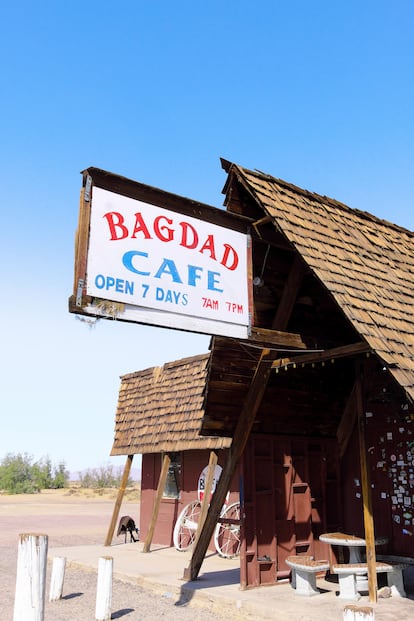
Interstate 40, which covers Interstate 66, is so featureless we are close to dozing off when, in Newberry Springs, we happen to stop at the Bagdad Cafe, a decadent mecca for cinephile tourists staffed by three elderly people. Shortly before San Bernardino – the birthplace of McDonald’s – the landscape begins to turn green and, in Rialto, we enter the urban dreamscape of California. We spend the night in Pasadena and catch a glimpse of the nearby Santa Anita Park racetrack.
Day 15: Pasadena - Santa Monica (87 miles)
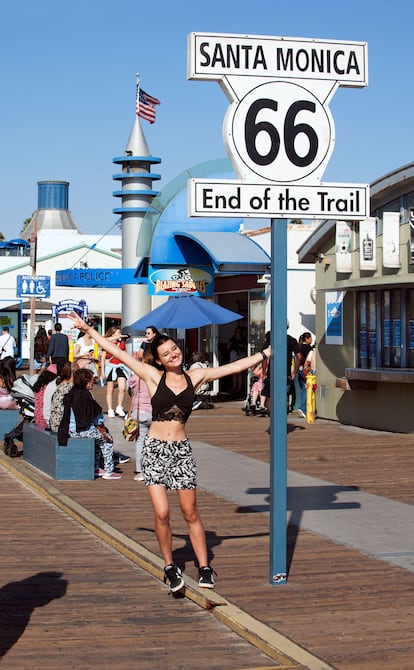
Early morning, we head for Hollywood, to the Warner Bros. Studios; and then, to the Griffith Observatory for a view of the most photographed sign on the planet. We stroll along the Walk of Fame and tour downtown and the unmistakable Frank Gehry’s Walt Disney Concert Hall before, surrounded by driverless taxis, we reach the Santa Monica pier, the end point of Route 66.
Tu suscripción se está usando en otro dispositivo
¿Quieres añadir otro usuario a tu suscripción?
Si continúas leyendo en este dispositivo, no se podrá leer en el otro.
FlechaTu suscripción se está usando en otro dispositivo y solo puedes acceder a EL PAÍS desde un dispositivo a la vez.
Si quieres compartir tu cuenta, cambia tu suscripción a la modalidad Premium, así podrás añadir otro usuario. Cada uno accederá con su propia cuenta de email, lo que os permitirá personalizar vuestra experiencia en EL PAÍS.
¿Tienes una suscripción de empresa? Accede aquí para contratar más cuentas.
En el caso de no saber quién está usando tu cuenta, te recomendamos cambiar tu contraseña aquí.
Si decides continuar compartiendo tu cuenta, este mensaje se mostrará en tu dispositivo y en el de la otra persona que está usando tu cuenta de forma indefinida, afectando a tu experiencia de lectura. Puedes consultar aquí los términos y condiciones de la suscripción digital.