Maduro’s removal from power reignites the battle for TPS among Venezuelans
Democratic lawmakers, community leaders, and activists warn that conditions in the country have become ‘even more dangerous’ in advocating for an extension of immigration protections
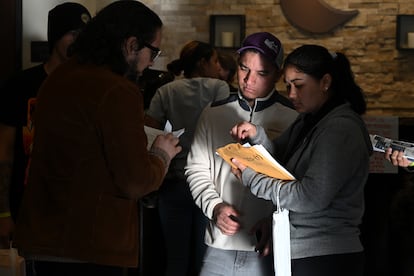

The capture of Nicolás Maduro in Venezuela has reignited pressure in Washington to reinstate Temporary Protected Status (TPS) for Venezuelans in the United States. Democratic lawmakers, community leaders, and activists warn that conditions in the country have become “even more dangerous,” that power remains in the hands of actors accused of abuses and human rights violations, and that repression against dissents has intensified following the U.S. Military action, while the Trump administration explores ways to negotiate control of the South American country’s oil production.
A group of 70 Democratic lawmakers highlighted the underlying tension in a letter to the Trump administration just over a week ago, noting that Washington has begun negotiations with the interim government of Delcy Rodríguez and indicating the need to maintain humanitarian protections for hundreds of thousands of Venezuelans in the country. They argue that Washington’s removal of Maduro and its redefinition of its relationship with Caracas is no guarantee of greater security for those who would be forced to return.
“Conditions in the country are deeply unstable and dangerous, and the still-intact Venezuelan regime, emboldened by support from the President of the United States, has doubled down on repression and brutality since taking power. The Trump Administration’s calamitous decision to terminate TPS for Venezuelans in January 2025 was rooted in a determination that conditions in the country had improved. This claim was baseless at the time, and, with the regime left in place, it is certainly untrue now,” the letter stated. No Republican lawmakers signed the document.
Leading the initiative is Florida Democratic Congresswoman Debbie Wasserman Schultz, who explained to EL PAÍS that many of her constituents have told her that repression has increased. “Their relatives in Venezuela are being forced to stay in their homes and have to erase the contents of their cell phones, because interim president Delcy Rodríguez ordered security forces to search and arrest anyone who supports Maduro’s removal.”
“Until security and stability are truly restored in Venezuela under democratic leadership, the United States should protect law-abiding Venezuelans. Instead, the Trump administration tells Americans it is unsafe to be in Venezuela, yet sends Venezuelans back to the same brutal dictatorship that forced them to flee,” she added.
“The capture of Maduro did not mean the end of the dictatorship. The repressive apparatus remains intact,” states Helen Villalonga, president of the human rights organization AMAVEX. Villalonga explains that after Maduro’s capture, the Venezuelan National Assembly issued decrees granting “broad powers to the Armed Forces and state security agencies to persecute, detain, and punish those who celebrated or supported the U.S. Military incursion.”
Furthermore, Villalonga points out that the Chavista government criminalizes deported Venezuelans simply because of the political perception that they are opposition members or because they were considered “collaborators” or “sympathizers” of the operation that put Maduro behind bars. Meanwhile, “central figures of power implicated in serious human rights violations continue to exert control over the state and its repressive forces. This confirms that there is no democratic transition and no minimum security guarantees for those who return.”
The efforts of Democratic lawmakers are not new. In May, for example, more than a hundred joined a legal challenge to overturn the decision to end Temporary Protected Status for Venezuelans. But now they have seized upon the new situation to push the battle over migrants to the center of the geopolitical debate.
Republicans in Florida, home to the largest Venezuelan diaspora in the United States, have for years championed TPS and Deferred Enforced Departure (DED) — a temporary measure that protects against deportation — as part of a hardline agenda against Chavismo. Among some, a consensus persists. Republican Congresswoman María Elvira Salazar of Miami told EL PAÍS that “Venezuela is still not a safe country,” and that “although the administration is working toward a democratic transition, the regime’s tentacles remain in power. As long as Delcy Rodríguez, Diosdado Cabello, and the corrupt elite continue to control the country, no Venezuelan should be forced to return.” “The State Department itself maintains Venezuela on its highest travel advisory. TPS for Venezuelans is not a political concession; it is a humanitarian necessity,” she added.
In May, Salazar and Wasserman Schultz proposed a bipartisan bill to grant TPS to Venezuelans for 18 months, but it was rejected. TPS is a humanitarian program that allows people from countries affected by conflict, crisis, or natural disasters to live and work legally in the United States. The Biden administration first granted TPS to Venezuelans in 2021 and extended it in 2023.
Last year, the Trump administration, through DHS Secretary Kristi Noem, ended TPS for Venezuelans, as well as numerous other countries, concluding that conditions in Venezuela no longer justified the measure and that maintaining it undermined national security efforts. The 2021 designation expired last November, and the 2023 designation expired in April. An estimated 600,000 Venezuelans who were under this protection were left in limbo. Many reside in South Florida.
Sign up for our weekly newsletter to get more English-language news coverage from EL PAÍS USA Edition
Tu suscripción se está usando en otro dispositivo
¿Quieres añadir otro usuario a tu suscripción?
Si continúas leyendo en este dispositivo, no se podrá leer en el otro.
FlechaTu suscripción se está usando en otro dispositivo y solo puedes acceder a EL PAÍS desde un dispositivo a la vez.
Si quieres compartir tu cuenta, cambia tu suscripción a la modalidad Premium, así podrás añadir otro usuario. Cada uno accederá con su propia cuenta de email, lo que os permitirá personalizar vuestra experiencia en EL PAÍS.
¿Tienes una suscripción de empresa? Accede aquí para contratar más cuentas.
En el caso de no saber quién está usando tu cuenta, te recomendamos cambiar tu contraseña aquí.
Si decides continuar compartiendo tu cuenta, este mensaje se mostrará en tu dispositivo y en el de la otra persona que está usando tu cuenta de forma indefinida, afectando a tu experiencia de lectura. Puedes consultar aquí los términos y condiciones de la suscripción digital.