The Trump administration wants to denaturalize a former North Miami mayor accused of lying about his identity
According to the Department of Justice, Philippe Bien-Aime, of Haitian origin, entered the country with a false passport and committed bigamy to obtain papers before being elected to lead the city in Florida
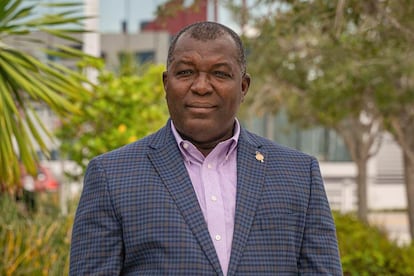

U.S. Authorities are seeking to strip the citizenship of a former South Florida mayor accused of entering the country with a false passport, lying about his identity for 30 years, and committing bigamy to obtain legal status. The Justice Department filed a lawsuit last week in a Miami federal court to denaturalize Philippe Bien-Aime, a Haitian national, who served as mayor of North Miami from 2019 until he ran for a County Commission seat in 2022.
The high-profile case comes amid a Trump administration offensive to revoke the citizenship of people who allegedly obtained it illegally or committed fraud in the process. A Justice Department memo from last year directs the department’s Civil Division to “prioritize and maximally pursue denaturalization proceedings in all cases permitted by law and supported by evidence,” marking a more aggressive approach to denaturalization enforcement. The memo notes that priority should be given to certain categories, ranging from individuals linked to terrorism, espionage, and war crimes to those who made false statements or simply when the case is determined to be “sufficiently important to pursue.”
The American Immigration Lawyers Association (AILA) has warned that this policy represents a significant shift in the use of denaturalization, which historically has been applied very rarely. From the 1990s until 2017, the average number of cases was 11 per year; a figure that increased considerably during the first Trump administration. According to the organization, the priorities of the new strategy are broad and vague, increasing the risk that people who have not committed any illegal acts will be stripped of their citizenship.
In Bien-Aime’s case, according to prosecutors, he arrived in the U.S. 30 years ago with a fraduluent “photo-switched” passport under the name Jean Philippe Janvier. The then-Immigration and Naturalization Service initiated deportation proceedings against him, requiring him to appear at several hearings between 1997 and 2000. There, he confessed to using a false passport, presented a birth certificate identifying himself as Jean Philippe Janvier, born in Port-au-Prince in 1965, and stated that he was married to Sarahjane Ternier, with whom he had lived in Fort Lauderdale, north of Miami, since 1994, according to court documents. A judge ordered their deportation in 2000, which they appealed. However, the following year, the defendant withdrew his appeal and claimed he had returned to Haiti.
However, the Justice Department indictment states that the man never left, but instead began calling himself Philippe Bien-Aime and in 2001 married U.S. Citizen Marie Rose Chauvet to obtain residency. Meanwhile, the government alleges, he was still married in Haiti to another woman, Beatrice Gelin. Bien-Aime, however claimed he had divorced her, and was in a relationship with Ternier, with whom he had two children, when he married Chauvet. He had a third child with Chauvet the following year.
Prosecutors allege that Bien-Aime lied and concealed key information during the residency application process. Among other things, he claimed to have only one child, born in 1988 in Port-au-Prince, and failed to disclose his deportation order or that he had previously used a different name. He also claimed to have divorced a previous wife in Haiti and submitted a falsified divorce certificate. He obtained residency in 2002 and applied for citizenship in 2005.
The Justice Department states that Bien-Aime also deliberately lied during that process, both on the forms and under oath in interviews with immigration officials, and continued those lies during the green card process. Nevertheless, in 2006, he was sworn in as a U.S. Citizen and illegally obtained a naturalization certificate, the government states.
The matter took a turn in 2019, when a fingerprint specialist with the Department of Homeland Security realized that the fingerprints taken from Jean Philippe Janvier in Miami in 1997 and those on Bien-Aime’s residency and citizenship applications belonged to the same person, according to the court document.
That same year, Bien-Aime was elected mayor of North Miami, a city of about 60,000 inhabitants northeast of Miami and one of the main Haitian enclaves in the country. In 2021 he was re-elected, but he resigned from office in 2022 to run for the Miami-Dade County Commission, a position he did not win. He had been a member of the North Miami City Council since 2013.
The Justice Department asked the court to revoke his citizenship, cancel his naturalization certificate, and require him to surrender his passport and all documents identifying him as a U.S. Citizen. Bien-Aime’s attorney, Peterson St. Philippe, did not respond to a request for comment for this report. In an email to the Miami Herald, St. Philippe said it was appropriate to address the allegations through legal channels, rather than through public comment.
Citizenship is considered the most important benefit of the immigration system, as it grants the right to vote and entails responsibilities such as jury service and defending the nation. To obtain it, people generally must have been permanent residents for at least five years, or three years if married to a citizen — as in Bien-Aime’s case. Requirements include civics and history exams, and English proficiency. However, the process has become increasingly complex under the Trump administration, which has implemented stricter rules, more rigorous exams, and suspended all immigration processes for citizens of a growing list of countries.
Sign up for our weekly newsletter to get more English-language news coverage from EL PAÍS USA Edition
Tu suscripción se está usando en otro dispositivo
¿Quieres añadir otro usuario a tu suscripción?
Si continúas leyendo en este dispositivo, no se podrá leer en el otro.
FlechaTu suscripción se está usando en otro dispositivo y solo puedes acceder a EL PAÍS desde un dispositivo a la vez.
Si quieres compartir tu cuenta, cambia tu suscripción a la modalidad Premium, así podrás añadir otro usuario. Cada uno accederá con su propia cuenta de email, lo que os permitirá personalizar vuestra experiencia en EL PAÍS.
¿Tienes una suscripción de empresa? Accede aquí para contratar más cuentas.
En el caso de no saber quién está usando tu cuenta, te recomendamos cambiar tu contraseña aquí.
Si decides continuar compartiendo tu cuenta, este mensaje se mostrará en tu dispositivo y en el de la otra persona que está usando tu cuenta de forma indefinida, afectando a tu experiencia de lectura. Puedes consultar aquí los términos y condiciones de la suscripción digital.