Legal and bureaucratic obstacles complicate family reunification for migrants deported by Trump
Some 400 Hondurans expelled by the US are denouncing that authorities did not allow them to take their children with them and are asking their government for help in getting them back
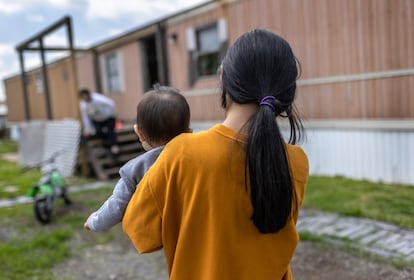

Parents deported to Honduras face legal, administrative, and financial barriers that make reunification with their children nearly impossible. As in other receiving countries in the region, Hondurans expelled from the United States risk long-term or irreversible separations. Deportees spend days unable to contact their families, and due to the limited information, support, and follow-up provided by U.S. Authorities, reunification is extremely difficult to achieve, as shown in a report by the Women Refugee Commission (WRC) and Physicians for Human Rights (PHR).
Family reunification involves numerous state, federal, and sometimes international agencies. For example, a U.S. Citizen minor might need a U.S. Passport to board an international flight, in addition to a visa or passport from the destination country to enter it. In the past, Immigration and Customs Enforcement (ICE) provided information to other state and federal authorities and consulates to facilitate the reunification of children with their parents, but civil society organizations report that this practice is no longer being carried out.
Parents also face legal barriers. In Honduras, the law requires both parents to sign the reunification petition. If the other parent is detained, missing, deported to another country, or if the parents are not in contact (even due to violence or abuse), reunification may be practically impossible.
On the other hand, the cuts to development aid implemented by the United States government have reduced the resources available to recipient countries to carry out any programs that would help with family reunification. According to the report, 400 parents have requested assistance from the Honduran government to recover their children.
The complaint filed by WRC and PHR from Honduras contradicts the Trump administration, which has repeatedly asserted that — unlike in its first term — it is not separating families through deportations. This practice also runs counter to the Department of Homeland Security’s own directives to offer detained migrants the option of deporting their children with them or keeping them in the United States.
To prepare the report, members of both organizations traveled last November to Migrant Returnee Assistance Centers in Honduras, where they interviewed dozens of migrants deported by the United States and staff. During their visit to La Lima, the main reception center, 854 deportees arrived.
“What we documented in Honduras provides concrete evidence that suggests ICE is not adhering to its own policies to keep families together,” says Zain Lakhani, director of migrant rights and justice at the WRC. “The human cost of this is devastating and confirms what the WRC has been documenting since the beginning of this administration: children crying for their mothers, young children abandoned without warning, parents deported without being given the opportunity to decide what will happen to their children, and pregnant women denied basic and even life-saving medical care.”
The Honduran government does not have a formal plan to reunite families, but in February 2025 it adopted a National Emergency Strategy, anticipating the mass deportation of its citizens. Through the “Brother, Sister, Come Home” program, it provides deportees with short-term services and essential resources. Contrary to expectations, deportations to Honduras were lower in 2025 than the previous year, with approximately 38,000 people (85% men and 15% women) compared to 45,923 in 2024. However, medical workers, lawyers, and other professionals interviewed by WRC and PHR revealed how they have been affected by the Trump administration’s hardline policies.
ICE agents are required to ask people at the time of their arrest if they have minor children and to give parents the opportunity to decide what will happen to their children if they are deported. The majority of parents interviewed by the organizations stated that neither of these things happened.
Those who have experienced involuntary separation suffer physical and psychological consequences. “As a physician, I traveled to Honduras and interviewed newly deported mothers within days of their arrival. What I heard was horrifying. PHR has documented the severe and lasting damage that family separation inflicts on both parents and children, including post-traumatic stress disorder that persists for years after reunification,” said Michele Heisler, medical director of PHR and professor of internal medicine and public health at the University of Michigan.
Among the reported cases, a mother recounted being detained outside a hospital after a medical appointment. She had three children with her and three more at home; she repeatedly warned the officers who detained her about the other three children, but they ignored her. The family is now separated, and their reunification is very difficult.
“They didn’t ask me anything. They didn’t talk to me, they just yelled at me, they humiliated me. They never said, ‘You have a daughter, you can bring her,’ because I might have even brought her, she’s very attached to me,” said another 22-year-old mother.
A father, whose wife had already been arrested, was also detained outside his home and begged to be allowed inside to warn his daughter’s nanny. “They kept yelling at me to get on the ground,” he recounted. “I tried to escape, but they threw me to the ground and wouldn’t let me say anything. They beat me brutally.” The officers wouldn’t let him in. His three-year-old daughter was left alone with the nanny, who, worried when he never returned home, stayed with the child for 11 days.
The deportees also denounced the treatment they received during their detention in the United States. “I was detained for three months, not knowing what was going to happen to my daughter. They never asked me if I could bring her with me, and that’s what I wanted most... They didn’t even let me speak. Nobody cared. They say really awful things to you, that as a migrant you have no rights. The treatment there is terrible... But look, nothing compares to the psychological trauma. They killed me psychologically,” said a 35-year-old father separated from his daughter.
Deported without parental authorization
While many families lament the separation, others have not been given the opportunity to leave their children in the United States, where they might have better conditions, and they have instead been deported along with their parents. Some of these children were receiving medical treatment that they cannot access in the countries where they have been sent.
“We see mothers who aren’t offered the option of allowing their children, who are U.S. Citizens, to stay. Last month, we saw a mother with two Honduran children and one U.S. Citizen child. The father had a green card, but the mother wasn’t given the opportunity to allow her U.S. Citizen child to stay with the family. She asked if she could speak with a lawyer or call her husband, and they told her no,” recounted a worker at a deportation center in Honduras. “She broke down in tears because she wasn’t given any opportunity to allow her child to stay with her husband.”
Sign up for our weekly newsletter to get more English-language news coverage from EL PAÍS USA Edition
Tu suscripción se está usando en otro dispositivo
¿Quieres añadir otro usuario a tu suscripción?
Si continúas leyendo en este dispositivo, no se podrá leer en el otro.
FlechaTu suscripción se está usando en otro dispositivo y solo puedes acceder a EL PAÍS desde un dispositivo a la vez.
Si quieres compartir tu cuenta, cambia tu suscripción a la modalidad Premium, así podrás añadir otro usuario. Cada uno accederá con su propia cuenta de email, lo que os permitirá personalizar vuestra experiencia en EL PAÍS.
¿Tienes una suscripción de empresa? Accede aquí para contratar más cuentas.
En el caso de no saber quién está usando tu cuenta, te recomendamos cambiar tu contraseña aquí.
Si decides continuar compartiendo tu cuenta, este mensaje se mostrará en tu dispositivo y en el de la otra persona que está usando tu cuenta de forma indefinida, afectando a tu experiencia de lectura. Puedes consultar aquí los términos y condiciones de la suscripción digital.