Venezuela’s ousted leader Maduro heads back to New York court for key hearing in ‘narco-terrorism’ case
The prosecutor is asking the judge to prevent the defense from accessing evidence that could endanger witnesses and their families
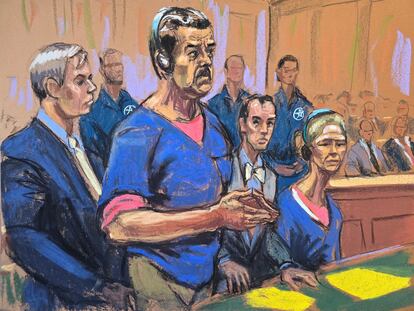

Deposed Venezuelan President Nicolás Maduro and his wife, Cilia Flores, are heading back to federal court in the Southern District of New York on Thursday for a second hearing following their arrest in January, as part of what’s expected to be a long and arduous process. Their lawyers are claiming that the U.S. Government is “illegally blocking” the Venezuelan state funds needed to pay their legal fees, which would deprive the couple of freely choosing their lawyers.
Maduro and Flores, who will appear before veteran federal judge Alvin Hellerstein, 92, are facing charges including narcoterrorism and drug trafficking conspiracy, to which they already pleaded not guilty at their arraignment in January and where Maduro declared himself to be “a prisoner of war.” This second hearing—originally scheduled for March 17—is expected to begin debating pre-trial motions, such as the validity of the evidence on which the U.S. Department of Justice has based its case, as well as to define the lines of argument and defense strategy.
The hearing will be key in determining whether Judge Hellerstein accepts the requests of the defense and the prosecution, or whether the procedural schedule continues to move forward toward a trial that experts predict will not begin for another year or two, when the judge would be 94 years old. According to The New York Times, the judge was seen falling asleep during a hearing last year, raising doubts about his ability to conduct a trial that is expected to be lengthy and technically very complex. One of the major issues will be whether a leader who has been forcibly removed from his country can be tried—that is, whether or not Maduro is protected by international law.
The defense filed a new motion with the court on Thursday, insisting that the narcoterrorism charges be dismissed, and directly challenging the arguments of the U.S. Government. Maduro and Flores claim they lack the financial resources to pay for their private defense, and allege they are being prevented from using Venezuelan state funds because Maduro is no longer recognized as head of state.
The motion, signed by Barry Pollack, Maduro’s legal representative, and Mark Donnelly, Flores’ attorney, argues that the freeze on funds imposed by the U.S. Treasury Department’s Office of Foreign Assets Control, which on February 9 revoked an initial license to release the payment, violates the Sixth Amendment to the U.S. Constitution and “directly interferes with the couple’s right to choose the attorney of their choice.” “The Venezuelan government has an obligation to pay Mr. Maduro’s fees,” Pollack insists.
Furthermore, the case took another turn on Monday when the U.S. Government, through the prosecutor in charge of the case, Jay Clayton, asked Judge Hellerstein for a protective order, or confidentiality order, preventing him from sharing certain pieces of evidence with the defense. Maduro and Flores’ lawyers largely accepted the order except for one key paragraph: point 13, which prohibits sharing the evidence with the other four co-defendants in the case, all fugitives from U.S. Justice. These are Interior Minister Diosdado Cabello, Ramón Rodríguez Chacín, Nicolás Maduro Guerra—the president’s son—and Héctor Guerrero Flores, alias “Niño Guerrero,” the alleged leader of the Tren de Aragua criminal organization.
Four co-defendants released
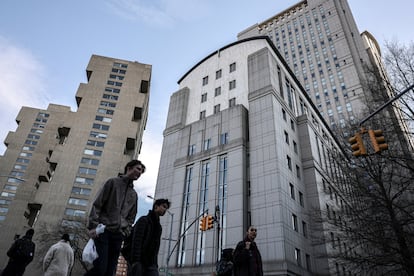
Neither of these individuals has ever set foot in a U.S. Courtroom. Maduro Guerra spoke out this week in Caracas, via a video on the social media platform X, saying that his father “is doing very well,” in “great spirits” and “strong” despite the harsh conditions of confinement at the Brooklyn’s Metropolitan Detention Center where he has been held since early January. “We are going to see a slim, athletic president; he is exercising every day,” the congressman said. Regarding Cilia Flores, he emphasized that she is “steadfast and alert.”
The prosecution’s argument for requesting strict confidentiality regarding evidence in the case is compelling: these four co-defendants, who are free abroad, could identify witnesses and, “through the Venezuelan state apparatus,” arrest, threaten, or harm them. In its letter to Hellerstein, the prosecution cites as a precedent the case of Venezuelan military officers detained in 2006 to cover up a cocaine shipment linked to Maduro and Cabello. The officers were allegedly arrested to divert attention from the case.
If Judge Hellerstein approves the protective order, the New York court would control what information reaches—and what doesn’t—figures who still wield power in Venezuela. But if he rejects it, Maduro and Flores’ lawyers could freely share case documents with Cabello, Rodríguez Chacín, Maduro Guerra, and Guerrero Flores without the court being able to sanction them. The defense intends to appeal the prosecutor’s request by March 30 at the latest, which could cause a further delay. Courts typically issue protective orders as a means of protecting the identity of witnesses.
In his letter to the judge, Clayton, a former chairman of the U.S. Securities and Exchange Commission (SEC), argued that the risk of harm to witnesses and destruction of evidence is particularly pressing in the present case, “not only because the undetained individuals have historically resorted to violence against witnesses and others, but also because they have done so under the protection of state power, and could do so again against witnesses or their relatives (…), who could be unjustifiably arrested and detained without the Government or this court having any recourse” to prevent it.
Each of the co-defendants is subject to a current arrest warrant issued by the court. Cabello Rondón, Rodríguez Chacín, and Maduro Guerra are prominent political figures in Venezuela, with close ties to the Venezuelan military and security forces, and they have hundreds of thousands—or even millions—of online followers, the chief prosecutor told the judge. Cabello has 2.6 million followers on X and more than a million on Instagram, for example. They are also accused of trafficking massive quantities of cocaine into the United States and—in the case of Cabello Rondón and Rodríguez Chacín—in association with foreign terrorist organizations.
The United States began its legal pursuit of Maduro in March 2020, when it accused the Venezuelan president of drug trafficking and offered $15 million for information leading to his capture. “It is time to call this regime what it is,” said Attorney General William Barr at the time—in the final year of Donald Trump’s first presidency—announcing charges that also affected other prominent members of the Venezuelan government, including Diosdado Cabello; Hugo “El Pollo” Carvajal, who was extradited to the U.S. And pleaded guilty last year to the charges against him; the recently dismissed Vladimir Padrino; and Industry Minister Tareck El Aissami.
Sign up for our weekly newsletter to get more English-language news coverage from EL PAÍS USA Edition
Tu suscripción se está usando en otro dispositivo
¿Quieres añadir otro usuario a tu suscripción?
Si continúas leyendo en este dispositivo, no se podrá leer en el otro.
FlechaTu suscripción se está usando en otro dispositivo y solo puedes acceder a EL PAÍS desde un dispositivo a la vez.
Si quieres compartir tu cuenta, cambia tu suscripción a la modalidad Premium, así podrás añadir otro usuario. Cada uno accederá con su propia cuenta de email, lo que os permitirá personalizar vuestra experiencia en EL PAÍS.
¿Tienes una suscripción de empresa? Accede aquí para contratar más cuentas.
En el caso de no saber quién está usando tu cuenta, te recomendamos cambiar tu contraseña aquí.
Si decides continuar compartiendo tu cuenta, este mensaje se mostrará en tu dispositivo y en el de la otra persona que está usando tu cuenta de forma indefinida, afectando a tu experiencia de lectura. Puedes consultar aquí los términos y condiciones de la suscripción digital.