Élmer Mendoza: ‘The situation in Sinaloa is not a reason to feel sad or hopeless’
Mindful of the insecurity in his native country, the Mexican writer presents ‘The Mermaid and the Retiree,’ a political and suspenseful work set in Culiacán that follows a congressional candidate who must confront the many forms of violence around her
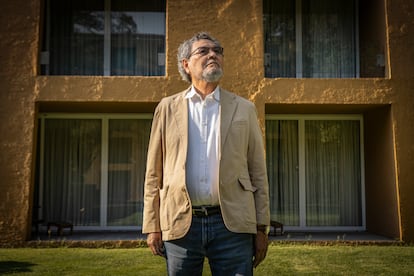

Five years ago, Élmer Mendoza didn’t give Mexican President Claudia Sheinbaum a second thought. “I don’t see her as having the political stature,” he said in an interview with EL PAÍS. “I think the problems have overwhelmed her.” Fast‑forward to today, Mendoza laughs.
Sheinbaum — who at the time was then head of government of Mexico City — experienced difficult times midway through her term, especially due to insecurity. But she survived. Then she won the Morena party’s primary, made it to the general election, and the rest is history. “You know what? I voted for her,” the writer says, amused, “because she’s a woman, a scientist, and because the other candidates... [Laughs], oh, God. She’s a university graduate, from UNAM [the National Autonomous University of Mexico], like me. I said, ‘If anyone can do something, it’s her.’”
That spirit of hope fuels the new book by the Sinaloan author, The Mermaid and the Retiree, which steps away for a moment from Zurdo Mendieta — Mendoza’s tormented and endearing detective — and turns its focus to the political game, with all its violence, intrigues, strongmen, and a heavy dose of machismo that mirrors the national landscape. It’s a different world to compared with Mendieta’s other novels, which center on the cruel world of corruption and local drug trafficking, so prevalent in these months of war between factions of the Sinaloa Cartel. In his new book, Mendoza dissects politics with his signature style: a torrent of regional orality and colloquialisms that catapulted him to literary stardom a quarter of a century ago.
The protagonist of his new book is Carmen Larrañaga, a strong, independent woman from the mountains who has endured different kinds of violence, always at the hands of men. Playing a secondary role is a retired museum security guard whose greatest achievement in life — marriage aside — was outsmarting a governor who, one drunken night, gave a Miró to a friend, a situation the guard discovered and capitalized on. Thanks to the governor’s gift, the “retiree” retires. At least until Carmen Larrañaga bursts into his life.
Question. The protagonist of your new novel is a woman, a politician, an independent candidate, a victim… This is quite a significant change from the characters you have written before.
Answer. The idea was to write about a woman of our time, in her early thirties, above all intelligent, who trusted her intelligence more than her beauty. That was the basis. Where I live, women with those characteristics are mountain women, highlanders. But I also needed her story to be strong, the starting point, so I could take her out of that situation, with the idea of overcoming obstacles, of triumphing, of not conforming to what others expected of her.
Q. The male politicians who appear — Camarena, Vega Fernández, Barragán, the party leader, who incidentally resembles former president Andrés Manuel López Obrador…
A. [Laughs].
Q. Well, there is a subtle, yet forceful, critique of the traditional, and very masculine, form of politics.
A. Politics has been a male domain since [Greek statesman] Pericles. And here in Mexico, it’s the same. Modernity is the breaking of that mold. We now have a female president, and before [Sheinbaum], some countries had successful female presidents... Anyway, my Carmen Larrañaga is in an absolutely male-dominated field. Politics here is very hypocritical, like the constant deception, the practiced smile. But the real issues are difficult for politicians. And I wanted Carmen to be the opposite, transparent, genuine. And running as an independent is the only solution.

Q. Touching on what you mention, that politics is hypocritical, a character, Vega Fernández, says, paraphrasing [Giuseppe Tomasi di] Lampedusa: “Politics is letting things happen, letting things pass, and letting everything change so that nothing changes.”
A. [Laughs], yes. You know what? When my generation read The Leopard (1958), we really took to heart what the count’s nephew says: that everything should change so that nothing changes. I don’t know if politicians, for starters, have even read Lampedusa.
Q. At least it has permeated.
A. That’s right. It’s an important principle in the kind of politics that exists in the world. Someone comes to power and, well, all they want is to hold onto it, they propose changes, but everything stays the same.
Q. I wanted to ask about Culiacán, how is the situation there? The last year and a half has been complicated.
A. It’s been pretty serious… I am a mature man and, as such, I do not have an epic view of the matter.
Q. What do you mean?
A. Well, I don’t see this idea that we have to wage war against them [the cartels], that we have to kill them all, I don’t think in that way. Nor do I think it’s a reason to be sad or hopeless. We culichis [people from Culiacán] have been through many trials; Culiacán is a very old city, very rich, we have 11 rivers, a strong agricultural sector. We suffered the pandemic, which exposed many weaknesses throughout the world. And then, many of our acquaintances got sick and died. They developed cancer, unexpected illnesses. In my family, we were left behind… Then, when this issue of the mini-war [between factions of the Sinaloa Cartel] came up...
Q. Mini!
A. Yes, the war in the Middle East is real. But then this happens, and what do you do? You take cover. And you think, ‘But what’s going on?’ Two gangs are fighting… According to Leonardo Sciascia, when the older [drug lords] leave, the younger heirs are very ruthless, and what they do is fight each other. And that’s what explains the situation, in my opinion, with the population caught in the middle. It started in small towns; they forced people to leave and they went to the cities. But then the cities became violent, first in the outskirts, but then also in the center. They steal vehicles, they kidnap young men and turn them into hitmen… First there’s bewilderment; then comes the question, what can we do? Because we’re peaceful people, we don’t have the means, or the know-how.
Q. Were you aware of the incident that started this wave of violence, the capture of Mayo Zambada, the meeting he attended in Culiacán where he was ambushed? He thought the governor, Rubén Rocha, would be there, that he was going to resolve a dispute with another local political figure, Héctor Cuen, who, incidentally, later turned up dead at a gas station… That whole affair could fill three novels.
A. Well… I’m working on it, so we’ll have to talk about it later, [laughs]. No, that’s interesting. It is.
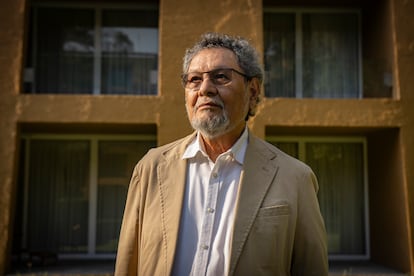
Q. What interests you about all this? Without revealing your work…
A. Well, the mystery lies in the events themselves, because nobody knows the truth. And then there’s the mechanism: why it happened that way, who decided it, why it was all so clumsy, so foolish. It was like they’d read my novels! [Laughs]… There’s something very human about it, because to err is human. I’ve tried to uncover what’s behind it, but it’s not the right time to investigate yet, because when I’ve tried to investigate, they tell me no. Nobody wants to deal with the matter. But the time will come when they will, and I’ll be there. It’s still a secret.
Q. At the rate that factions are being killed or their members arrested, when the time comes to talk, there won’t be anyone left.
A. Even more interesting. Because I can write a ghost story.
Q. From the crime novel to the horror novel…
A. Of course.
Q. You once said that you’ve never denied feeling a certain admiration for murderers and drug traffickers, that you can only create them by idealizing them. While preparing for this interview, a quote from Simone Weil came to mind: “Imaginary evil is romantic and varied; real evil is gloomy, monotonous, barren, boring.” Do you still think the same way?
A. My perception is very different now; it’s not like that anymore. It’s the same as with [Leonardo] Sciascia. The first ones were clever, humane guys, whom circumstances had placed there, in a position to generate relatively easy wealth. Some time ago, I met the leader of a gang… When they started, they stole cotton. He and his friends did it. Big trucks would arrive loaded with it, and they’d steal some off each. Then they’d sell it. I met him in a prison, where I went to read with the people. And I asked him, “But, listen, did you make money from that?” He said yes, and that sometimes they resold it to the same people they’d stolen it from. I asked him how they made the leap, because they moved on to cannabis. And he said, “It’s the same, because we grew up and we had to make more money.”
Q. One plant for another.
A. Yes. Then I asked him if he’d gotten into cocaine; he said no, that that was international relations. And he said, ‘We’re practically a neighborhood gang.’ So, well, I used to like those guys, but they don’t exist anymore. Now they’re murderers, their power is based on murder and abuse. I, at least, don’t like them.
Q. I read in several past interviews that your next big project was a science fiction book, but it’s not coming out…
A. It’s just that I haven’t quite got it yet, but I think I’m getting there. The last version I wrote, which I felt was close, I had to throw away in Lisbon. I got Covid, and while I was there, reflecting, during the 14 days I was in quarantine… I liked the story, but I wasn’t telling it well. I have a concept of what storytelling is, a style, a way of doing things, that I’ve worked on a lot, and I just couldn’t achieve it on that occasion.
Q. Were you looking for that orality so characteristic of your work, or something else?
A. I was looking for rhythm, the variation of rhythms, which is indeed related to orality. The novel told the story, but it was sluggish. I’m sure you’ve read novels that are slow, and they move slowly. I respect them, but I greatly admire the opposite: novels that move you, that unsettle you, that show you that you are nothing, that you have much to learn.
Q. It’s dangerous to read something so good that it might prevent you from writing more.
A. Well, that’s how you grow. Anyway, that’s what it was missing. I’m getting there, the novel is progressing, and I’m proceeding very carefully. And I’ve also changed the time period in which it takes place. Because at the beginning it was set very early on, but now I’ve jumped four centuries forward.
Q. Oh, wow, I thought that if your setting was a dystopian Culiacán, it wouldn’t be long before reality would surpass it.
A. [Laughs], it’s not even Culiacán anymore, the city has a different name… Besides, I believe in this theory that if global warming continues, everything is going to be flooded. And the part of the world that will be left… Well, that’s where I set the novel. And my idea is that there’s going to be a global government.
Q. And I suppose a heavy-handed one, right?
A. That’s the idea!
Sign up for our weekly newsletter to get more English-language news coverage from EL PAÍS USA Edition
Tu suscripción se está usando en otro dispositivo
¿Quieres añadir otro usuario a tu suscripción?
Si continúas leyendo en este dispositivo, no se podrá leer en el otro.
FlechaTu suscripción se está usando en otro dispositivo y solo puedes acceder a EL PAÍS desde un dispositivo a la vez.
Si quieres compartir tu cuenta, cambia tu suscripción a la modalidad Premium, así podrás añadir otro usuario. Cada uno accederá con su propia cuenta de email, lo que os permitirá personalizar vuestra experiencia en EL PAÍS.
¿Tienes una suscripción de empresa? Accede aquí para contratar más cuentas.
En el caso de no saber quién está usando tu cuenta, te recomendamos cambiar tu contraseña aquí.
Si decides continuar compartiendo tu cuenta, este mensaje se mostrará en tu dispositivo y en el de la otra persona que está usando tu cuenta de forma indefinida, afectando a tu experiencia de lectura. Puedes consultar aquí los términos y condiciones de la suscripción digital.