El Mencho operation boosts Claudia Sheinbaum’s approval rating, but insecurity remains the primary concern
The Mexican president’s approval rating has recovered to 71% after slight declines since the summer. Both the downfall of the drug lord and electoral reform have garnered strong support, according to an Enkoll poll for EL PAÍS
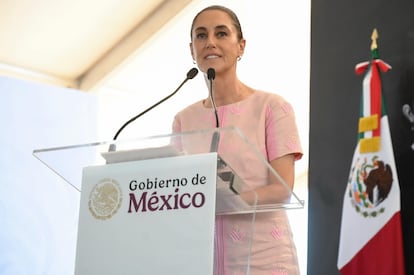

With the start of the year, Claudia Sheinbaum’s approval ratings have recovered. In the final months of 2025, the Mexican president suffered from a new surge in the security crisis, with Michoacán as its epicenter, and the various opposition protests that inflamed the streets. Now that the crisis has subsided, and buoyed by the operation that led to the death of El Mencho, the most wanted criminal on both sides of the U.S.-Mexico border, the president has regained ground, reaching a 75% approval rating at the beginning of March, according to an Enkoll poll conducted for EL PAÍS and W Radio. Despite the improvement in her overall public support, which never fell below a very high average, insecurity and drug trafficking remain Sheinbaum’s biggest challenge and the greatest concern for Mexican citizens.

The president is gaining ground after experiencing slight declines in her approval rating since last summer. The most pronounced drop — four points to 74% — occurred in December, at the height of the security crisis triggered by the assassination of the popular mayor of Uruapan, Carlos Manzo, and the Generation Z protests, along with demonstrations by transport workers and farmers that dominated much of the daily political agenda. Sheinbaum has reversed this trend, which is also reflected in an improvement in her disapproval rating, from 24%, the highest so far in her six-year term, to 20% this March. The two major events of recent months — the military operation against Jalisco New Generation Cartel leader El Mencho and the electoral reform — both enjoy approval ratings above 80%. Specifically regarding the drug lord, 70% say their opinion of the president has improved since the operation.

Among the most highly valued areas, social assistance programs stand out again, with 35% approval, broken down into scholarships and subsidies for senior citizens and women. Social programs are a key pillar of the Sheinbaum administration’s social policy, which this year has increased the budget to over one trillion pesos ($55.9 billion). The area with the highest disapproval ratings continues to be insecurity, at 26%, followed by the economy at 2%. Amid the turmoil of facing pressure from U.S. President Donald Trump, the Mexican economy narrowly avoided recession at the end of last year, thanks to a boost from exports, which grew by 0.7%.
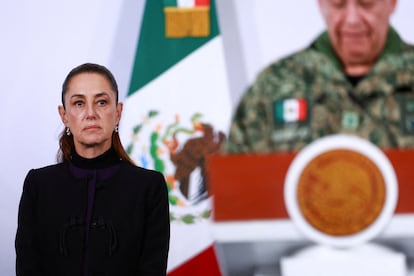
Nearly half of those surveyed say that insecurity is the country’s main problem, although this perception has improved slightly since the last poll, dropping from 51% to 48%, followed by economic problems (16%) and corruption (14%). In another section on insecurity, when asked how concerned they are about the current security situation, considering their daily lives and those of their families, 68% responded that they are very worried. And when asked if the situation will improve in the coming years, only half of Mexicans expressed optimism.
On a more general level, 63% of those surveyed believe that the country’s situation has improved since the president took office. However, when broken down by specific categories, the perception of a decline in healthcare services stands out, rising from 44% to 46%, while those who believe public safety has worsened fell by almost 10 points — the largest drop of the six-year term so far — to 48%. This perception is complemented by the overwhelming majority (76%) who believe that the operation against the leader of the Jalisco New Generation Cartel represents progress in the government’s security strategy, which has been showing improvements in the number of murders, arrests, and drug seizures for months. These moves have been largely synchronized with pressure from Trump.
Next year, coinciding with the midterm elections, a recall referendum for the president is scheduled. Support for Sheinbaum has increased by two points since the last poll, reaching 70%. Regarding the forecasts for the parliamentary elections, the ruling Morena party leads by a wide margin in voting intentions, although it has registered a slight drop compared to the December poll, with an effective preference of 54%, followed by the National Action Party (18%) and Citizens’ Movement (12%). The Institutional Revolutionary Party (PRI) continues to be the bloc with the highest disapproval rating at 51%.

The electoral reform, one of the key reforms of this six-year term, has faced a tortuous path in recent months, culminating this week in the presentation of a first draft. Parliamentary allies of Morena, the Green Party, and the Labor Party have obstructed the project, which, among other changes, reduces party funding. Survey results, however, reveal support for the presidential initiative, showing a general favorable sentiment (over 80%) for measures such as reducing salaries for high-ranking officials at the National Electoral Institute (INE), modifying proportional representation seats in the Chamber of Deputies, prohibiting nepotism, and reducing funding for political parties. The only sections showing less support, which in any case exceeds 60%, are the authorization of electronic voting in referendums and the elimination of the Preliminary Results Program (PREP), the body that publishes preliminary results on election nights.
Even stronger is the support for the military operation that resulted in the death of the El Mencho on February 22. Eighty-one percent consider the operation to have been “very good,” compared to only 10% who express a negative opinion. Nearly half of those surveyed believe that the Sheinbaum administration is confronting organized crime groups “more effectively” than previous governments, and 38% believe that the security situation will improve after the drug lord’s death, while another third think it will remain the same and yet another third believe it will worsen.

The operation against El Mencho involved U.S. Intelligence collaboration and took place at a time of intense pressure, amid constant threats of a possible U.S. Intervention in Mexican territory. Sixty-eight percent of those surveyed agree with cooperation on intelligence and training, while another 60% reject the possibility of U.S. Operations on Mexican soil. These figures have barely changed in the various Enkoll polls conducted during this presidential term. What has changed, however, is confidence in the way the Mexican president is handling the complicated bilateral relationship with Trump. Sheinbaum’s approval rating, which stood at 75% at the beginning of last year, had dropped nine points to 64% at the end of 2025.
Methodology
Sample size:
1,210 effective interviews with men and women aged 18 and over, with a valid voter ID and residing in Mexico.
Date of data collection:
From February 26 to 28, 2026.
Data Collection Methodology:
Face-to-face interviews in homes, conducted using electronic devices and a data collection instrument (questionnaire) appropriate for the purposes of the study.
Sample Selection:
The sample is representative of the Mexican Republic. A probabilistic, multi-stage sample was conducted:
- Stage I. Electoral sections were selected using probability proportional to size (PPS) sampling of the voter registration list.
- Stage II. Blocks were selected in each primary unit in the sample using probability proportional to size (PPS) sampling of the voter registration list.
- Stage III. Dwellings were selected in each block using systematic sampling with a random start. For better population representation, quotas are used by gender and age range.
Accuracy and confidence:
The results have a margin of error of around +/- 2.8% with a 95% confidence level in the main indicators.
Tu suscripción se está usando en otro dispositivo
¿Quieres añadir otro usuario a tu suscripción?
Si continúas leyendo en este dispositivo, no se podrá leer en el otro.
FlechaTu suscripción se está usando en otro dispositivo y solo puedes acceder a EL PAÍS desde un dispositivo a la vez.
Si quieres compartir tu cuenta, cambia tu suscripción a la modalidad Premium, así podrás añadir otro usuario. Cada uno accederá con su propia cuenta de email, lo que os permitirá personalizar vuestra experiencia en EL PAÍS.
¿Tienes una suscripción de empresa? Accede aquí para contratar más cuentas.
En el caso de no saber quién está usando tu cuenta, te recomendamos cambiar tu contraseña aquí.
Si decides continuar compartiendo tu cuenta, este mensaje se mostrará en tu dispositivo y en el de la otra persona que está usando tu cuenta de forma indefinida, afectando a tu experiencia de lectura. Puedes consultar aquí los términos y condiciones de la suscripción digital.