Euphoria for ‘Sinners’ and flowing tequila: the night at the bars of the Dolby theatre
Around the midpoint of the nearly four-hour ceremony, the first-floor bar was packed to capacity with everyone from Emma Stone to Mia Goth and Nick Jonas

Inside the Dolby Theatre, the stands nearly erupted when Michael B. Jordan won the Oscar for Best Actor. The entire theater rose to its feet to celebrate the night’s big win for Sinners, which took home four awards, second only to One Battle After Another with six. The ovation for the actor reflected the conversation echoing through the hallways on the night of the most anticipated film awards of the year. At the bars of the legendary Dolby Theater, the same question was repeated again and again: how many statuettes would Ryan Coogler’s film win?
The collective euphoria surrounding the vampire and blues film set in the American South during the harsh and violent Jim Crow era—laws that enforced racial segregation until the mid-1960s—reached its peak when Jordan took to the stage to accept the first Oscar of his meteoric career. He began his speech with a traditional affirmation of the African American Christian church: “God is good.” “All the time!” Some in the audience responded. In addition to thanking his family and loved ones, as all the other winners did, Jordan took the opportunity to acknowledge the legacy of other Black actors who, like him, had stood on that stage. “I stand here because of the people who came before me, Sydney Poitier, Denzel Washington, Halle Berry, Jamie Fox, Forest Whitaker, Will Smith; to be amongst those giants, amongst those greats, amongst my ancestors, amongts my guides.”
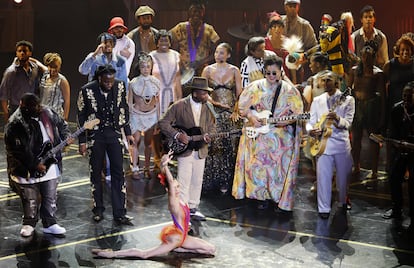
It was the same ancestors Miles Caton evoked when the Dolby Theatre was immersed in the juke joint party from Sinners with the song I Lied to You, one of only two musical performances of the night. Caton and the film’s team recreated the famous scene from the movie while the audience danced and celebrated African American culture and history, this time written by Ryan Coogler, who won the award for original screenplay and also received a standing ovation. “Please sit down, I’m very nervous,” the filmmaker joked upon receiving the award. In his hair, Coogler wore a braided guitar as a tribute to the music that paved his way.
In an otherwise apolitical gala, where neither Donald Trump’s name nor the war against Iran that the U.S. President launched last month alongside Israel was even mentioned, one had to be alert to find the few veiled political references. This was despite host Conan O’Brien’s warning at the beginning of the evening that politics might come up. “If that makes you uncomfortable, there’s an alternative show hosted by Kid Rock,” he added, referring to the show that Trump supporters organized in protest against superstar Bad Bunny’s performance at the Super Bowl halftime show in February.
“These are very chaotic, frightening times. It’s at moments like these that I believe that the Oscars are particularly resonant,” O’Brien remarked in one of his most direct comments of the night. But he stopped far short of mentioning his country’s president or elaborating on the chaos the latter has unleashed in the first 14 months of his second term in office.
What did flow freely throughout the night, as is customary every year, was the tequila at the Dolby Theatre’s bars. Around the midpoint of the nearly four-hour ceremony, the first-floor bar was packed to capacity. From Emma Stone to Mia Goth and even Nick Jonas, everyone stopped by for a drink to tide them over for the rest of the evening.
Seen chatting together at the bar were actor Jacob Elordi and Spanish film director Oliver Laxe, who was there representing the movie Sirât. “I won the award for makeup on Frankenstein. I was Jacob’s double,” Laxe joked about Guillermo del Toro’s film, which had just won the award for makeup and hairstyling (it took home three awards in total). Regarding the rumor that Elordi and the director of Sirât—which didn’t win either of the awards it was nominated for on Sunday night—might be working on a future project together, Laxe just laughed. “No, no,” he told this newspaper.
Among the crowd on the theater’s first floor, the jubilation of the team behind one of the best short film winners (there was a tie) stood out. The team from Two People Exchanging Saliva, a 36-minute dystopian film in French, erupted in cheers and whistles when Natalie Musteata appeared in the lobby with her statuette in hand. “It’s an incredible feeling. It’s like saying, ‘Fuck yeah, it doesn’t have to be one thing or the other!’ And, considering how different the films were, I loved it,” Musteata said of the tie—the seventh in the Oscars’ 98-year history—with The Singers.
On the big night for Paul Thomas Anderson’s One Battle After Another, Sean Penn’s absence was noticeable. He was the only actor not present to collect his award, in his case for Best Supporting Actor. Penn seemed to find it a better—or perhaps more important—plan to travel to Ukraine than to accept his third Oscar and enjoy a few tequilas at the Dolby Theatre bar.
Tu suscripción se está usando en otro dispositivo
¿Quieres añadir otro usuario a tu suscripción?
Si continúas leyendo en este dispositivo, no se podrá leer en el otro.
FlechaTu suscripción se está usando en otro dispositivo y solo puedes acceder a EL PAÍS desde un dispositivo a la vez.
Si quieres compartir tu cuenta, cambia tu suscripción a la modalidad Premium, así podrás añadir otro usuario. Cada uno accederá con su propia cuenta de email, lo que os permitirá personalizar vuestra experiencia en EL PAÍS.
¿Tienes una suscripción de empresa? Accede aquí para contratar más cuentas.
En el caso de no saber quién está usando tu cuenta, te recomendamos cambiar tu contraseña aquí.
Si decides continuar compartiendo tu cuenta, este mensaje se mostrará en tu dispositivo y en el de la otra persona que está usando tu cuenta de forma indefinida, afectando a tu experiencia de lectura. Puedes consultar aquí los términos y condiciones de la suscripción digital.