From ‘public charge’ to key figure in the thaw with Cuba under Obama: the story of Julissa Reynoso comes to the theater
The first play about the life of the Dominican lawyer and US ambassador can be seen at the Public Theatre in New York until April 12
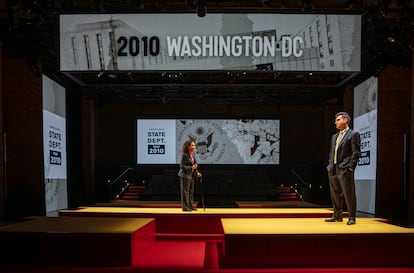

On December 17, 2014, Barack Obama made a public statement announcing the opening of relations with Cuba after 49 years without official contact between the two countries. He also announced the release of the U.S. Citizen Alan Gross, who had been imprisoned for five years on the island for providing clandestine internet services while working as a contractor for the United States Agency for International Development (USAID). Julissa Reynoso, 51, born in the Dominican Republic and raised in the Bronx since the age of seven, played a significant role in this milestone. In 110 minutes without a break, Public Charge brings to the stage the story of this Latina whose influence was decisive in one of the most significant episodes in contemporary American foreign policy.
The play is directed by Doug Hughes (Tony Award winner for Doubt: A Parable) and features a cast that includes notable figures such as Zabryna Guevara (star of the Pulitzer Prize-winning Water by the Spoonful) and Barbara Walsh (known for several Broadway productions). It was written by Reynoso herself in collaboration with playwright Michael J. Chepiga, also a lawyer by training, whom she met 25 years ago while working at a law firm. Reynoso was clear that she wanted to bring her past as a civil servant to life through a play: “I’m surprised by how little the average American knows about the work of diplomats in the U.S.,” she states in the program notes.
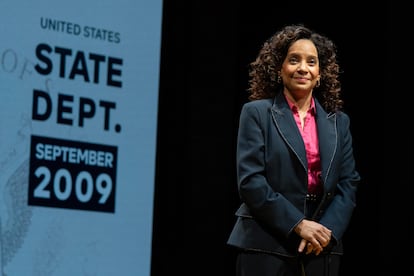
After a brilliant academic career (she graduated in Political Science from Harvard, in Law from Columbia University, and holds a master’s degree in Politics and Development Economics from Cambridge), in 2009, at the age of 34, Reynoso assumed the position of advisor to Hillary Clinton, Obama’s then Secretary of State, for Caribbean and Central American affairs. She not only outlined the opening of diplomatic relations with Cuba, but also took the first steps toward a thaw, personally reaching out to Cuban diplomats during the earthquake crisis in Haiti, along with Cheryl Mills, an advisor to Secretary Clinton.
Public Charge begins with the episode in which Reynoso, as a young girl who doesn’t speak English, arrives in the United States in 1982 to reunite with her mother, who was living in the country with limited resources. It was then that an immigration agent expressed his fear that the little girl could become a burden on the American state. He did so using the legal term "public charge‚" which gives the play its title to emphasize the irony. The story reflects that what happened next was radically different from what that agent feared. Reynoso “helped shape the country’s foreign policy. She didn’t just enter the system: she transformed it,” says Saheem Ali, associate artistic director of the Public Theater. “This story is a reminder that the American project has always been complex (imperfect, contradictory) and yet capable of transforming itself from within.”
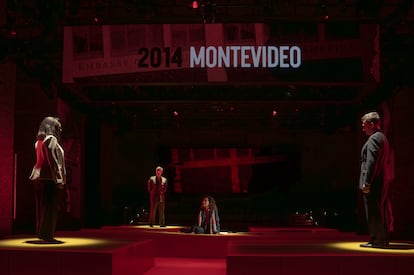
The play focuses its plot on the years between 2009 and 2014, a period marked by the opening of relations between the United States and Cuba. Figures such as former Uruguayan President José (Pepe) Mujica contributed to this process, and Reynoso developed a close relationship with Mujica during her tenure as U.S. Ambassador to Uruguay (2012-2014). Mujica also appears in the play, portrayed by Al Rodrigo. The play culminates with the success of that diplomatic relationship, suggesting that relations between the two countries would improve from then on.
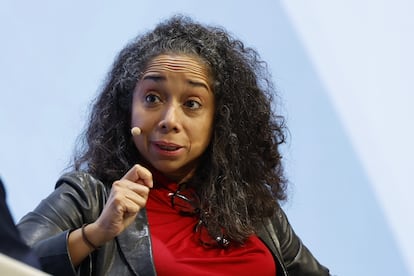
This assertion contrasts sharply with the tense situation between Washington and Havana today, 12 years later, due to the profound economic and energy crisis plaguing the island. The deterioration of Cuba’s electrical system has been compounded by the tightening of sanctions and the blockade of oil imports imposed by the Trump administration, creating an increasingly dire and unsustainable situation for Cubans. It is the underlying optimism evident in the play’s characters (perhaps a veiled irony on the part of the playwrights) that elicits laughter from the audience on several occasions.
Reynoso, who entered diplomacy through political appointment, made history later by becoming the first female ambassador to Spain and Andorra (2021-2024), after working as Chief of Staff to First Lady Jill Biden during Joe Biden’s administration, when Democrats returned to power after Trump’s first presidency.
“For me, the key has been being present. Not abandoning people. I didn’t abandon Hillary when she lost the primaries to Obama; I told her I would stay with her until the end, and when she became Secretary of State, she called me and I joined her team. It was a relationship based on trust,” Reynoso explained in 2025, in a discussion with students at City College of New York. “For me, it’s very important to dedicate time and energy to trying to get the best possible person to represent me, my interests, my family, and my community.”
Reynoso resigned from her post as ambassador to support Biden in his election campaign and, after the Democratic Party’s defeat to Trump in 2024, returned to private practice at the law firm Winston & Strawn, where she currently works.
Even more surprising, however, has been this leap into professional theater, and in such a grand way: Public Charge is playing at the Public Theater, one of the most important theatrical institutions in the U.S. (It also premiered the hit musical Hamilton, for example), within the off-Broadway circuit. It does so with a play—running to April 12—that falls within the realm of political documentary theater and acquires special relevance at a time of information overload, serving as a channel for education and fostering reflection among new generations. It also aims to empower the Latino migrant community amidst the tension caused by the mass arrests and deportations undertaken by Trump in the last year.
Sign up for our weekly newsletter to get more English-language news coverage from EL PAÍS USA Edition
Tu suscripción se está usando en otro dispositivo
¿Quieres añadir otro usuario a tu suscripción?
Si continúas leyendo en este dispositivo, no se podrá leer en el otro.
FlechaTu suscripción se está usando en otro dispositivo y solo puedes acceder a EL PAÍS desde un dispositivo a la vez.
Si quieres compartir tu cuenta, cambia tu suscripción a la modalidad Premium, así podrás añadir otro usuario. Cada uno accederá con su propia cuenta de email, lo que os permitirá personalizar vuestra experiencia en EL PAÍS.
¿Tienes una suscripción de empresa? Accede aquí para contratar más cuentas.
En el caso de no saber quién está usando tu cuenta, te recomendamos cambiar tu contraseña aquí.
Si decides continuar compartiendo tu cuenta, este mensaje se mostrará en tu dispositivo y en el de la otra persona que está usando tu cuenta de forma indefinida, afectando a tu experiencia de lectura. Puedes consultar aquí los términos y condiciones de la suscripción digital.