A living drug manages to eliminate tumors in mice with pancreatic, ovarian and kidney cancer
The experimental drug is an ultrasensitive version of CAR-T therapies, which have already revolutionized the treatment of leukemias and lymphomas
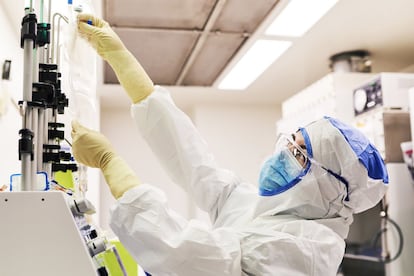

A living drug, called CAR-T cell therapy, has revolutionized the treatment of blood cancers, achieving thousands of complete remissions of leukemias, lymphomas and myelomas since its first experimental use in 2010. The therapy involves extracting immune cells from the patient, genetically modifying them, and then reintroducing them, now with an enhanced capacity to destroy cancer cells. However, this successful treatment has so far failed against solid tumors, which are the most common kind. A new study released Thursday offers hope. An ultrasensitive version of CAR-T cell therapy has successfully eliminated human pancreatic, ovarian and kidney cancer tumors implanted in laboratory mice.
The lead researcher is the French-Canadian immunologist Michel Sadelain, born in Paris 66 years ago. His team demonstrated in 2003 that CAR-T cells, which target the CD19 protein on the surface of cancer cells, eliminated lymphomas in mice. Solid tumors—such as those of the breast, lung, colon, or pancreas—are more heterogeneous and do not display the CD19 protein, which has led to the failure of this strategy over the past two decades.
Sadelain’s group at Columbia University in New York is proposing a new target: the CD70 protein, characteristic of more than 20 types of solid tumors. It’s a well-known target, but until now no experimental treatment had worked because it’s apparently present in only a percentage of the cancer cells within a given tumor. One of the researchers on the Columbia team, Sophie Hanina, had a hunch: perhaps the CD70 protein was indeed present in all tumor cells, but in some of them at such minute levels that it was undetectable by standard CAR-T cell therapies.
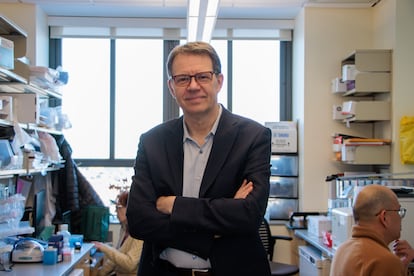
Sadelain’s team, then at Memorial Sloan Kettering Cancer Center in New York, designed an ultrasensitive version of CAR-T cell therapy in 2022, called HIT, capable of detecting cancer cells that had previously gone undetected. The new strategy has achieved the complete eradication of kidney, pancreatic, and ovarian tumors in mice. Their results are published this Thursday in the journal Science.
“You can never predict how effective it will be in humans, but the results achieved in rigorous animal models, which use human T cells [a type of white blood cell] to treat implanted grafts derived from patients, are quite remarkable,” Sadelain explained to EL PAÍS. The scientist needs millions of dollars to make the leap from mice to humans. “We haven’t yet secured funding for several trials targeting CD70 that we hope to undertake,” the scientist acknowledged. “We hope that the publication of this study will spark interest in this strategy,” he added. Michel Sadelain and Sophie Hanina have applied for a patent for this experimental treatment.
The immunologist leads the Initiative in Cell Engineering and Therapy at Columbia University. He is optimistic, but remains grounded, because until now, CAR-T cell therapies have consistently failed in solid tumors, which account for more than 90% of cancers. “There are several reasons for this lower effectiveness: some solid tumors prevent T cells from entering the tumor, other tumors inactivate the T cells already present within the tumor, and finally, T cells may not find the tumor cells because there is insufficient target antigen (CD70 in our case). Our study addresses this third limitation,” explains Sadelain. Two weeks ago, the researcher won the BBVA Foundation Frontiers Award, worth €400,000, along with his American colleague Carl June, for pioneering the revolutionary CAR-T cell therapies.
One of these treatments can cost up to €300,000 per patient. In Spain, there are already five commercially available CAR-T therapies funded by the National Health System, all of them for blood cancers: two marketed by Gilead Sciences and the rest by Novartis, Janssen, and Bristol Myers Squibb. In addition, there are two academic options, developed by the public health system at the Hospital Clínic in Barcelona, for acute lymphoblastic leukemia and multiple myeloma, at around €90,000 per person.
The head of the Immunology Department at the Hospital Clínic, Manel Juan, applauds the new study, in which he did not participate. “It is a highly relevant and impeccably developed proof of concept. It opens up a new therapeutic option to combine with others and seek a better treatment for all these tumors,” the immunologist says. Juan describes the study as “excellent,” although he misses an analysis of the possible adverse effects on healthy cells outside the tumor. “The work is so powerful because the possibilities of using this approach are crystal clear,” he says.
The first patient treated with CAR-T in 2010, Bill Ludwig, was a 65-year-old prison officer who was near death from leukemia. He had already received last rites. At the University of Pennsylvania Hospital in the United States, he received an experimental CAR-T treatment as a last resort. In 2022, after more than a decade cancer-free, immunologist Carl June declared Ludwig “cured.”
Sign up for our weekly newsletter to get more English-language news coverage from EL PAÍS USA Edition
Tu suscripción se está usando en otro dispositivo
¿Quieres añadir otro usuario a tu suscripción?
Si continúas leyendo en este dispositivo, no se podrá leer en el otro.
FlechaTu suscripción se está usando en otro dispositivo y solo puedes acceder a EL PAÍS desde un dispositivo a la vez.
Si quieres compartir tu cuenta, cambia tu suscripción a la modalidad Premium, así podrás añadir otro usuario. Cada uno accederá con su propia cuenta de email, lo que os permitirá personalizar vuestra experiencia en EL PAÍS.
¿Tienes una suscripción de empresa? Accede aquí para contratar más cuentas.
En el caso de no saber quién está usando tu cuenta, te recomendamos cambiar tu contraseña aquí.
Si decides continuar compartiendo tu cuenta, este mensaje se mostrará en tu dispositivo y en el de la otra persona que está usando tu cuenta de forma indefinida, afectando a tu experiencia de lectura. Puedes consultar aquí los términos y condiciones de la suscripción digital.