The use of AI and ‘bots’ behind the wave of digital disinformation about the fall of El Mencho
A report reveals that social media and far-right figures in the United States spread widely replicated false content about the operation that took down the leader of the Jalisco New Generation Cartel
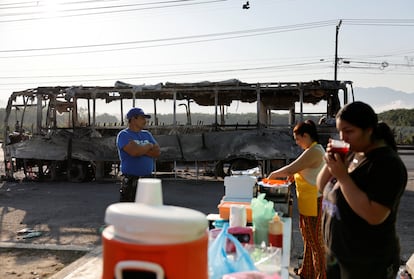

The fall of Nemesio Oseguera, alias “El Mencho,” leader of the Jalisco New Generation Cartel (CJNG), was followed not only by a wave of violence and chaos in the country, but also by a flood of digital disinformation. In the 48 hours following the operation led by the Mexican army in Jalisco, hundreds of false or unverified posts circulated on various platforms. The attacks unleashed by the drug cartels in several states, with a succession of road blockades, vehicles set on fire, and clashes between federal security forces and armed groups, were magnified through content amplified by bots — computer programs designed to automate repetitive tasks over the internet — by the manipulation of artificial intelligence (AI) tools, and by the influence of the American far right.
According to the report “Desinformación tras el abatimiento de “El Mencho”: volumen, velocidad y alcance“ (Disinformation Following the Killing of ‘El Mencho’: Volume, Speed, and Reach), published by the Digital Media Observatory at the Technological Institute of Monterrey (ITESM), numerous audiovisual pieces of content were disseminated on social media without descriptions, verification, or context. Various Instagram accounts shared videos and photographs without specifying their origin. “It was impossible to determine whether these were recent recordings related to violent reactions by organized crime in different parts of the country, or whether they corresponded to archival material strategically reused to amplify the narrative of the wave of violence following El Mencho’s capture,” the document explains.
The images of chaos that flooded social media were reminiscent of the Culiacanazo, another episode of violence during Andrés Manuel López Obrador’s presidency, which followed the arrest of Ovidio Guzmán, one of the sons of Joaquín “El Chapo” Guzmán, and which forced authorities to subsequently release him due to the terror sown by the Sinaloa Cartel in the state capital. The most shocking videos from Sunday came from Puerto Vallarta and Guadalajara, specifically from the airport. Although authorities were quick to state that the terminals were never closed, several national and international airlines decided to cancel flights until passenger safety could be guaranteed.
The report also reveals that other fabricated, manipulated, out-of-context, or even conspiratorial content that stood out amid the tide of disinformation included claims that President Claudia Sheinbaum had been transferred to a Navy vessel in the Pacific; that El Mencho was still alive and hospitalized; an alleged connection to the capture of former Venezuelan president Nicolás Maduro; and even that the Mexican government had killed El Mencho to prevent his extradition to the U.S. And the disclosure of state secrets. According to the report, these last two speculations garnered over 100,000 user interactions on X.
According to the Digital Media Observatory, there is no official count consolidated by authorities or platforms, but based on a digital propagation model and typical behavior in high-impact events in Mexico, they estimate that in the first 48 hours after the operation, between 200 and 500 posts containing false or unverified information were shared. Between 20 and 40 posts achieved high virality, and several of them exceeded 50,000 reactions, 100,000 views, and were shared at least 10,000 times. This generated an estimated three to five million potential exposures to false or unverified content. “This does not equate to five million unique people; there may be duplicates, but it does reflect the volume of circulation,” the report specifies.
In the case of the Guadalajara International Airport, videos showed stampedes of passengers without specifying what was allegedly taking place. The observatory states that it is not yet possible to confirm whether those who fled heard actual explosions inside the terminal. However, various accounts on the social network X, primarily bots spreading ultraconservative content, claimed, without official support, that the airport had been invaded by the Jalisco New Generation Cartel and that tourists — mainly Americans and Canadians — were taken hostage. This did not happen.
Some local media outlets picked up the images without explaining the context or the causes of the panic, leaving the interpretation open and amplifying the uncertainty. Hours later, an image of a burning plane, created with artificial intelligence, began circulating on social media, falsely presented as if it were from the same airport. The far-right U.S. Media outlet Real America’s Voice News widely shared this false content.
Alberto Escorcia, a journalist and researcher specializing in disinformation, went further in his analysis and revealed that 500 bot accounts amplified three profiles that spread disinformation about the violence following the death of El Mencho, and that one of the effects generated was the stampede at Guadalajara Airport.
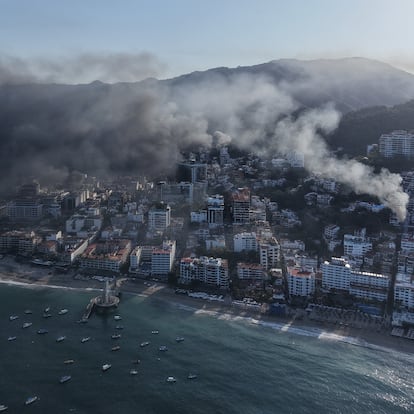
“Likewise, a video circulated on TikTok claiming: ‘Moments of terror in Puerto Vallarta,’ showing an image with multiple fires. However, in the lower right corner of the image, a Gemini watermark [an artificial intelligence chatbot developed by Google] was visible, the main indication that it was generated with AI,” reads an excerpt from the report.
Conspiracies and the US far right
Laura Loomer, a far-right figure with nearly two million followers on X, claimed that the operation in Tapalpa, Jalisco, was led by the U.S. And that the Jalisco New Generation Cartel responded to El Mencho’s death with an armed attack on Guadalajara Airport. “Now they are taking American tourists hostage on highways and in nearby hotels,” she wrote in one of her posts.
Even Bernie Moreno, Republican senator for Ohio, denounced from his account on X the existence of “troubling reports” originating in Puerto Vallarta and other parts of Mexico that “narco-terrorists” were “hunting down American citizens.”
“The drug cartels should be aware that if any American citizen is harmed in Mexico there will be a violent and terminal retribution from the U.S.,” Moreno wrote in a portion of his post. The same message was echoed Tuesday by White House Press Secretary Karoline Leavitt in an interview with the conservative outlet Fox News: “We encourage all Americans in Mexico to of course adhere to the guidance provided by the State Department. Right now, we are unaware of any reports of any Americans being hurt, kidnapped, or killed. And the Mexican drug cartels know not to lay a finger on a single American or they will pay severe consequences under this president [Donald Trump].”
From the official X accounts of the Mexican Embassy in the U.S. And the Mexican Ministry of Foreign Affairs (SRE), efforts were made to quell the numerous rumors circulating in the hours following the death of El Mencho. The SRE announced on Monday that it had received no reports of any foreign nationals being harmed amid the wave of violence that erupted in several states after the operation against the CJNG leader. On the same social media platform, the official U.S. Diplomatic mission in Mexico commended the Mexican Security Forces and praised the bilateral cooperation between the two nations.
“The killing of El Mencho demonstrates the speed with which information, and disinformation, can circulate in contexts of high public sensitivity. [...] Therefore, it is essential that citizens adopt a critical attitude toward the information they consume and share, verifying the source, comparing it with reliable media outlets, and avoiding disseminating content whose veracity has not been confirmed by recognized authorities or journalistic institutions,” the ITESM document states.
Sign up for our weekly newsletter to get more English-language news coverage from EL PAÍS USA Edition
Tu suscripción se está usando en otro dispositivo
¿Quieres añadir otro usuario a tu suscripción?
Si continúas leyendo en este dispositivo, no se podrá leer en el otro.
FlechaTu suscripción se está usando en otro dispositivo y solo puedes acceder a EL PAÍS desde un dispositivo a la vez.
Si quieres compartir tu cuenta, cambia tu suscripción a la modalidad Premium, así podrás añadir otro usuario. Cada uno accederá con su propia cuenta de email, lo que os permitirá personalizar vuestra experiencia en EL PAÍS.
¿Tienes una suscripción de empresa? Accede aquí para contratar más cuentas.
En el caso de no saber quién está usando tu cuenta, te recomendamos cambiar tu contraseña aquí.
Si decides continuar compartiendo tu cuenta, este mensaje se mostrará en tu dispositivo y en el de la otra persona que está usando tu cuenta de forma indefinida, afectando a tu experiencia de lectura. Puedes consultar aquí los términos y condiciones de la suscripción digital.