El Mencho’s death brings to a halt the search for missing persons in Jalisco
Family members are avoiding making statements and public appearances for their safety, while the local Congress is debating an initiative to prohibit missing persons posters in some areas of Guadalajara
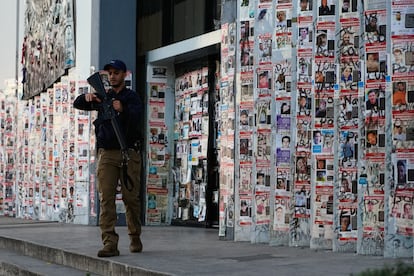

Families of missing persons in Jalisco have decided to halt their searches — as well as their public appearances and statements — amid the wave of violence, uncertainty, and fear that pervades the state following the death of Nemesio Oseguera Cervantes, alias “El Mencho,” the leader of the Jalisco New Generation Cartel (CJNG). But risk is not the only challenge facing these groups. In the local Congress an initiative is being debated that, although initially intended to protect their activities, such as posting missing persons flyers in public places and preventing their removal, now proposes prohibiting them in certain locations. “The authorities know very well how to obstruct the search,” say relatives of missing persons, who requested anonymity.
It’s not that things have been any different before for those who go to the mass graves — whose locations are revealed to them anonymously — without the company of the authorities, armed only with picks and shovels, and who have been victims of kidnappings or direct attacks on their lives. Now, when the local government claims that things are gradually returning to “normal,” a feeling hangs over the state and the entire country that something is about to happen. There is a latent threat. And some groups assert that the State Search Commission is indeed paying attention, but without the support of the National Guard or the Ministry of Defense (Sedena).
“The lack of clear and transparent strategies to continue the search for our missing loved ones causes us profound uncertainty. We find ourselves between a rock and a hard place: aware that we cannot risk our safety or our lives without the protection, safeguarding, and accompaniment of the National Guard. Our searches will not stop because disappearances in the state and the country do not cease. Searching and being searched for is a human right, and the government must protect, guarantee, and respect it,” one of the groups said in a statement.
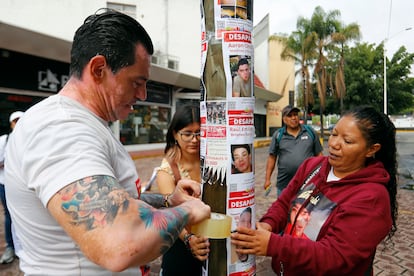
Jonathan Ávila, from the Center for Justice, Peace, and Development (Cepad) in Jalisco, asserts that the situation in the state following the operation against El Mencho is a context familiar to the families. “This fear and uncertainty we have experienced these past few days is just a glimpse of what families face daily when they go about their searches. There have been cases where families themselves, while searching for graves, even here in the Guadalajara metropolitan area, have ended up being victims of threats, surveillance by lookouts, and even caught in the crossfire between organized crime groups trying to intimidate them.”
The State Search Commission assures that it continues to attend to families during regular hours and that cases are being monitored. “Even with the activation of Code Red in the state, the facilities remained open and continued to provide assistance to individuals and groups,” the institution stated in an email. Some groups indicate that searches will be canceled in the coming weeks and even months, in anticipation of the World Cup, with four games to be played at the Akron Stadium in Jalisco.
Official figures for missing persons in Jalisco reach 16,079, according to the State Government Registry. Meanwhile, the National Registry of Missing and Unlocated Persons reports 12,570 victims of forced disappearance in the same state.
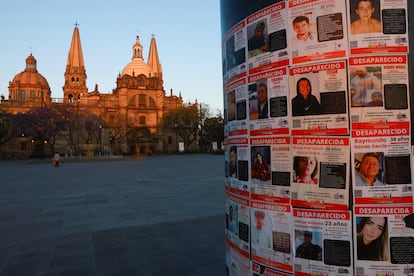
In the local Congress, the initiative originally presented to prevent the removal of missing persons posters placed by families in various public squares in Guadalajara — a very common practice — has undergone a transformation that even the legislators themselves cannot explain. Alejandro Puerto, an independent deputy, stated on the University of Guadalajara’s news channel: “I must admit that the modification to this ruling occurred a couple of weeks ago; we hadn’t noticed the details of the change and how it altered the spirit of the initiative. It was the advocacy groups who made us realize the seriousness of it, because it effectively establishes prohibited and permitted locations, which is something I would never endorse.”
Ávila also can’t explain whether it was a legislative error or a malicious change. The groups have been demonstrating outside Congress to denounce what they perceive as a “whitewashing” of the state capital by the authorities, to keep their records and complaints out of the public eye during the World Cup. “The governor’s rhetoric isn’t helpful because he seems more interested in sending a message to FIFA, in the context of the World Cup, than in reassuring the population. It seems this is more focused on those who will come to invest in and visit Jalisco than on those who live here,” says Ávila.
Cartels and disappearances
Drug trafficking is responsible for the largest number of disappearances in Mexico. The CJNG is one of the main factors contributing to the alarming increase in missing persons in Jalisco, its stronghold, in recent years. Its all-encompassing criminal structure has focused on recruiting young people between the ages of 10 and 19, age groups that have seen a 63% to 72% annual increase in disappearances in the state.
Ávila says that Cepad has documented two fates for missing persons: some were kidnapped and taken to safe houses, where they were beaten, tortured and in some cases released or murdered and buried in clandestine graves — especially in Zapopan or Tlajomulco; the other is forced recruitment, through false job offers on social networks, especially among young people, as the Izaguirre Ranch case demonstrated.
Brothers abducted from their homes in the early hours of the morning, or fathers kidnapped and murdered, buried in graves their daughters continue to search for. “Drug trafficking groups have perpetrated these disappearances, often with the authorization, collusion, or even the negligence of state authorities, which has allowed the violence to become even more widespread. We have documented how these cases don’t involve people simply vanishing out of nowhere, but rather being taken from the street or even from their own homes... And through case follow-up and analysis of convictions, the link between the authorities who aid and abet these disappearances and the criminal structures or agents who carry them out becomes very clear,” says Ávila.
According to various studies by the University of Guadalajara, drug trafficking groups “disappear” people in several ways: when they try to sell a vehicle or find work, and also in car accidents. In April 2025, during a conversation at the Jesuit University of Guadalajara, Rossana Reguillo Cruz, professor emerita, asserted that Mexico was facing a “heartless machine that produces and exterminates bodies in order to reproduce itself.” Reguillo made calculations and stated at the time that the CJNG would need between 30,000 and 50,000 operatives of all kinds, such as mechanics, nurses, cooks, and hitmen, to maintain and continue feeding its structure.
Sign up for our weekly newsletter to get more English-language news coverage from EL PAÍS USA Edition
Tu suscripción se está usando en otro dispositivo
¿Quieres añadir otro usuario a tu suscripción?
Si continúas leyendo en este dispositivo, no se podrá leer en el otro.
FlechaTu suscripción se está usando en otro dispositivo y solo puedes acceder a EL PAÍS desde un dispositivo a la vez.
Si quieres compartir tu cuenta, cambia tu suscripción a la modalidad Premium, así podrás añadir otro usuario. Cada uno accederá con su propia cuenta de email, lo que os permitirá personalizar vuestra experiencia en EL PAÍS.
¿Tienes una suscripción de empresa? Accede aquí para contratar más cuentas.
En el caso de no saber quién está usando tu cuenta, te recomendamos cambiar tu contraseña aquí.
Si decides continuar compartiendo tu cuenta, este mensaje se mostrará en tu dispositivo y en el de la otra persona que está usando tu cuenta de forma indefinida, afectando a tu experiencia de lectura. Puedes consultar aquí los términos y condiciones de la suscripción digital.