Puerto Vallarta, in the aftermath of El Mencho’s death: ‘We got the message; they’re in charge here’
The popular tourist area suffered one of the most ferocious reprisals following the taking down of the Jalisco New Generation Cartel leader
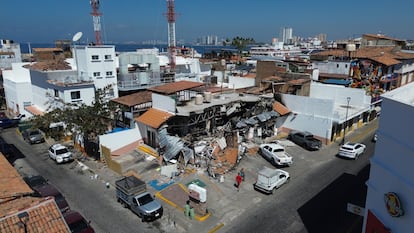

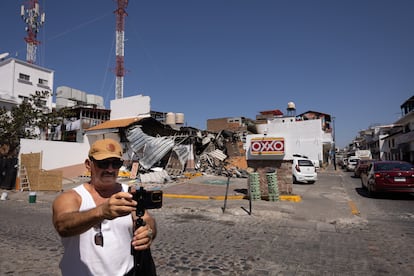
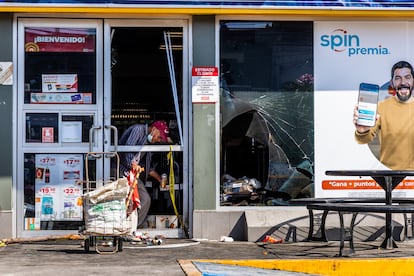
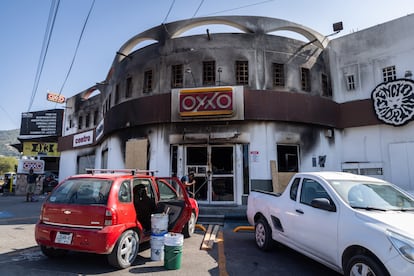
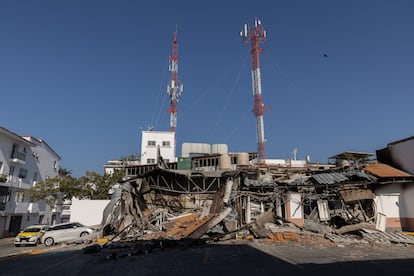
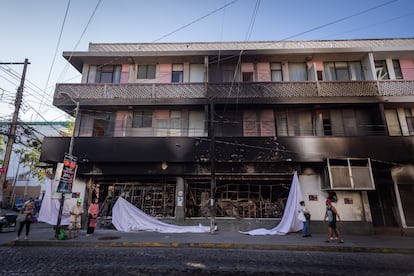
It was a store, and now it’s a twisted wreck of steel, ashes, and scattered sheets of metal. The maintenance workers, already sunburnt, explain that the workload (though not the pay) overwhelmed them as of last Sunday: the structure was weak, the metal warped from the extreme heat, it couldn’t support the weight of the roof, and everything collapsed. The arson attacks carried out by the Jalisco New Generation Cartel (CJNG) against dozens of businesses and vehicles has left Puerto Vallarta, a coastal paradise in Mexico, scarred. The retaliation for the downfall of Nemesio Oseguera Cervantes, “El Mencho,” scared away thousands of tourists, triggered a wave of cancellations, and reignited the fear in everyone who already knew, underneath it all, who controlled the city. Even outsiders understood: “We got the message. It was a show of power. They’re in charge here,” said Karen and Chris, a Canadian couple, after taking some photos in the burned-out ruins that had been an Oxxo convenience store just a week before. They weren’t the only ones taking a selfie, wearing a sun hat and swimsuit, as a souvenir.
They hadn’t even taken El Mencho down in Tapalpa, and smoke was already rising in Puerto Vallarta. At 8 a.m., in the mountains, the Mexican army was still fighting the CJNG leader’s security detail, but at that hour, Lalo, a hotel worker, had already spotted the first plumes of smoke from the boardwalk. At 8:40 a.m., Rosa nervously closed her small restaurant because the sky over the tourist hotspot was turning completely black. Twenty minutes later, Valeria pressed the emergency button at the gas station where she works to shut off the fuel supply before the flames reached her. Then she took off running. And Edgar’s group, who were still playing volleyball on a beach far from the city center, received the call: seek shelter, the cartel is setting the city ablaze.
A chronology
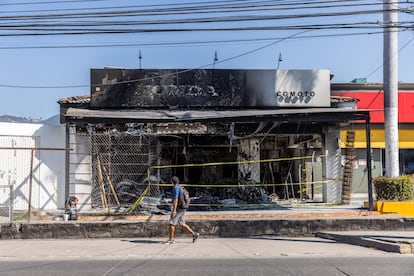
First they burned cars, buses, and trucks — more than 200 in total — blocking avenues and street corners. “On very few occasions did they show any compassion. A colleague, who’s quite elderly, went out to ask them to let him move his car, because it was his only means of survival,” says Andrés, a taxi driver. “They did allow it.” At midday, as El Mencho fell wounded in the Tapalpa forest during the military attack, 400 kilometers (250 miles) away, his troops were already ransacking chain stores, looting shops and stealing motorcycles before burning them. Throughout that Sunday, February 22, the mayor, Luis Ernesto Munguía, didn’t speak publicly, but the governor of Jalisco, Pablo Lemus, activated the so-called red code and ordered the state’s population to take shelter.
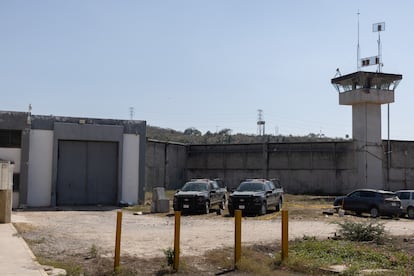
Meanwhile, a riot broke out at the Ixtapa prison, just outside Puerto Vallarta. An armed group arrived, fired shots at the facilities, and, with the help of a truck, rammed through a gate to gain entry. They helped 23 inmates escape, eight of whom had entered the prison together on November 11, 2021, a few days before the government arrested Rosalinda González Valencia, El Mencho’s wife. Among the escaped prisoners were some convicted of forced disappearance and murder, as well as local bosses for the Jalisco New Generation Cartel, such as Cristian Alonso Moreno, known as “El Joker,” who controlled Lagos de Moreno and was behind a massacre. During their escape, the criminals killed Rafael Hernández, a kind and hardworking man from Veracruz, a state police officer with nearly 25 years of service. He was a guard at the prison.
Before nightfall, when it was already known that the CJNG had set up hundreds of roadblocks and launched attacks in 20 states across the country, Daniel, a port operator, decided to return home to his family. He had been surrounded by gunfire all day, but he left his car in the parking lot and started walking. “I walked with my head down, not looking at anyone. I could hear their motorcycles whizzing by. I prayed the whole way.” After an hour, he arrived home and didn’t leave again until Tuesday, just like the 290,000 other residents of Puerto Vallarta. “This locked us down faster than Covid,” summarizes Guillermo, a worker at a small refinery.
Why Puerto Vallarta?
Here, a former governor has been gunned down and El Chapo’s sons have been kidnapped, but even with the visible scars, tourists and locals insist: “Puerto Vallarta is very peaceful.” Foreigners claim it’s safer than some cities in the United States, even Canada, and that they like it for the weather, the beautiful beaches, the friendliness of the people, and because they can walk around at any hour. Andrés, who has just finished his engineering degree but works as a taxi driver, confirms this: “You could walk around here at four or five in the morning without any worries.” All the business owners, vendors, and drivers interviewed by this newspaper say that organized crime doesn’t extort them or demand protection money for working in the city. The simplest explanation is that the CJNG gets enough from Vallarta through its other activities: drug dealing, tourism, and money laundering.
Like Cancún, Mazatlán, and Los Cabos, Vallarta is home to large hotel complexes. It’s a favorite breeding ground for laundering illicit funds. “Organized crime has historically sought ways to incorporate illicitly obtained money into the formal economy because cartels have a business structure,” notes lawyer Luis Pérez de Acha. “And the real estate sector lends itself to this money laundering, especially where there are large, resource-intensive projects, such as tourist areas.” Just three days before the operation against El Mencho, the U.S. Treasury Department had sanctioned 17 companies on this coast (several linked to Carlos Rivera, son of another former governor) for their ties to the CJNG in a real estate fraud. The Office of Foreign Assets Control (OFAC) has long identified Puerto Vallarta as a “strategic stronghold” for money laundering by the Jalisco New Generation Cartel.
But protecting money laundering isn’t the only reason for the organization’s brutal response last Sunday. “Puerto Vallarta is the crown jewel of a maritime territorial control that shouldn’t be overlooked,” points out Rossana Reguillo, an anthropologist from Jalisco. “It’s also a strategically located place, surrounded by mountains, impregnable.” In the mountains that overlook it, “there are training camps, laboratories, and crops,” explains David Coronado, a sociologist specializing in drug cultivation at the University of Guadalajara. “They all depend on Puerto Vallarta.” Both Coronado and journalist Alejandra Guillén have spent years studying disappearances in Jalisco, and both assert that Puerto Vallarta is part of a corridor that begins on the coast, crosses the Valles region and the capital, and reaches the Highlands of Jalisco, Lagos de Moreno, and Encarnación Díaz; it’s a corridor of disappearances, closely linked to forced recruitment.
Erick, Fernando, Luis, Jonathan, Filiberto
The afternoon ends at the Tree of Hope, in the center of Ixtapa’s main square. From its branches hang spheres bearing faces, names, and dates. It’s the tree of Erick Javier Placencia, Iván Jiménez, Leonardo Sandoval, Óscar Noe Medina... They were taken between 2010 and 2025, the 15 years of brutal control the CJNG has imposed on this region. Their stories are a reminder of what it means to live in territories scarred by organized crime.
Fernando Peña was taken on September 2, 2023, along with his motorcycle, as he returned from buying tacos for his wife and one-year-old son. “The boy still calls for him, he asks on his birthday when his dad’s present will arrive,” says Lidia Fregoso — who is searching for Fer in place of everyone who stepped back because it was too dangerous — through tears. Another member of her collective, A Light for Our Disappeared, Marcela Mendoza, has overcome her fear to go out and comb the earth and to appear on camera wearing a pendant bearing the face of her son, Luis Miguel Mendoza. He was a construction worker; the last time he was seen was in Puerto Vallarta in June 2019, after working on a project in the mountains. He left behind six children.
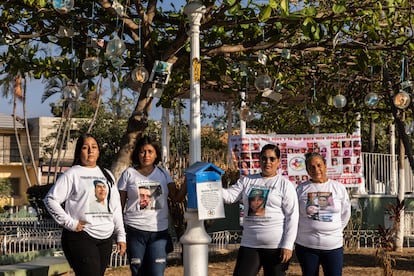
Jonathan Araiza was a bricklayer. He moved from Puerto Vallarta to Ixtapa at 18, and on September 3, 2024, his mother, Liliana Ibarra, received a message: “They took your son. I recommend you don’t file a report, don’t do anything.” But a mother’s courage doesn’t work that way. It was the police who abducted Filiberto Nolasco, then 33, on March 9, 2024. This is confirmed by police reports, after two years of struggle by his wife, Susana Muñoz, who has twice received photos of him kneeling, thin and neglected, holding signs pleading for help: “I’m going to find him.”
The most recent wave of violence didn’t surprise these women, who are all too familiar with the ravages of crime in Vallarta. But it also stirred up new fears: “I didn’t know where to hide anymore. It makes me feel like all the children are in danger right now,” says Marcela Mendoza. Hidden in those few words is what no one yet knows: how the CJNG’s criminal power struggles will unfold after the death of its leader. “We’re afraid Vallarta will become like Mazatlán,” says Guillermo, who is considering moving back to Guadalajara with his family, alluding to the mirror of the fratricidal war in Sinaloa.
The U.S. Government has identified four key figures in Puerto Vallarta: Carlos Andrés Rivera Varela, alias “La Firma”; Julio César Montero Pinzón, known as “El Tarjetas” or “Moreno”; Francisco Javier Gudino Haro, alias “La Gallina”; and Gonzalo Mendoza Gaytán, alias “El Sapo.” The latter two were identified to EL PAÍS by a high-ranking Mexican government security official as high-priority targets due to their positions within the CJNG cartel. Furthermore, El Sapo is the name revealed by the few survivors of forced recruitment camps as the person responsible for forcing kidnapped individuals to kill each other.
“The criminal continuity in Puerto Vallarta shows that it has not been enough to decapitate groups; that has been done since the 1980s. If the protection networks and the networks of impunity are not addressed, nothing will change,” says Carlos Flores, a political science researcher at CIESAS. “Because the criminal actors have changed faces and leaders, but the business and political power that has allowed them [to operate] remains.”
Today
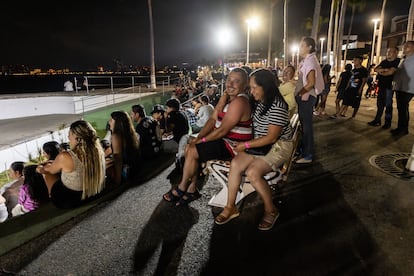
You can tell they’re tourists because they have sand stuck to the soles of their feet, matching shorts and anchor-print t-shirts, big hats, and sunburned skin. They walk along the Puerto Vallarta boardwalk and sunbathe on the lounge chairs. There are fewer of them than there should be this time of year, but they’re still holding out. Some mention the scare, others say that after years of coming to Vallarta, it also hurts to see the city like this. They show real concern for the Mexicans who live here. They also confronted Americans and Canadians who took advantage of the chaos to loot some stores. “I felt ashamed!” Says Karen, who went viral for standing up to the looters. For a city that lives off tourism, they are essential. “Yesterday I worked all day and only made two trips,” says Andrés from his taxi.
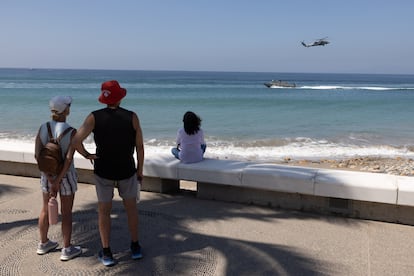
The government is trying to project an image of normalcy: Governor Lemus arrived this week to assure everyone that everything was recovering, and a ship carrying 100 marines also arrived to join the patrol efforts. “Don’t worry, the entire National Guard is here, along with the marines, a lot of police, and helicopters: come on, everything’s normal,” employees insist with a forced smile from the empty tourism booths. Despite the security deployment, 17 of the escaped prisoners are still at large. Outside Vallarta, near El Colorado, five were found and one was killed during a clash with security forces, while the prison director has been dismissed. “Now our season is really over, because if even someone who lives here is scared, imagine how they feel,” says Bernhard Güth, chef of the renowned Trío Restaurant, after three decades in the city: “But Vallarta has overcome so many things, how can it not overcome this?”
Sign up for our weekly newsletter to get more English-language news coverage from EL PAÍS USA Edition
Tu suscripción se está usando en otro dispositivo
¿Quieres añadir otro usuario a tu suscripción?
Si continúas leyendo en este dispositivo, no se podrá leer en el otro.
FlechaTu suscripción se está usando en otro dispositivo y solo puedes acceder a EL PAÍS desde un dispositivo a la vez.
Si quieres compartir tu cuenta, cambia tu suscripción a la modalidad Premium, así podrás añadir otro usuario. Cada uno accederá con su propia cuenta de email, lo que os permitirá personalizar vuestra experiencia en EL PAÍS.
¿Tienes una suscripción de empresa? Accede aquí para contratar más cuentas.
En el caso de no saber quién está usando tu cuenta, te recomendamos cambiar tu contraseña aquí.
Si decides continuar compartiendo tu cuenta, este mensaje se mostrará en tu dispositivo y en el de la otra persona que está usando tu cuenta de forma indefinida, afectando a tu experiencia de lectura. Puedes consultar aquí los términos y condiciones de la suscripción digital.