The Venezuelan opposition moves past the 2024 elections and prepares for the next ones
María Corina Machado has announced she is returning, and the country is once again talking about voting, even though no date has been set
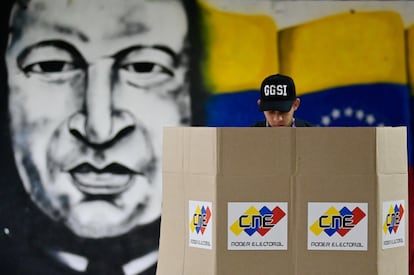
Many things have changed in Venezuela since January 3, when U.S. Elite troops captured Nicolás Maduro. Throughout this time, however, the regime’s most hardline opposition maintained the same slogan: “Venezuelans have already voted.” This was a reference to the presidential elections of July 28, 2024, when Edmundo González, the candidate backed by María Corina Machado, achieved a landslide victory against Maduro.
That victory, far from being celebrated, forced many of opposition politicians into exile and hiding. Today, however, the opposition’s message is beginning to wane. Two months after the U.S. Military intervention that shifted the balance of power in Venezuela and opened an uncertain — though unmistakable — process of political opening, the most hardline sector of the anti‑Chavista movement is preparing for something it had long opposed: competing again in elections with no clear timetable, rules, or electoral authorities.
The clearest sign of that change came on Sunday. María Corina Machado — the leader who orchestrated the political machinery that documented the fraud and defended the results of the July 28 election from hiding — announced that she will return to Venezuela in the coming weeks to prepare for “a new and enormous electoral victory.”
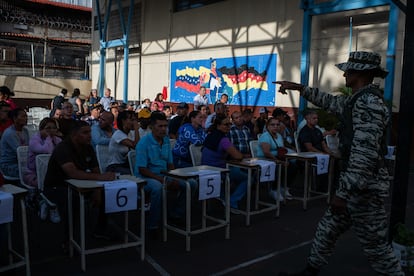
Such a shift would have been unthinkable just a few months ago. For more than a year, the strategy of the opposition led by Machado was to maintain, both within and outside the country, that the 2024 presidential elections had already decided Venezuela’s political future.
According to 83% of the tally sheets collected by election observers, Edmundo González Urrutia obtained 67% of the votes, compared to Maduro’s 30%. Those papers, printed by each voting machine and gathered over the long election night by thousands of volunteers, became the material proof of the fraud. Maduro, currently imprisoned in New York, never relinquished power.
The voter tallies circulated around the world. They were presented to the Organization of American States, supported diplomatic complaints, and ended up stored in bank vaults in Panama. More than 30 countries —including the United States, Argentina, Chile, Costa Rica, and the 27 members of the European Union— recognized González as the president‑elect, even though he was never sworn into office.
For months, while hiding somewhere in Venezuela, Machado made defending those results the cornerstone of the entire opposition strategy. “Venezuelans already voted,” she repeated time and again to justify abstaining from the local and legislative elections that followed. The leader of Vente Venezuela maintained that taking part in those elections was tantamount to accepting the regime’s attempt to sideline what happened on July 28.
But the U.S. Military intervention on January 3 abruptly altered the Venezuelan political landscape. Since then, the country’s political process seems to be advancing according to a roadmap drawn up in Washington. U.S. Secretary of State Marco Rubio spoke of three phases — stabilization, reconstruction, and transition — and announced a few days ago that the first had already been completed. In this framework, new elections appear as the endpoint of the political process, rather than its starting point, as many imagined immediately after Maduro’s fall.
Machado was one of the first opposition leaders to acknowledge that the landscape had shifted. If for months the priority had been to defend the July 28 result, the challenge now is to ensure that any potential political transition does not take place without her and her allies. Her announcement that she will return to the country is part of this new phase, after long months moving between hiding and trips abroad to keep alive the organization that made the 2024 electoral mobilization possible.
In recent weeks, the mass releases of political prisoners have also included a significant number of members of Vente Venezuela and Comando Con Venezuela, the organization that coordinated the defense of the vote on July 28. Parish, municipal, and state leaders who had been arrested or forced into hiding are beginning to regroup. Political parties are meeting again, and the political networks that had been paralyzed by Maduro’s repression are starting to rebuild.
Henry Alviárez, the main leader of Vente Venezuela inside the country who spent nearly two years in prison, was released last month. He now says he will travel across Venezuela in a campaign that still has no name or timetable. “July 28 is a fact. Edmundo González is the legitimate president of Venezuela,” he said this week. “But if the reality that is emerging in the 60 days since January 3 invites us to a process of understanding, what better way to do so than by allowing every citizen to express their choice with guarantees?” The opposition is holding on to its account of that victory, but it is now beginning to prepare to compete again.
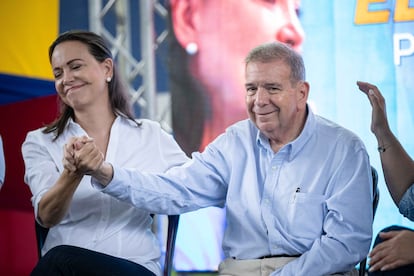
The dates for new elections remain unknown, and they are not even being considered in the short term. Even so, Machado has suggested a possible horizon. In recent weeks, she has said that it would be feasible to organize elections in less than a year if real guarantees and minimal institutional conditions are put in place.
This is not unfamiliar territory for her. Before becoming the most influential political figure in the Venezuelan opposition, she began her career in Súmate, an organization dedicated to defending the vote.
Her teams are now working discreetly on one of the issues the opposition has denounced for years: the voter registry. A new registration drive and a cleanup of the voter roll will be a priority if a new electoral process is ultimately opened. The current system excluded hundreds of thousands of Venezuelans abroad and also displaced voters within the country, moving them from one polling station to another to make participation more difficult.
Diosdado’s ‘surprise’
The main obstacle continues to be the institutions, where the regime still maintains its grip. The Chavista government now led by Delcy Rodríguez has begun testing changes aimed at projecting an image of openness. The resignations of the attorney general and the ombudsman have been interpreted as signs of reforms underway.
However, the two bodies that are essential for any election — the National Electoral Council (CNI) and the Supreme Court — remain in the hands of the same structures that endorsed the official 2024 results and allowed Maduro to stay in Miraflores despite allegations of fraud.
Machado also remains the most troublesome political adversary for the new Chavista leadership. Her disqualification from running in elections is still in force. And although Delcy Rodríguez has promoted an amnesty law for some political prisoners, she has also warned that the opposition leader will have to “answer for her actions” upon her return.
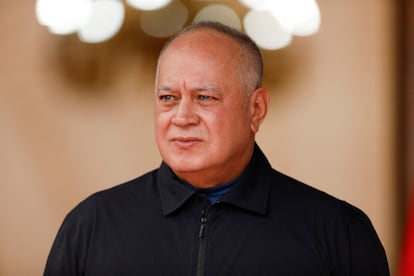
Interior Minister Diosdado Cabello has sounded even more threatening. On Wednesday, on his television program, he issued a warning regarding Machado’s intention to return: “I won’t tell you what surprise I have in store for her.” However, the threats and the hints of repression are unfolding alongside conversations about candidates and campaigns.
Former presidential candidate and former political prisoner Enrique Márquez, who appeared in Washington during Donald Trump’s State of the Union address, said he is not ruling out running for president again. And within the traditional parties, the debate is also shifting. Henry Ramos Allup, secretary general of Democratic Action, has insisted on the need to preserve opposition unity “at all costs” and announced his support for a potential Machado candidacy.
With no election date, no electoral authority, and under Washington’s oversight, Venezuela is slowly beginning to talk about politics again.
Sign up for our weekly newsletter to get more English-language news coverage from EL PAÍS USA Edition
Tu suscripción se está usando en otro dispositivo
¿Quieres añadir otro usuario a tu suscripción?
Si continúas leyendo en este dispositivo, no se podrá leer en el otro.
FlechaTu suscripción se está usando en otro dispositivo y solo puedes acceder a EL PAÍS desde un dispositivo a la vez.
Si quieres compartir tu cuenta, cambia tu suscripción a la modalidad Premium, así podrás añadir otro usuario. Cada uno accederá con su propia cuenta de email, lo que os permitirá personalizar vuestra experiencia en EL PAÍS.
¿Tienes una suscripción de empresa? Accede aquí para contratar más cuentas.
En el caso de no saber quién está usando tu cuenta, te recomendamos cambiar tu contraseña aquí.
Si decides continuar compartiendo tu cuenta, este mensaje se mostrará en tu dispositivo y en el de la otra persona que está usando tu cuenta de forma indefinida, afectando a tu experiencia de lectura. Puedes consultar aquí los términos y condiciones de la suscripción digital.