Ali Larijani, the most influential figure in Iran after Khamenei
The National Security Council secretary, whom Israel claims to have killed, played a key role in the nuclear agreement and the crackdown on protests
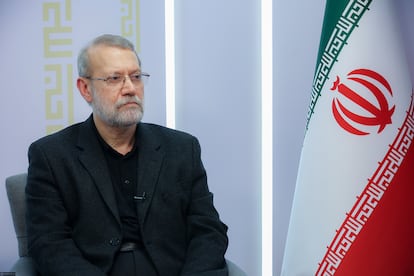

With the death of Ali Larijani in an operation claimed by the Israeli army, the Islamic Republic has lost one of the key and most influential figures in Iranian politics and security over the past four decades. Larijani — the secretary of the Supreme National Security Council — was a symbol of the complex interplay between power, family, and ideology in Iran; a politician who, drawing on his military experience, nepotism, and pragmatism, managed to consolidate a unique position within the complex Iranian power structure and become a central player in the country’s defining moments.
Ali Ardashir Larijani was born on June 3, 1958, in Najaf, Iraq. He came from a Shiite clerical family originally from the Larijan region of Amol, in northern Iran, on the shores of the Caspian Sea. His father, Mirza Hashem Amoli, was a prominent cleric. Larijani had four brothers — all of whom held high-ranking political, judicial, and security positions — who played prominent roles in the Iranian power structure. Their marriages to daughters of influential clerics helped consolidate the family’s influence within the political system, particularly strengthening Larijani’s position. He himself was the son-in-law of Morteza Motahari, a prominent religious figure and theorist of the Islamic Revolution, who was close to Ruhollah Khomeini, the founder of the Islamic Republic.
Before the revolution, he enrolled at Sharif University of Technology (then called Aryamehr), where he graduated with a degree in computer science. Later, on Motahari’s recommendation, he turned to philosophy and earned a doctorate from the University of Tehran. His background in logical and structured thinking, along with his strong family connections, facilitated his rise and were reflected in his political and security approach, which was always aligned with preserving the system.
Father-in-law’s key role
His entry into state broadcasting in 1979, facilitated by his father-in-law, marked the first step in Larijani’s career in the Islamic Republic. In 1982, he joined the Islamic Revolutionary Guard Corps, where he held senior positions until 1992, including roles as deputy and deputy chief of staff. In 1991, he served as chairman of the board of directors in the founding of Jahad-e-Khodkafai, the Revolutionary Guard’s self-sufficiency organization, which would later play a key role in the development of Iran’s missile program. Simultaneously, his time in various parliamentary and legal positions within ministries allowed him to gain experience in the mechanisms of political power.
In the summer of 1992, following the resignation of Mohammad Khatami as minister of culture, then-president Akbar Hashemi Rafsanjani appointed Larijani as his successor, despite his limited experience in the cultural field. Just a year later, on February 14, 1994, Supreme Leader Ali Khamenei appointed him director of state broadcasting. He remained at the helm of this organization for over a decade, during which time he significantly expanded the network of television and radio channels.
During his tenure, controversial programs such as Hoviyat (Identity), considered the first television format based on forced confessions in Iran, were broadcast. This media policy not only strengthened the state’s propaganda and control capabilities but also consolidated its political position. Years later, Ahmad Pournejati, former deputy director of the agency, revealed that Larijani maintained direct contact with Saeed Emami, a central figure in the Ministry of Intelligence during the mass assassinations of intellectuals in the 1990s. Larijani remained at the head of the state broadcaster until 2004, after which he was appointed as one of the supreme leader’s representatives on the Supreme National Security Council.
Disagreements with Ahmadinejad
In 2005, he ran for president but received less than 6% of the vote and failed to advance to the second round. That same year, having previously been appointed the leader’s representative to the Security Council, he was named secretary of that body by then-president Mahmoud Ahmadinejad, replacing Hassan Rouhani. He held the position until 2007, at the height of escalating tensions between Iran and the West over Iran’s nuclear program. His resignation came amid disagreements with Ahmadinejad, although some sources pointed to his direct negotiations with Spanish diplomat Javier Solana — conducted without coordination with the president — as the reason for his departure. This episode reflected a recurring theme in his career: his prioritization of the supreme leadership over internal government dynamics.
In 2008, he began his parliamentary career as a deputy for the province of Qom and was elected speaker of Parliament, a position he held until 2020, becoming the longest-serving leader in that role in the history of the Islamic Republic. During his tenure, he founded the Parliament’s Center for Islamic Research in Qom, with the aim of ensuring the laws’ conformity with Sharia law. In practice, he acted as the executor of the supreme leader’s directives, playing a key role in the rapid approval of the Joint Comprehensive Plan of Action (JCPOA), which was ratified in just 20 minutes, provoking harsh criticism from the more conservative wing of the establishment.
One of the most tense episodes of his tenure as parliamentary speaker was his clash with Ahmadinejad during the session to dismiss Labor Minister Abdolreza Sheikholeslami, known as Parliament’s “Black Sunday.” In that context, Ahmadinejad released a video showing Fazel Larijani, Larijani’s brother, allegedly trying to establish contacts with businessman Babak Zanjani — later convicted in one of the biggest corruption cases in the country’s history — through Judge Saeed Mortazavi, who was himself removed from office and, years later, convicted for the killing of Zahra Kazemi, an Iranian‑Canadian journalist.
Amid internal power struggles, and with the supreme leader’s support, a strategy to reduce the Larijani family’s influence began to take shape in 2020. In this context, Sadeq Larijani was replaced as head of the judiciary by Ebrahim Raisi, and in 2021, the Guardian Council disqualified Ali Larijani from running for president.
Return to the forefront in 2024
His return to the political forefront came in November 2024, amid escalating tensions between Iran and Israel, when he was sent as a special envoy to Syria and Lebanon. In that context, he advocated for negotiations with the United States on the premise that Iran would not develop nuclear weapons in exchange for concessions. A month later, he visited Damascus during the height of the offensive against Bashar al-Assad. In August 2025, following the 12-day war between Iran and Israel, he was again appointed secretary of the Supreme National Security Council by President Masoud Pezeshkian. With the backing of the inner circle, he managed to politically sideline the president and assume a central role in the country’s strategic direction.
Larijani was one of the main figures responsible for the repression of the latest protests against the Islamic Republic in January, which resulted in 7,000 deaths in the streets, according to estimates by the U.S.-based Iranian NGO HRANA. The official death toll is 3,117, but according to health sources, the number is in the tens of thousands.
Throughout his life, Larijani played a decisive role at critical moments: from the approval of the nuclear agreement and the management of security crises to the repression of protests and leading international negotiations and diplomatic missions. His influence on the Iranian power structure was undeniable, as was his responsibility for the regime’s strategic errors.
Sign up for our weekly newsletter to get more English-language news coverage from EL PAÍS USA Edition
Tu suscripción se está usando en otro dispositivo
¿Quieres añadir otro usuario a tu suscripción?
Si continúas leyendo en este dispositivo, no se podrá leer en el otro.
FlechaTu suscripción se está usando en otro dispositivo y solo puedes acceder a EL PAÍS desde un dispositivo a la vez.
Si quieres compartir tu cuenta, cambia tu suscripción a la modalidad Premium, así podrás añadir otro usuario. Cada uno accederá con su propia cuenta de email, lo que os permitirá personalizar vuestra experiencia en EL PAÍS.
¿Tienes una suscripción de empresa? Accede aquí para contratar más cuentas.
En el caso de no saber quién está usando tu cuenta, te recomendamos cambiar tu contraseña aquí.
Si decides continuar compartiendo tu cuenta, este mensaje se mostrará en tu dispositivo y en el de la otra persona que está usando tu cuenta de forma indefinida, afectando a tu experiencia de lectura. Puedes consultar aquí los términos y condiciones de la suscripción digital.