Ukraine progressing in designing air defense shield inspired by Israel’s Iron Dome
The main obstacle facing Kyiv is that it has a territory roughly 30 times larger than the Jewish State
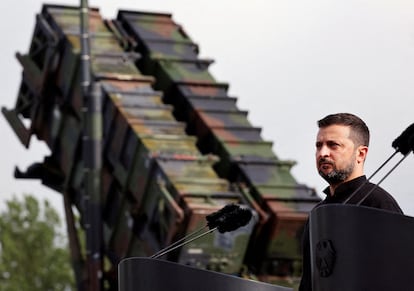

“We don’t need their help in drone defense. We know more about drones than anybody. We have the best drones in the world, actually.” In a new gesture of public contempt for Kyiv, Donald Trump asserted last Friday on Fox News that his country does not require cooperation to counter the unmanned aerial vehicles Iran is using in the Middle East war to retaliate against U.S. And Israeli attacks. The Jewish State, however, is signaling otherwise and appears to have Kyiv’s developed technology on its radar. At the same time, Kyiv is trying to draw inspiration from the Israeli air defense system, the Iron Dome, to create its own.
“Rhetoric is rhetoric,” Ukrainian President Volodymyr Zelenskiy responded to Trump, refusing to take the bait. Beyond the Republican leader’s words, the Ukrainian president is aware that, behind the scenes, the reality of his country’s military capabilities is quite different.
Following interest shown by Washington, European countries, and Gulf states, the latest country to join those valuing Ukraine’s progress is Israel, according to Kyiv authorities. This is quite paradoxical, since — faced with the large-scale Russian invasion in 2022 and an offensive involving thousands of drones and missiles — the Jewish State did not provide the crown jewel of its own air defense system, the Iron Dome. This has forced Ukraine to design its own, a colossal challenge due to the necessary resources and technology, and above all, because its territory is approximately 30 times larger than Israel’s.

Kyiv’s ambassador to Tel Aviv, Yevgen Kornichuk, and local sources cited by the press confirmed that Israeli Prime Minister Benjamin Netanyahu wishes to discuss the arms issue directly with Zelenskiy, a conversation that could take place soon. Israel, in an attempt to play it safe and maintain its relations with both Russia and Ukraine, has for years ignored Kyiv’s request to provide access to its air defense system, which consists of several layers of protection at different altitudes. Netanyahu justified this in 2023, according to statements to The Wall Street Journal, by citing his fear that it would fall into Iranian hands. He did, however, highlight the delivery of an early warning system that would help the Ukrainians anticipate casualties from airstrikes.
Netanyahu is acting with “caution” because his “interest is in maintaining good relations with Russia, a superpower with 1.5 million citizens in Israel,” observes Yehoshua Kalisky, a senior research fellow at the Institute for National Security Studies (INSS) in Israel. In the current situation, “Netanyahu must be very careful in dealing with Putin,” even though “Zelenskiy, who is Jewish, is primarily helping us against Iran, which in turn is helping Russia,” he adds in written responses.
With the experience gained primarily over the last four years of conflict and tens of thousands of deaths on its conscience, Ukraine is now developing its own system inspired by Israel’s Iron Dome. With this mission, among others, in mind, Zelenskiy appointed Pavlo Yelizarov as the new deputy commander of the Air Force in January. In an interview with Ukrainian journalist Yanina Sokolova, reported by various local media outlets, Yelizarov did not hide the fact that one of the main problems they face is the size of their territory.
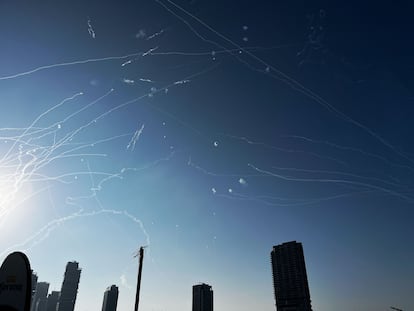
Moscow has the capacity to strike with drones, bombs, and missiles of all kinds, targeting the integrity of the over 233,000 square miles that constitutes Ukraine, of which approximately 20% remains under Russian occupation. The lack of sufficient weaponry to counter the Kremlin’s air offensive continues to be one of Zelenskiy’s main demands to his allies. In the last week alone, the Russians have attacked Ukrainian territory with 1,770 suicide drones, more than 1,530 aerial bombs, and 86 missiles of various types, according to the president.
“Russia is trying to launch drones and missiles in large waves to overwhelm our air defenses. Therefore, we need new technological solutions that will allow us to respond quickly to these attacks,” Yelizarov explained. The Air Force’s deputy commander also emphasized that a modern defense system should combine resources such as radar, anti-aircraft missiles, and electronic warfare systems.
But this Ukrainian shield must be adapted to Kyiv’s own capabilities and limitations. That is, it must be implemented using available domestic technology and weaponry supplied by the West. High-ranking military officials like Yelizarov are aware that they cannot design a system that relies solely on expensive Western-made missile defense systems like the Patriot or the IRIS-T.
“Our task is to build an anti-drone dome over Ukraine: a system that does not react after the fact, but destroys the threat as it approaches,” Defense Minister Mikhail Fedorov said in January, welcoming Yelizarov, considered by Kyiv as someone who “has proven his effectiveness in modern warfare.”
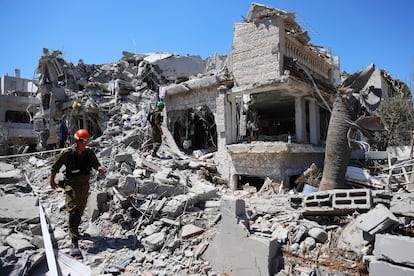
Part of the system Ukraine is developing consists of interceptor drones, with which Kyiv is already achieving greater effectiveness in shooting down drones than with ground-based anti-aircraft batteries or helicopters. According to Yelizarov, the deployment of mobile anti-aircraft units, like the one visited last week by EL PAÍS in border areas with Russia, has already achieved a shoot-down rate of around 50% against enemy drones. This is despite the Russians’ increasingly frequent tactic of launching kamikaze drones in swarms.
These Ukrainian-designed unmanned aerial vehicles (UAVs), primarily designed to combat Iranian Shahed drones and their Russian variants, have attracted interest not only from Israel but also from the United States and Middle Eastern countries. The world’s largest oil company, Saudi Aramco, is reportedly in the process of purchasing these aircraft, according to The Wall Street Journal. One of the Ukrainian companies mentioned, Wild Hornets, manufacturer of the Sting interceptor drone, has denied this, insisting that its production capacity is insufficient even to meet the demands of its own country’s military.
Dozens of Ukrainians on the ground
Meanwhile, and despite Trump’s stated lack of need for assistance, Zelenskiy has confirmed that each of the three teams Ukraine has deployed on the ground comprises dozens of military personnel, engineers, and experts in this new type of warfare, increasingly dominated by drones. Among their locations is a U.S. Military base in Jordan. Zelenskiy has insisted, however, that they will not attack Iran and that their cooperation is purely defensive.
“There have been several requests, either to help a particular country or to assist Americans. Our soldiers are in contact at various levels. We have received letters, calls, and requests from all military institutions,” Zelenskiy told a group of journalists over the weekend.
Trump’s snub of Ukraine’s drone expertise coincided with two other moves that illustrate, once again, his erratic strategy. Earlier, he lifted sanctions on Russian oil tankers for a month. Zelenskiy estimates that Moscow could reap €9 billion ($10.37 billion) from this measure. Meanwhile, the U.S. President continues to show no signs of resuming his mediation efforts between the Russian and Ukrainian leaders, which were interrupted by the renewed escalation of hostilities in the Middle East.
Ukraine, threatened by Iran
Amid the controversy, Iran directly threatened Ukraine on Saturday, considering it an ally of Israel. The Tehran regime thus added a new enemy to its list. Ibrahim Azizi, head of the parliamentary security committee, threatened Kyiv in a post on his X social media profile. “By providing support to the Israeli regime with drones, Ukraine has effectively been drawn into the war and, under Article 51 of the UN Charter, has made its entire territory a legitimate target for Iran,” he warned, alongside a photograph of Zelenskiy and Netanyahu.
Another paradox is that, since 2022, Russian troops have relentlessly bombarded Ukrainian territory with thousands of Iranian-made drones or copies manufactured in factories on Russian soil. Zelenskiy considers the ayatollahs’ regime “terrorist” and has defended the offensive launched by the U.S. And Israel from the outset. Furthermore, he asserts that Moscow is offering strategic assistance to Tehran to enable it to defend itself and reach targets with its drones.
Sign up for our weekly newsletter to get more English-language news coverage from EL PAÍS USA Edition
Tu suscripción se está usando en otro dispositivo
¿Quieres añadir otro usuario a tu suscripción?
Si continúas leyendo en este dispositivo, no se podrá leer en el otro.
FlechaTu suscripción se está usando en otro dispositivo y solo puedes acceder a EL PAÍS desde un dispositivo a la vez.
Si quieres compartir tu cuenta, cambia tu suscripción a la modalidad Premium, así podrás añadir otro usuario. Cada uno accederá con su propia cuenta de email, lo que os permitirá personalizar vuestra experiencia en EL PAÍS.
¿Tienes una suscripción de empresa? Accede aquí para contratar más cuentas.
En el caso de no saber quién está usando tu cuenta, te recomendamos cambiar tu contraseña aquí.
Si decides continuar compartiendo tu cuenta, este mensaje se mostrará en tu dispositivo y en el de la otra persona que está usando tu cuenta de forma indefinida, afectando a tu experiencia de lectura. Puedes consultar aquí los términos y condiciones de la suscripción digital.