Three things about Iran: A country that is not as religious as it seems and a long history of feminist struggle
The roles of Islam, the army, and women are three key elements to understanding a country that defies stereotypes and in which the current war has sparked renewed interest
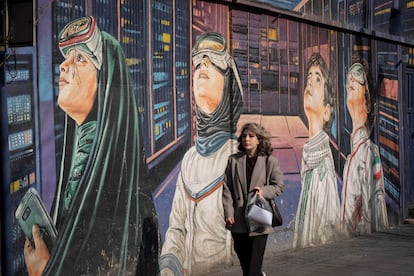

There is enormous interest in the war being waged by Israel and the United States against the Islamic Republic. In addition to the human cost for Iranians, there is the cost of the counteroffensive against neighboring countries and the immediate domino effect it has had on energy prices worldwide. Suddenly, everyone wants to know more about Iran. Are they as religious as state television portrays them, or as secular as the diaspora claims? Will the military intervention bring down a regime that the protests failed to topple? Will a democracy emerge? Will women be able to abandon the veil? In trying to answer these and other questions, the responses often obscure more than they clarify. Here are three issues that commonly lead to misunderstandings.
The Weight of Religion. Without going to the extreme of those who see a war of religions in every conflict that erupts in the Middle East, many commentators look to the mysteries of Islam for an explanation for the actions of Iranian leaders (though they don’t do the same to decipher the messianic behavior of Israeli or American ones). They delve into the differences between Shiism and Sunnism, the two main branches of Islam, or resort to the exegesis of legends and myths upon which they base their arguments, searching for the keys to decisions that are undeniably political. According to numerous studies, Muslims in Iran are among the least observant in the region. The imposition of an institutionalized faith since the proclamation of the Islamic Republic in 1979 has led to significant secularization and increasing distance from the official interpretation of Islam. Even many devout people are bothered by the political use of religion.
A military regime is coming. Prestigious strategists and analysts have been opining that, after the war, the regime of the ayatollahs will be transformed into a military regime. As if it weren’t already. The venerable Ulema of Qom, Iran’s Islamic scholars and jurists, have long since lost their prescriptive influence to the interests and aspirations of the Revolutionary Guard, the ideological army charged with protecting the Islamic Republic. The Guard is in charge of security, nuclear and missile programs, and relations with allied militias, something that has shaped Iranian foreign policy. But in addition, it has gained control of between 40% and 60% of the economy through a vast network of companies, consortiums, and foundations that range from strategic sectors such as hydrocarbons, telecommunications, and infrastructure to pharmaceuticals. Furthermore, although the Constitution prohibits active members of the Armed Forces from joining political parties or directly participating in politics, since the beginning of the century, reserve officers have occupied an increasing number of positions. Even without this active presence, their influence over key state institutions has, for at least a decade, made them the power behind the throne.
Iran became feminist in 2022. The death in police custody of Yina Mahsa Amini sparked the “Woman, Life, Freedom” protests. Many observers suddenly discovered Iranian feminism. But by then, Iranian women had already been fighting for many years against the mandatory veil and, above all, against the legal discrimination they face. “The first time we took to the streets to celebrate International Women’s Day was in 2002, under the reformist president Khatami,” recalls activist Sussan Tahmasebi. Four years later, with the far-right president Ahmadinejad in office, the police violently dispersed the 200 Iranian women, supported by a handful of men, who were marching again on International Women’s Day. In the meantime, thousands of volunteers, under the leadership of Nobel laureate Shirin Ebadi, had launched the Million Signature Campaign across the country to demand equality before the law. Their offices were shut down shortly afterward. Numerous women participated in the 2009 protests against what a large part of the population considered electoral fraud. So in 2022, the novelty wasn’t that Iranian women took to the streets; the novelty was that they were supported by men, especially young men. The movement quickly demanded an end to the theocracy, freedom of expression, and human rights, which are also women’s rights.
Sign up for our weekly newsletter to get more English-language news coverage from EL PAÍS USA Edition
Tu suscripción se está usando en otro dispositivo
¿Quieres añadir otro usuario a tu suscripción?
Si continúas leyendo en este dispositivo, no se podrá leer en el otro.
FlechaTu suscripción se está usando en otro dispositivo y solo puedes acceder a EL PAÍS desde un dispositivo a la vez.
Si quieres compartir tu cuenta, cambia tu suscripción a la modalidad Premium, así podrás añadir otro usuario. Cada uno accederá con su propia cuenta de email, lo que os permitirá personalizar vuestra experiencia en EL PAÍS.
¿Tienes una suscripción de empresa? Accede aquí para contratar más cuentas.
En el caso de no saber quién está usando tu cuenta, te recomendamos cambiar tu contraseña aquí.
Si decides continuar compartiendo tu cuenta, este mensaje se mostrará en tu dispositivo y en el de la otra persona que está usando tu cuenta de forma indefinida, afectando a tu experiencia de lectura. Puedes consultar aquí los términos y condiciones de la suscripción digital.