Will Michelle Bachelet become the next UN Secretary-General? What the forecasts are saying
Chile’s withdrawal of its support for the former president brings the selection process for António Guterres’ successor to the forefront. Pundits believe the winning candidate will probably be a woman and hail from Latin America
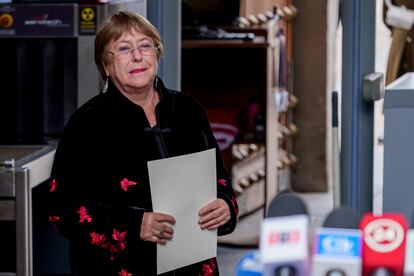

By withdrawing its support for former Chilean president Michelle Bachelet’s candidacy, the current government of Chile on Tuesday brought the race to succeed António Guterres as United Nations Secretary-General to the forefront of current events. Four other candidates are vying for the position. Though overshadowed by the war in the Middle East, the significance of the process is underscored by the fact that, for the first time in the organization’s history, a woman could hold this position. This possibility is doubly, even triply, significant: not only because of the large critical mass in favor of female leadership, amplified by, among others, the global platform GWL Voices; but also because, of the five candidates to succeed Guterres, three are women: Bachelet, Costa Rican politician and economist Rebeca Grynspan, and Argentina’s Virginia Gamba, former UN Special Representative for Children and Armed Conflict.
The other two candidates are Argentina’s Rafael Grossi, current head of the International Atomic Energy Agency—and the fourth Latin American candidate—and Macky Sall, former president of Senegal, who represents the African quota (the geographical distribution, by continent rotation, is the norm in the election of a secretary-general, and it is assumed to be Latin America’s turn). Although the political motivations are clear to everyone, it was the concentration of Latin American candidates that the government of Chile’s conservative president José Antonio Kast cited as the reason for withdrawing its support for Bachelet, a socialist. The “dispersion of candidates” from Latin America makes her candidacy “unviable,” the Chilean Foreign Ministry emphasized on Tuesday.
The candidacy of Bachelet, who presided Chile from 2006 to 2010 and from 2014 to 2018, and who also served as head of the UN Women agency, is the most politically charged and prominent of all the candidates. Her name was put forward by the previous Chilean government just days before the transfer of power, along with Brazil and Mexico. The continued support of these two countries makes her candidacy still viable, as does Chile’s promise not to support any of the other candidates “in consideration of Bachelet’s track record.” Grossi is officially backed by his country, though not personally by President Javier Milei, while Grynspan has been nominated by her country; Gamba, by the Maldives; and Sack by Burundi.
Bachelet, 74, has a chance, as all indications point to the geographical rotation leading to the election of a Latin American for the position. The “woman” variable is statistically likely, but in her case, somewhat more random. Ideologically speaking, she faces two formidable adversaries, both with veto power in the Security Council. One is China, which strongly protested an independent report on human rights violations against the Uyghur minority, which Bachelet presented as her farewell as UN High Commissioner for Human Rights in 2022. The second powerful adversary is the United States, which has previously denounced her “criticisms of Israel and the U.S.”
Bachelet’s representation at the UN is now facing pressure from hardline U.S. Republicans due to her pro-abortion stance. In a recent congressional hearing, Chuck Edwards, speaking on behalf of a group of Republican legislators, said that Bachelet, both in her role at the UN and during her two presidencies of Chile, “has repeatedly prioritized an extremist agenda on abortion” and is therefore an unsuitable candidate for Secretary-General, “whom the U.S. Should veto.”
The Chilean Foreign Ministry’s statement pointed to this obstacle: “Differences with some of the relevant actors defining this process,” which, although diplomatic language is often a mystery, can be interpreted as referring to the two countries mentioned. It would therefore be a simple matter of putting two and two together: it is up to the Security Council to formally recommend a candidate to the General Assembly, where there is no veto power, but the deciding vote will depend on just one of the five permanent members capable of blocking any initiative.
A commitment to multilateralism
Bachelet’s clearly feminist profile also clashes sharply with the moves by the U.S. In a UN that is subordinate—or at least muzzled by initiatives like the Gaza Board of Peace—to the Trump administration, something that its permanent representation, led by Mike Waltz, has been demonstrating this month since assuming the rotating presidency of the Security Council. The Chilean politician’s candidacy and the U.S. Political agenda at the UN overlap, when they do not altogether clash. Ten days ago, the US stood alone—literally alone—during the UN Conference on Women’s Rights (CSW70), which rejected its proposal to restrict the definition of gender. The U.S. Defeat was met with cheers and applause in the hall.
Bachelet’s declaration of intent as a candidate for UN Secretary-General is bound to send shivers down the spines of United States authorities. “If entrusted with the responsibility of Secretary-General, I will serve all Member States with impartiality, determination, and respect, guided by one principle above all others: that cooperation remains humanity’s most powerful instrument for peace, dignity, and shared progress,” she declared on March 11 at an event at New York University.
Whether or not she is chosen, whoever becomes Secretary-General will inherit a UN on the brink of a crisis of representation, but also a financial one, largely due to Washington’s unilateralism. The U.S. Withdrawal from various entities, including 31 UN agencies “that no longer serve U.S. Interests,” has jeopardized its financial viability, as it owes approximately $4.2 billion in overdue mandatory contributions, in addition to this year’s payment.
Although the U.S. Chose Melania Trump to inaugurate its rotating presidency of the Security Council on March 2nd, in an organization with a systemic deficit of female representation—72 member countries have never appointed a woman as permanent representative—the election of a female secretary-general would be, in the words of Susana Malcorra, former Argentine foreign minister, a boost for multilateralism, so threatened by Washington’s imperial and hegemonic worldview. “When a woman reaches a top position, she tends to work as part of a team, which is something that is sorely needed today,” Malcorra added at a recent meeting at the Cervantes Institute in New York. In times of unilateral actions, of wars waged by diktat—the one unleashed against Iran at Israel’s behest being a prime example—the possibility of a different world takes on a certain viability.
The unofficial deadline for submitting nominations expires on April 1. The selection process, overseen by the Security Council and the General Assembly, is scheduled to appoint a new leader in the third quarter of 2026. The next UN Secretary-General will serve a five-year term, from 2027 to 2031.
Sign up for our weekly newsletter to get more English-language news coverage from EL PAÍS USA Edition
Tu suscripción se está usando en otro dispositivo
¿Quieres añadir otro usuario a tu suscripción?
Si continúas leyendo en este dispositivo, no se podrá leer en el otro.
FlechaTu suscripción se está usando en otro dispositivo y solo puedes acceder a EL PAÍS desde un dispositivo a la vez.
Si quieres compartir tu cuenta, cambia tu suscripción a la modalidad Premium, así podrás añadir otro usuario. Cada uno accederá con su propia cuenta de email, lo que os permitirá personalizar vuestra experiencia en EL PAÍS.
¿Tienes una suscripción de empresa? Accede aquí para contratar más cuentas.
En el caso de no saber quién está usando tu cuenta, te recomendamos cambiar tu contraseña aquí.
Si decides continuar compartiendo tu cuenta, este mensaje se mostrará en tu dispositivo y en el de la otra persona que está usando tu cuenta de forma indefinida, afectando a tu experiencia de lectura. Puedes consultar aquí los términos y condiciones de la suscripción digital.