Lack of transparency about causes of oil spill in Gulf of Mexico fuels public concern
The government claims the state company Pemex has no responsibility, while experts and environmental groups wonder whether the spill originated from a ship or a failure in the pipe infrastructure
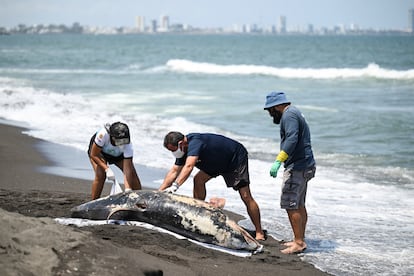
In early March, the first alerts were raised that tar slicks were washing up on several beaches in the states of Veracruz and Tabasco, staining the flora and killing the fauna. Almost a month later, two main questions remain unanswered about this oil spill in the Gulf of Mexico: the Mexican government has still not identified its cause, or whether it is still ongoing. Until now, authorities had maintained the version given by state authorities in Veracruz, namely that it was a spill from a ship belonging to a company not associated with the state oil company Pemex. But on Tuesday, during her daily press conference, President Claudia Sheinbaum announced that an interdisciplinary group had been formed with environmental and energy sector authorities, as well as the Mexican Navy, to determine “the cause of the spill” and “whether there is still a leak, or if it was just a one-off incident.” That same day, according to the president, she had received reports on the matter from Pemex and the Navy.
Verónica Munier, a member of the Bety Cariño Human Rights Center for the Peoples of Southern Veracruz, complains about the lack of transparency in the handling of the spill: “We don’t really know the extent of the damage. They haven’t told us anything, and we haven’t heard anything about them conducting any studies, or at least they haven’t reported on them,” she says. This lack of information has characterized the management of this emergency, and it keeps the affected communities on edge, as they question the origin of the spill. “It seems there was a spill in Campeche a month ago, something like that. And well, we’re realizing that it takes time for the sea to carry things to other places. In Tuxpan, it arrived almost three weeks after it was here [in Pajapan], so it could be possible, but we really don’t know, and we don’t believe the ghost ship theory,” she states, referring to the government’s initial explanation for the origin of the spill.
This Wednesday, Pemex and other authorities issued a joint statement. Its wording, like Sheinbaum’s remarks the previous day, is cautious. In addition to listing the amount of waste collected so far (“128 tons of crude oil-soaked residue”) and the length of coastline inspected (“165 kilometers of coastline near the ports of Alvarado, Coatzacoalcos, Tuxpan, and Veracruz, in the state of Veracruz, as well as Dos Bocas, Tabasco”), it includes a section titled “Technical Investigation into the Origin of the Hydrocarbon” in which they essentially state that they do not know the cause. “A technical and scientific investigation is underway to determine the origin of the detected hydrocarbon, using satellite imagery, monitoring vessel movements in the area with drone support, and conducting overflights with aircraft from the Mexican Navy,” the text reads.
It was Rocío Nahle, governor of Veracruz, who first pointed to this unidentified ship on March 12, with a message for the administrations that came before Morena, her own political party, adding that the concession for exploration and exploitation activities was granted during the six-year term of Enrique Peña Nieto (2012-2018), of the PRI party. Although Sheinbaum confirmed this statement on Monday, when she announced that the Attorney General’s Office was conducting an investigation, on Tuesday she no longer mentioned the unknown vessel and said that the responsible company had not yet been identified. What everyone has maintained, however, is that Pemex is not responsible for the environmental disaster.
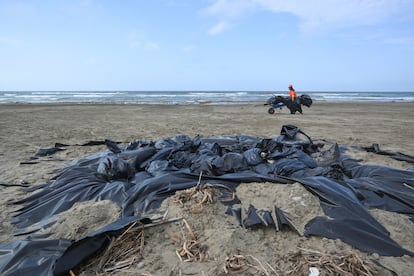
Amid this information vacuum, a group of environmental organizations published a series of satellite images on Wednesday afternoon, taken between February 6 and 17. According to these groups, the images show what appears to be a crude oil spill from a vessel. They also show five additional ships attempting, unsuccessfully, to contain the spill, which ultimately covered an area of 50 square kilometers, roughly 1,000 times the size of Mexico City’s enormous Zócalo square. “The spill remained active at least until February 17, subsequently dispersing due to factors such as ocean currents and weather conditions, which favored its gradual, dispersed, and sustained arrival on the coasts of Tabasco and Veracruz over the past three weeks,” the text states.
This statement asserts that these images show that “the incident was known to the authorities early on” due to the containment efforts that failed to prevent its spread, but that there was no “timely public information about the magnitude of the spill, its risks, or the response measures” and that the authorities must “explain what measures they activated, when they did so, and why they did not alert the population in a timely manner.”
“It’s not normal that so much time has passed and we still don’t know the official cause,” says Ramses Pech, an analyst and consultant in the energy industry. Pech, who doubts that a ship was the primary cause and leans more toward the possibility of a leak—too small to be detected by the pressure difference—in the pipeline system along the Tabasco coast, believes that, whatever the cause, there are a series of questions that need to be answered. “The important thing here is to determine where the oil started flowing out and where it’s coming from. If there was a spill, where was it and when did it happen? And if there was, why wasn’t any action taken before it reached the beaches and became a disaster? If there was a spill, why wasn’t it reported to the authorities? Are we really complying with regulations and reporting leaks?” Pech asks.
Sign up for our weekly newsletter to get more English-language news coverage from EL PAÍS USA Edition
Tu suscripción se está usando en otro dispositivo
¿Quieres añadir otro usuario a tu suscripción?
Si continúas leyendo en este dispositivo, no se podrá leer en el otro.
FlechaTu suscripción se está usando en otro dispositivo y solo puedes acceder a EL PAÍS desde un dispositivo a la vez.
Si quieres compartir tu cuenta, cambia tu suscripción a la modalidad Premium, así podrás añadir otro usuario. Cada uno accederá con su propia cuenta de email, lo que os permitirá personalizar vuestra experiencia en EL PAÍS.
¿Tienes una suscripción de empresa? Accede aquí para contratar más cuentas.
En el caso de no saber quién está usando tu cuenta, te recomendamos cambiar tu contraseña aquí.
Si decides continuar compartiendo tu cuenta, este mensaje se mostrará en tu dispositivo y en el de la otra persona que está usando tu cuenta de forma indefinida, afectando a tu experiencia de lectura. Puedes consultar aquí los términos y condiciones de la suscripción digital.