Skepticism in Miami over Delcy Rodríguez’s promises of legal security in Venezuela: ‘We have to wait and see if they do what they say’
Business leaders and investment funds participating in the global forum where the Trump-backed leader spoke believe it is still too early to assess the changes in the Latin American country
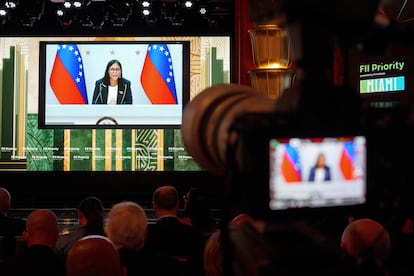
Investors are generally skeptical about Venezuela’s economic opening, touted by interim president Delcy Rodríguez, who promises legal security to foreign businesses to encourage their return to the country. The Latin American leader, who was Nicolás Maduro’s right-hand aide, came to power after the military operation carried out by Washington last January to capture the Chavista leader.
Matias—the fictitious name of a businessman who has lived in the United States for years but has Venezuelan roots—fears that his words could have negative consequences for his ties to the country. He is very skeptical about the changes promised by Delcy Rodríguez. “I agree with what the Exxon executive said to Trump: you can’t invest in Venezuela,” he says, speaking from the Faena Hotel, a luxury residential complex in Palm Beach (Miami).
Miami has become the financial capital of the United States for a week. It is currently one of the world’s cities with the highest concentration of investors per square meter, following the arrival of nearly a thousand business leaders and executives from companies and investment funds in the U.S. And the Persian Gulf to participate in the annual FII Priority forum, a business conference backed by Saudi Arabia’s sovereign wealth fund.
Venezuela’s interim president, Delcy Rodríguez, has presented herself to the financial world in this diverse setting where Saudi millionaires mingle with Italian, Israeli, Argentinian, Brazilian, but above all, American investors, in search of investment opportunities for PIF, the mammoth Saudi public fund endowed with the profits of the world’s largest oil company, Aramco.
Rodríguez has been trying to win over the public to invest in the new Venezuela. Following the U.S. Military operation to capture Nicolás Maduro, the country is attempting to open itself up to business, under the close scrutiny of U.S. Authorities. “It is important that the investment environment be secure, for investors to know that, regardless of political changes or restrictive circumstances, there is security, that there are laws in Venezuela that allow for the safe return of their investments,” the interim president stated via videoconference from Caracas. She is still unable to travel to the United States because she needs special permission due to the sanctions imposed by Washington against the Chavista regime.
Matías, an associate of FII Priority, summarizes the sentiment of half a dozen investors participating in the forum who spoke with EL PAÍS, and some of whom preferred to remain anonymous. “We have to wait and see if they do what they say,” he cautions. Another businessman he is speaking with maintains that “Rodríguez is giving that speech because she’s addressing international investors, but then she doesn’t do it at home.”
Both believe that until there is political change, the country will not be able to fully regain investor confidence. “They can do what Chevron has done, which is create its own parallel state, with its own security force and private services without government assistance,” points out. “If you want to invest in Venezuela now, you have to take care of everything yourself; you can’t count on the government. If you want to transport anything, you’ll have to build the loading docks, the port, everything yourself, because the government isn’t going to help you. And that’s if they don’t rob you through the payment of bribes or other things.”
Delcy Rodríguez’s speech to executives, business leaders, and investors coincided this Wednesday with an address by Venezuelan opposition leader María Corina Machado at CERAWeek, the world’s largest energy conference. There, she also pledged legal security to business leaders provided that “fair and free” elections are held in her country.
Separated by an ideological ocean, both have promised investors similar recipes, competing to attract foreign capital to Venezuela.
The opening is evident. The United States, which oversees Caracas, has extended an olive branch so that the Venezuelan oil industry can regain the luster it enjoyed in the 1990s. President Donald Trump has encouraged American oil companies to return to Venezuela to take a piece of the lucrative pie represented by its vast oil reserves, the largest in the world. But after decades of international sanctions, neglect, and corruption, the infrastructure is far from its best. And doubts linger among business leaders.
“We are in a process of stabilizing the implementation of reforms that are required for this productive environment and to receive investments that will allow us to diversify the productive engines of the Venezuelan economy, as we are seeing, not only significant growth in the hydrocarbon sector, but also in construction, banking, insurance, mining, and manufacturing,” Rodríguez remarked, without clearing up doubts about a democratic transition, nor whether she will call elections as the opposition is demanding.
While Rodríguez was trying to entice foreign investors, the U.S. Chargé d’Affaires in Venezuela, Laura Dogu, met with a delegation of American businesspeople visiting the Latin American country to learn about the situation and explore potential investments. In a post on social media, Dogu stated, “We are here to support the growth of U.S. Investment.” She added that private companies will play a “fundamental role in rebuilding a stable and prosperous Venezuela.” Just in case there was any doubt, Trump will participate in the same forum as Delcy Rodriguez, while there are no reports of him having spoken recently with opposition leader María Corina Machado.
Paolo, an Italian businessman with interests in the energy sector in Spain, points out that trust in Venezuela is still lacking. “The faces have changed, but it’s still the same regime,” he maintains. Until elections are held and democratic change is demonstrated, he will remain distrustful of the situation in the Latin American country, he reflects.
Miguel Armaza manages a venture capital fund. He invested in Venezuela a couple of years ago and says things are going very well for him. He appears more optimistic regarding the opening up of Caracas. He believes that significant changes have taken place since the rise of Delcy Rodríguez. Although he admits that opportunities exist, he remains cautious. “Provided that you can diversify your investments.” Armaza hosts a podcast in which he interviews figures from the economic world. He “genuinely believes in Venezuela’s potential—specifically in the technology sector.” However, he notes: “Democratic elections are needed for real change to be perceived.”
Andrea Riposati is the CEO of Dante Omics, a company that uses artificial intelligence for healthcare solutions. He is more optimistic and believes Venezuela is full of opportunities. “When we talk about Venezuela, we always think about oil and energy, but we also have to consider that there is commercial activity there, which needs to scale up.” He points out that there are opportunities in the retail and healthcare sectors. “There are options to raise the level of commerce, with retail networks or pharmacies and medicines; it’s an opportunity,” he notes. He believes that the country has suffered in the last 20 years due to the embargoes against the Chavista regime, but that with the reopening of recent months, it will be able to grow and, to some extent, catch up with the Dominican Republic. “Tourism is another engine it can take advantage of,” he predicts.
Sign up for our weekly newsletter to get more English-language news coverage from EL PAÍS USA Edition
Tu suscripción se está usando en otro dispositivo
¿Quieres añadir otro usuario a tu suscripción?
Si continúas leyendo en este dispositivo, no se podrá leer en el otro.
FlechaTu suscripción se está usando en otro dispositivo y solo puedes acceder a EL PAÍS desde un dispositivo a la vez.
Si quieres compartir tu cuenta, cambia tu suscripción a la modalidad Premium, así podrás añadir otro usuario. Cada uno accederá con su propia cuenta de email, lo que os permitirá personalizar vuestra experiencia en EL PAÍS.
¿Tienes una suscripción de empresa? Accede aquí para contratar más cuentas.
En el caso de no saber quién está usando tu cuenta, te recomendamos cambiar tu contraseña aquí.
Si decides continuar compartiendo tu cuenta, este mensaje se mostrará en tu dispositivo y en el de la otra persona que está usando tu cuenta de forma indefinida, afectando a tu experiencia de lectura. Puedes consultar aquí los términos y condiciones de la suscripción digital.