New state bill proposals seek to protect the rights of those who monitor and protest against ICE
Recent crackdowns by the federal government against residents of cities that have rejected its immigration operations have prompted legislative initiatives to protect their freedoms
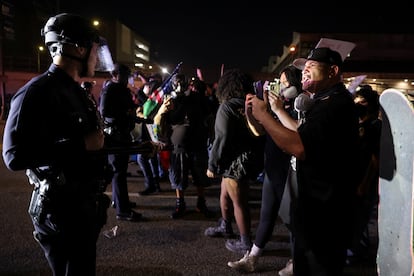

Clashes between immigration authorities and citizens documenting their operations have reached the center of the political debate around Donald Trump’s anti-immigrant agenda. Reports of what civil society organizations describe as intimidation campaigns against people who protest or record agents with their phones are becoming increasingly frequent, and recent incidents, particularly the deaths of two people at the hands of immigration officers in Minneapolis in January, have intensified scrutiny of the administration’s tactics.
Democratic lawmakers have taken note, and at the state and federal levels, bills have begun to emerge that are being presented as mechanisms to defend the rights of Americans. California Senator Sasha Renée Pérez introduced a bill this week that would prohibit local police from assisting federal agents, in order to prevent the “harassment” of observers. In Maine, Representative Chellie Pingree has proposed another bill to limit ICE funding for “aggressive and invasive surveillance and intimidation” technologies. The proposals mark a shift in the political debate, previously focused primarily on immigrants’ rights, toward a growing concern for the constitutional guarantees of those who challenge the government.
The Trump administration is carrying out an anti-immigrant offensive that it has described as the largest deportation operation in history, with large-scale raids in Democratic-run cities reaching a fever pitch after the deaths of Renee Good and Alex Pretti, two U.S. Citizens shot dead by federal agents in Minneapolis. Months earlier, in the summer, Los Angeles was the scene of a massive deployment involving thousands of National Guard troops, sparking widespread protests. Portland, Oregon, and Chicago followed. More recently, in Maine, the government launched an operation called “Catch of the Day” last month, further expanding the network.
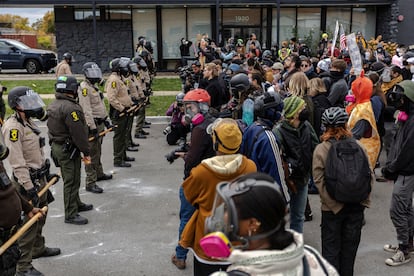
Senator Pérez of Pasadena announced the Protect California Rights Act this week alongside Angie Vargas, an Alhambra (Los Angeles) resident who recorded an altercation with local police while monitoring an immigration operation. In the video, which went viral and sparked protests last month, a local police patrol cruiser is seen cutting off Vargas’ vehicle as she followed an unmarked car she suspected was carrying federal immigration agents. City police and Border Patrol agents questioned her, took her picture, and accused her of obstruction.
“It is essential that those who observe the actions of the federal government can do so publicly, without fear of being harassed or intimidated,” Pérez tells EL PAÍS. “And we must also ensure that our local and state police forces are not used by the federal government to do its job.” The initiative falls within the framework of the California Values Act, which since 2018 has limited the involvement of local police in the enforcement of federal immigration laws.
Angélica Salas, director of the Coalition for Humane Immigrant Rights (CHIRLA), a co-sponsor of the bill, warns that there has been an increase in cases in which local authorities, at the behest of federal authorities, “detain and harass” people who record ICE activities. She also notes that the proposal seeks to reaffirm that agencies must enforce state laws during federal operations.
In Maine, Representative Chellie Pingree’s proposal, called the Stop ICE Intimidation Act, would prevent ICE from receiving funding for further surveillance tools until the Department of Homeland Security (DHS) explains to Congress how it uses databases, biometric technologies, and facial recognition. The bill argues that government “surveillance and intimidation of bystanders” could violate First and Fourth Amendment rights.
“When a federal agent can photograph someone’s license plate, add them to a database, and label them a ‘domestic terrorist’ simply for filming ICE officers, we’ve crossed a dangerous line,” Pingree said in a statement, citing the case of a Portland woman who was recording an ICE agent when the latter began filming her and taking pictures of her license plate before telling her, “We have a nice little database, and now you’re considered a domestic terrorist.” The video of the incident sparked widespread public outrage and led Acting ICE Director Todd Lyons to testify before the Senate that no such databases exist. The congresswoman added that other citizens have been “followed home” and received calls and threats simply for documenting what is happening in their own communities. “In a truly free society, citizens do not live in fear of their government.”
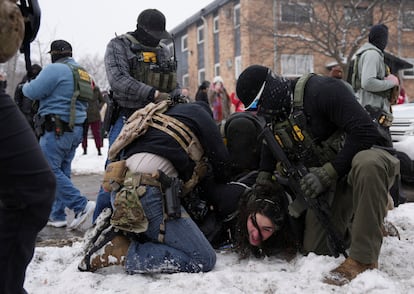
Experts have sounded the alarm about the expansion of the government’s surveillance apparatus. A recent report from the American Immigration Council warns that authorities are using surveillance tools to track anyone, including U.S. Citizens. According to estimates cited in the report, immigration authorities have accessed driver’s license data for up to three-quarters of adults in the U.S. And have scanned photographs of approximately one in three, in addition to tracking movements through vehicle and public transportation records. The government has spent an estimated $300 million on these technologies. And according to recent reports, the DHS has sent hundreds of administrative subpoenas to Google, Meta, Reddit, Discord and other companies to obtain personal data from accounts that criticize or track ICE, including anonymous profiles.
“The Trump administration has directly called for the repression of protesters and observers documenting ICE’s brutality,” says Will Owen, communications director for the Surveillance Technology Oversight Project (STOP), an organization dedicated to combating mass surveillance. “These are not isolated incidents, but part of a broader government strategy to stifle dissent. Cities and states across the country must take action, and these initiatives are important first steps to protect our civil liberties and confront the growing authoritarianism of the federal government.” The organization, which focuses on combating mass surveillance, has filed lawsuits seeking records on the use of facial recognition and other technologies against protesters.
Sign up for our weekly newsletter to get more English-language news coverage from EL PAÍS USA Edition
Tu suscripción se está usando en otro dispositivo
¿Quieres añadir otro usuario a tu suscripción?
Si continúas leyendo en este dispositivo, no se podrá leer en el otro.
FlechaTu suscripción se está usando en otro dispositivo y solo puedes acceder a EL PAÍS desde un dispositivo a la vez.
Si quieres compartir tu cuenta, cambia tu suscripción a la modalidad Premium, así podrás añadir otro usuario. Cada uno accederá con su propia cuenta de email, lo que os permitirá personalizar vuestra experiencia en EL PAÍS.
¿Tienes una suscripción de empresa? Accede aquí para contratar más cuentas.
En el caso de no saber quién está usando tu cuenta, te recomendamos cambiar tu contraseña aquí.
Si decides continuar compartiendo tu cuenta, este mensaje se mostrará en tu dispositivo y en el de la otra persona que está usando tu cuenta de forma indefinida, afectando a tu experiencia de lectura. Puedes consultar aquí los términos y condiciones de la suscripción digital.