Republican pressure mounts on Trump to end the war in Iran
The cost of gasoline and the prospect of a protracted conflict are eroding support for the president while the offensive threatens the campaigns of members of Congress seeking reelection
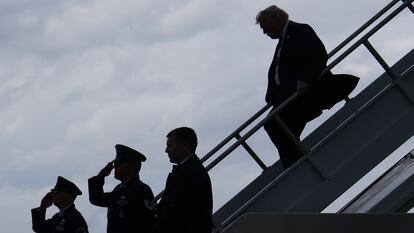

With a president so fond of contradictory messages, debates in Washington often veer into the realm of semantics, if not outright philosophy. Currently, for example, everything revolves around the meaning of an ending; the end of the war between Israel and the United States against Iran, which is heading into its third week. Trump said this Monday that it is near, given the chaos in the markets. He also said that it will only come after an “unconditional surrender” on the part of Tehran. Or that — as he asserted this Wednesday in an interview with Axios — the offensive will stop when he says it will.
Doubts about what that ending will look like add to the confusion surrounding the justifications for launching the attack (Trump provided a dozen in the first week alone) and the contradictory messages about how long the war might last: “a few days,” “four weeks” that became “five,” “whatever it takes”... Wednesday afternoon brought the penultimate timeframe, when Trump defined his offensive against Tehran as “a little two-week diversion.” He did so in Cincinnati, Ohio, where he traveled to defend his economic policies against that abstract concept called Middle America.
There are, therefore, many unknowns, but also one certainty: the war is not in the best interest of Republican members of Congress, who are currently engaged in an election year. Some of them are beginning to pressure Trump to end the conflict.
In November, all 435 members of the House of Representatives and a third of the Senate face reelection. A war in the Middle East, which Trump promised would not happen if he returned to the White House, is hardly the best campaign argument, given its potential impact on inflation and the price of gasoline.
“I think the sooner we get to what the president was talking about yesterday — a decisive, clear end to this conflict — the better,” declared Republican Senator Josh Hawley (Missouri) at an event hosted by the parliamentary news website Punchbowl News. Later that evening, Hawley told Fox News that “it’s time to declare victory” and to “thank [the troops] for their service.” “This has been absolutely amazing. It’s been astounding, historic,” he added, referring to a campaign that marks its 13th day this Thursday, with the theater of operations established in the Strait of Hormuz and amid renewed threats of its impact on the global oil market.
To dare to express publicly what many Republicans say privately on Capitol Hill, Hawley relied on Trump’s remarks from Monday, made at a retreat for conservative House representatives organized by the Congressional Institute in Doral, Florida, at one of the president’s hotels. There, Trump said that “the war is very complete.”
At that same forum, Speaker of the House Mike Johnson, who, along with other prominent party members, applauded Trump’s entrance for two minutes, spoke of the war — a word he goes to great lengths to avoid — as “a temporary blip.” Lisa McClain (Michigan), the fourth-most powerful Republican in the House, used the expression “snapshot in time” in statements to CNN, while Nicole Malliotakis (New York) expressed confidence that the economic turbulence brought about by the conflict would remain “short-term volatility.” A period as short as the run-up to the November elections.
With the midterms approaching, it’s clear that Republicans were more comfortable with Trump’s message from just a couple of weeks ago, when he addressed Congress in his State of the Union speech. One of the arguments he used to defend his record during his first year back in office was the price of gasoline, which, he reminded the audience, “peaked at over $6 a gallon” in some states while his predecessor, Joe Biden, was in the White House. “Now it’s below $2.30 a gallon in most states,” the president boasted at the time.
Early Wednesday afternoon, the average price of a gallon of gasoline in the United States was $3.58, according to the American Automobile Association website. This was the highest price in 21 months, following 11 consecutive days of increases.
Data like this has also prompted some of Trump’s advisors in the White House to privately encourage the president to seek an exit plan from the war, arguing that the military has already largely achieved its objectives, according to The Wall Street Journal. These advisors have expressed concern, the conservative newspaper maintains, that a prolonged conflict will ultimately erode support among Trump’s supporters for his military adventure, as his popularity remains stagnant and polls indicate that a majority of Americans do not support their country’s involvement in the war in Iran.
Anonymous sources
White House Press Secretary Karoline Leavitt described the information revealed by the WSJ as “crap from anonymous sources who, I can guarantee, are not in the room with President Trump.” “The president’s top aides are focused 24/7 on ensuring Operation Epic Fury continues to be a tremendous success, and the end of these operations will ultimately be determined by the commander in chief,” Leavitt told The Wall Street Journal.
Many of the Republicans on Capitol Hill — where on two occasions in the past two weeks the party has voted against limiting the White House’s power to wage war — still fit that definition of Trumpian loyalty outlined by Leavitt.
Sen. Lindsey Graham: “I'm going back to South Carolina and asking them to send their sons and daughters over to the MidEast.”
— AF Post (@AFpost) March 10, 2026
Follow: @AFpost pic.twitter.com/iAK4jxL9z9
Although surely none will go as far as Senator Lindsey Graham (South Carolina), one of the president’s most blindly loyal allies. Amid attacks on Spain for its refusal to allow the U.S. Military to use the Rota and Morón air bases, Graham told Fox News that he wants Saudi Arabia and other Arab nations to “step up” and adopt the objectives of the United States and Israel. He also said, “I’m going back to South Carolina and asking them [voters] to send their sons and daughters over to the Middle East [to fight].”
Those words drew criticism from within his own party, from Nancy Mace (also a representative from South Carolina) and Anna Paulina Luna (Florida), who said: “If Senator Graham wants to go fight in a foreign conflict, let him be the first to volunteer.” Graham, incidentally, has no children.
Sign up for our weekly newsletter to get more English-language news coverage from EL PAÍS USA Edition
Tu suscripción se está usando en otro dispositivo
¿Quieres añadir otro usuario a tu suscripción?
Si continúas leyendo en este dispositivo, no se podrá leer en el otro.
FlechaTu suscripción se está usando en otro dispositivo y solo puedes acceder a EL PAÍS desde un dispositivo a la vez.
Si quieres compartir tu cuenta, cambia tu suscripción a la modalidad Premium, así podrás añadir otro usuario. Cada uno accederá con su propia cuenta de email, lo que os permitirá personalizar vuestra experiencia en EL PAÍS.
¿Tienes una suscripción de empresa? Accede aquí para contratar más cuentas.
En el caso de no saber quién está usando tu cuenta, te recomendamos cambiar tu contraseña aquí.
Si decides continuar compartiendo tu cuenta, este mensaje se mostrará en tu dispositivo y en el de la otra persona que está usando tu cuenta de forma indefinida, afectando a tu experiencia de lectura. Puedes consultar aquí los términos y condiciones de la suscripción digital.