The shattered dream of migrating to the US and the odyssey of returning: ‘I was in jail for four months. That’s the only way I got to know New York’
The Trump administration’s persecution is generating a massive return flow to Latin America driven by the fear of mass raids
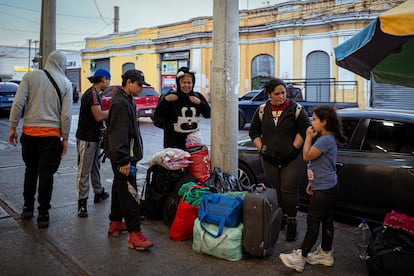
Laime Arold, a 26-year-old Haitian, buys energy bars at a small shop on the side of the Pan-American Highway in southern Chiapas, Mexico. José Adán, a Honduran, prays aloud in a park in Tapachula, asking God to protect him from kidnappers and the police along the way. Gerardo Aguilar, a Venezuelan, travels at 60 miles per hour, lying across two seats on a bus headed for Guatemala, while talking on the phone with the woman he left behind in Caracas.
The three all have something in common: they are in Mexico and they are migrants. None of them are heading north. They are heading south. They are not trying to cross the Rio Grande, but rather to get away from it. They are migrants fleeing the land they once dreamed of, and which later expelled them.
In the last year, the first of U.S. President Donald Trump’s second term, thousands of migrants (at least 14,000 as of September) have undertaken a reverse journey, driven by policies of terror and persecution by immigration agents. Between October 2025 and January 2026, this newspaper spoke with migrants making that journey in reverse. Southbound migration is not a new phenomenon, but it has become more pronounced under Trump’s xenophobic administration.
Venezuela, Haiti, and Honduras, three of the countries that have sent the most migrants to North America in the last decade, reappear on this map, now in reverse. According to official data, nearly 2.5 million Venezuelans, Haitians, and Hondurans have arrived in the United States in the last 10 years. And now many of them are returning.
Gerardo is 37 years old and left Caracas in November 2022. He did so driven by the meager salary he earned at an oil company. To live in the United States, he had to endure a harrowing ordeal: leaving everything and everyone behind in his country, crossing the Darién jungle risking his life, being kidnapped twice in Mexico, and working without documents, fearing that each day there could be his last.
For the past two years, he lived in Austin, Texas, where he worked in construction. With his earnings, he changed his life, paid off his debts, bought a car, designer clothes, and even some jewelry. He sent money to his family and eventually got used to the idea of living there. Until a raid in June 2025 turned him into a statistic.
“They arrested about seventy of us. All from the same construction project,” he says. “I was in jail for four months. That’s the only way I got to know New York. It’s a shame I got to know it from jail; I couldn’t get out.”
Since Trump returned to office, U.S. Immigration authorities have launched a crackdown on undocumented migrants not only at the border, but also in operations in communities, public spaces, and workplaces.
Data from U.S. Immigration and Customs Enforcement (ICE) shows that authorities made an average of 746 arrests per day in 2025. The raids instilled so much fear in the migrant workforce that, by year’s end, the agricultural, construction, and fast-food sectors reported significant staffing shortages because migrants were not showing up for work. Eighty-two percent of businesses in California reported millions of dollars in losses due to the arrests, and 44% said they lost more than half of their revenue, according to a Los Angeles County report published in September.
After four months in prison, Gerardo was deported to Piedras Negras, in the Mexican state of Coahuila, which borders Texas. There, in a shelter, he met other Venezuelans: Anderson, Gianna, and their eight-year-old daughter; also Yanira and Óscar, with their teenage son. After two months, they began their journey south and settled in the Vallejo neighborhood, on the outskirts of Mexico City. Then, on January 3, 2026, the U.S. Operation in Caracas to capture Nicolás Maduro led them to believe it was a good time to return home.
The removal of Maduro has given many Venezuelans a new sense of hope. “I don’t think things will change overnight, but now at least they can,” says Yanira, as she hugs her son on the bus heading to Guatemala.
These seven Venezuelans claim they were kidnapped by Mexican immigration agents while crossing through Oaxaca. There, they were robbed of the few pesos they had and, three days later, they were released.
The route in reverse
In mid-January 2026, the seven Venezuelans arrived at the Cristóbal Colón bus station in the heart of Guatemala City. There they waited for more than a week before resuming their journey, now headed for Panama. They would no longer be forced to cross the dangerous Darién jungle, as they had on their way here. In Bajo Chiquito, Panama, they would take a boat for $250 each that would take them to Necoclí, Colombia. “The American dream was shattered, my brother. Now we’re going to try our luck again in Venezuela,” says Gerardo.
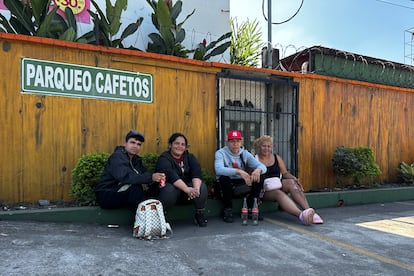
One day in early January 2026, on a bench in Bicentennial Park in the heart of Tapachula, Chiapas, José Adán takes a gamble. He sits across from three other migrants: two Hondurans and one Salvadoran. They’re playing cards and have bet what, to them, is a fortune: two hundred Mexican pesos, about $10. It’s his last day in this city, where he’s been staying for the past three months, hoping to save up seven hundred pesos to take a bus to Guatemala. He knows that losing the $10 could keep him there for at least another week.
José Adán is here. He explains why he was deported and had to leave his wife and two daughters, aged eight and nine, in Los Angeles. “I had a good job there. I earned a good living. I lived with my family. But now I’m not going back [to the United States]. Nobody is going back,” he says.
This will be his second attempt. On his last attempt a month and a half ago, he was kidnapped on the southern border. On the Suchiate River, which separates Mexico from Guatemala, rafters have found a new business, explains Adán: upon reaching the riverbank, they offer lodging and security. But in reality, that offer turns into an express kidnapping.
It’s Wednesday, October 1, 2025, and Laime Arold is walking under the sun toward northern Mexico. But he’s not trying to reach the United States. Three weeks ago, he self-deported. He turned himself in to immigration authorities, who took him to Piedras Negras. He planned to make a living there, but Mexican authorities felt he wasn’t far enough south, so they sent him nearly 2,500 miles further back to Tapachula, on the border with Guatemala.
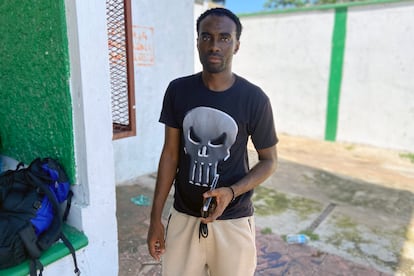
Laime is now walking north because he intends to reach Mexico City. In Austin, the 26-year-old Haitian recalls, he worked as a cook, a trade he learned almost a decade ago when he lived in Chile, where he fled after leaving Port-au-Prince, the capital of Haiti. There he also learned to speak Spanish.
“In Haiti there was a lot of fear. The gangs wouldn’t let us live. You couldn’t sleep. We had to hide. In the United States now it’s similar. There aren’t any gangs, but they chase you, they harass you,” he says as he walks along the sidewalk.
The U.S. Government’s efforts to get rid of undocumented immigrants have reached the point of offering rewards to those who do so. In January 2026, the Department of Homeland Security (DHS) announced that any immigrant who self-deported would receive a $2,600 payment and stated that by that date, approximately two million had already done so.
Laime didn’t receive that reward because he self-deported beforehand. “I had to watch TV and social media to see if there were any ICE raids. Several of my colleagues were taken away. There’s a lot of hatred, particularly against Haitians,” he says.
In September 2024, when he was still a candidate, Trump’s hate speech against Haitians became so intense that he went so far as to say that, “They’re eating the dogs, the people that came in, they’re eating the cats. They’re eating the pets of the people that live there,” of immigrants in Springfield, Ohio.
“You can’t live in fear. I don’t want to live in fear anymore. That’s why I’m going to look for a new life here, where there is hatred, but much less,” says Laime.
Sign up for our weekly newsletter to get more English-language news coverage from EL PAÍS USA Edition
Tu suscripción se está usando en otro dispositivo
¿Quieres añadir otro usuario a tu suscripción?
Si continúas leyendo en este dispositivo, no se podrá leer en el otro.
FlechaTu suscripción se está usando en otro dispositivo y solo puedes acceder a EL PAÍS desde un dispositivo a la vez.
Si quieres compartir tu cuenta, cambia tu suscripción a la modalidad Premium, así podrás añadir otro usuario. Cada uno accederá con su propia cuenta de email, lo que os permitirá personalizar vuestra experiencia en EL PAÍS.
¿Tienes una suscripción de empresa? Accede aquí para contratar más cuentas.
En el caso de no saber quién está usando tu cuenta, te recomendamos cambiar tu contraseña aquí.
Si decides continuar compartiendo tu cuenta, este mensaje se mostrará en tu dispositivo y en el de la otra persona que está usando tu cuenta de forma indefinida, afectando a tu experiencia de lectura. Puedes consultar aquí los términos y condiciones de la suscripción digital.