‘You can’t hide’: The skull patches worn by guards at Alligator Alcatraz
According to migrants held at the facility, personnel often use insignia with ominous messages to intimidate the detainees
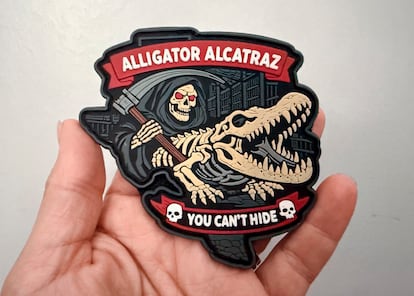

Guards at Alligator Alcatraz, the infamous migrant detention center in the Everglades, west of Miami, wear patches with skulls and ominous messages on their uniforms. One design depicts a grim reaper wielding a scythe over a crocodile skeleton alongside the text: “Alligator Alcatraz” and “You can’t hide,” surrounded by small skulls and against a background resembling prison bars.
The use of the patches came to light last week when a guard gave one to Courtney Prokopas, an activist protesting outside the center. Prokopas told EL PAÍS that she was with other people, holding a sign that read “Shame,” when she saw the guard coming out. He approached her and told her he had been fired for getting into a fight with someone else. She saw the patch and asked to take a picture of it. He then ripped it off—it was attached with Velcro to the sleeve of his uniform—and gave it to her. “”You can just have it," he said, “I have them made, and I give them out to people.”
The badges have added a disturbing new element to the controversial center, which has been singled out in reports by Amnesty International and other agencies for human rights violations, dehumanizing conditions and treatment that amounts to torture.
A man who was detained at the center for months said that most of the guards wear some kind of patch, sometimes several at once. The designs, which he estimates number around 15 different ones, all share a sinister theme, featuring grim reapers and skulls. According to the man, who asked to remain anonymous for fear of reprisals, the guards use them to show off in front of the detainees and intimidate them: “They tell you they’re your executioners, that you won’t get out of there alive,” and that “you’ll never see the light of day again. It’s like hell.”
It is unclear whether the patch design was officially approved or if it reflects internal messages from security personnel. Critical Response Strategies, the Jacksonville-based security firm contracted by the State of Florida for which the guards work, did not respond to a request for comment. The Florida Division of Emergency Management (FDEM), which manages the facility, and the Department of Homeland Security also did not respond.
The slogan “You Can’t Hide” on the patch echoes the rhetoric used by President Donald Trump and Florida officials, who have said that the wildlife around Alligator Alcatraz is part of the facility’s security and that anyone trying to escape will encounter alligators and pythons. On the day of his visit to kick off the center’s opening in early July, Trump joked to reporters about what would happen if someone tried to escape the prison. “We’re going to teach them how to run away from an alligator if they escape prison,” he said. “Don’t run straight. Run like this,” he added, while moving his hand in a zigzag motion.
“If we’ve learned anything from the Trump era, it’s that cruelty often comes across—or is disguised—as humor,” says Dr. Peter Kraska, a professor of criminal justice who has extensively studied the militarization of the police and testified on the subject before Congress. Some might argue that it’s just an inside joke, but “they’re clueless about just how serious this kind of thing is,” he adds.

“You have somebody that joins up with these folks, they just want a job, they’re just trying to take care of their family. And they’re not politicized. They’re not cruel. They don’t wanna really be involved with this. But they join up, and these are the kinds of cultural values that are transmitted to them constantly, both symbolically in language, in how people are treated, in the policies that are taking place, in the location of where these concentration camps are put up. And that recruit could easily, in eight months, become just like the patch wants them to be,” Kraska explains.
Controversial symbols
The use of symbols and emblems on uniforms, called “morale patches,” originated among the military during World War I. Initially serving as identification, they later began to be used to foster camaraderie, with designs reminiscent of sports mascots that often included darkly humorous slogans and figures associated with death, such as skulls or skeletons. In public safety settings, however, their use has been increasingly questioned.
One of the most controversial cases was that of the so-called “Punisher skull,” the symbol of the Marvel comic book character who punishes criminals on his own after his family is murdered. The character’s stylized skull began appearing on police patches and decals on patrol cars, sometimes alongside the so-called “thin blue line.” The symbol drew criticism because it evoked the idea of vigilante justice. Several police departments restricted its use and adopted rules allowing only official insignia.
Kraska studied that case. “It was just screaming symbolically that we don’t do things by the rules. We’re here to punish those that we see appropriate for punishment, and we’re the thin blue line between anarchy and law and order.” In reality, he adds, that kind of symbol projects an image of omnipotent state actors, above reproach, “and a type of policing or security personnel that really doesn’t care what anyone thinks. They’re gonna do things their own way.”
Professor Seth Stoughton, a former police officer who researches the use of force and police culture in the United States, argues that these symbols “reflect and normalize a problematic mindset, especially when they invoke violence, domination, or dehumanizing imagery. In custodial settings, where personnel exercise substantial authority over vulnerable people, those messages can be especially troubling.”
Other patches featuring Alligator Alcatraz and similar designs, including alligator images, prison bars, and surveillance slogans, are available for purchase online. The websites do not indicate who created or commissioned each design, nor whether they are produced in small batches.
Prokopas says that after he gave her the patch, the guard told her he was going to the police to file a report. He returned an hour later, and by then he had another patch on his sleeve, of the same type.
“I don’t know when he put on that second patch. For me, that’s the million-dollar question,” the activist points out. “Did he feel naked, as if he no longer had a purpose or direction? As if it were such an important part of his identity that he needed to put it back on immediately, even though he had just been fired?”
Sign up for our weekly newsletter to get more English-language news coverage from EL PAÍS USA Edition
Tu suscripción se está usando en otro dispositivo
¿Quieres añadir otro usuario a tu suscripción?
Si continúas leyendo en este dispositivo, no se podrá leer en el otro.
FlechaTu suscripción se está usando en otro dispositivo y solo puedes acceder a EL PAÍS desde un dispositivo a la vez.
Si quieres compartir tu cuenta, cambia tu suscripción a la modalidad Premium, así podrás añadir otro usuario. Cada uno accederá con su propia cuenta de email, lo que os permitirá personalizar vuestra experiencia en EL PAÍS.
¿Tienes una suscripción de empresa? Accede aquí para contratar más cuentas.
En el caso de no saber quién está usando tu cuenta, te recomendamos cambiar tu contraseña aquí.
Si decides continuar compartiendo tu cuenta, este mensaje se mostrará en tu dispositivo y en el de la otra persona que está usando tu cuenta de forma indefinida, afectando a tu experiencia de lectura. Puedes consultar aquí los términos y condiciones de la suscripción digital.