Afghan asylum seeker dies the day after being detained by ICE: ‘His family deserves answers’
Mohammad Nazeer Paktiawal, who worked for the US government in Afghanistan for 15 years, was not suffering from any illness when he was arrested, according to his family
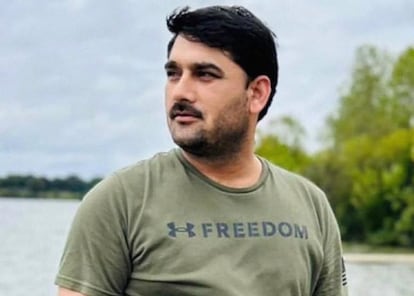

The death of an Afghan man in the custody of Immigration and Customs Enforcement (ICE) in Texas has once again brought into sharp focus the treatment of migrants detained by the agency as a result of the Trump administration’s anti-immigration crackdown. On the morning of Friday, March 13, Mohammad Nazeer Paktiawal was preparing to take his children to school when he was surrounded by masked agents who handcuffed and arrested him. He was pronounced dead on Saturday morning. Little information is available about what happened in the hours following his arrest and what led to the sudden death of the 41-year-old man, who, according to his family, had no underlying health conditions.
“The cause of death is unknown, but it is not normal for a healthy 41-year-old man to die less than 24 hours after being taken into government custody,” said Shawn VanDiver, president of AfghanEvac, a San Diego-based group that helps Afghans who sought refuge in the United States after cooperating with U.S. Authorities during the war in Afghanistan.
Paktyawal lived in Texas with his wife and six children, the youngest of whom is 18 months old and a U.S. Citizen. He worked at an Afghan halal market in the Dallas area and was the primary breadwinner for his family. He had arrived in the United States in 2021, when the U.S. Government evacuated him and his family and took them in after the Taliban came to power. Paktyawal had served in the U.S. Military during the war, and his green card had expired in August 2025. He had a pending asylum application when he was detained.
The Department of Homeland Security (DHS) reported that Paktyawal’s death is under investigation. According to the statement released by the department that oversees ICE, on Friday night Paktyawal began complaining of shortness of breath and chest pain while at an immigration enforcement office in Dallas, and was taken to Parkland Hospital. He received treatment, and doctors recommended he remain hospitalized overnight for observation. On Saturday morning, according to the statement, Paktyawal was having breakfast when medical staff noticed his tongue was swollen, prompting medical intervention. He was pronounced dead at 9:10 a.m. After several attempts at resuscitation.
“His family deserves answers. The public deserves transparency. And the government should focus on explaining what happened instead of attacking the victim,” VanDiver added. In what has become a typical response by the government when justifying the death of people in ICE custody, DHS labeled Paktiawal a criminal. “Paktiawal had a criminal record, including an arrest by local authorities for SNAP (food stamp) fraud on September 16, 2025. He was arrested a second time for theft on November 1, 2025,” the department statement read.
Paktyawal’s family, for their part, have questioned the veracity of that information. “His children adored him, and he worked hard every day to take care of them and build a future for them in the United States,” they said.
The DHS did not mention that the victim was an Afghan special forces soldier who worked with the U.S. Army in Paktika province since 2005. For more than a decade he fought alongside Americans in some of the most dangerous areas of Afghanistan.
With Paktyawal’s death, the number of people who have died in ICE custody this year has reached 12. Multiple complaints from detainees, their families, and human rights organizations reveal the unsanitary conditions in which people are held in detention centers, where they complain of being denied access to needed medication and medical care, as well as to their lawyers.
In 2025, a record 30 deaths were recorded in ICE facilities. This month, a 56-year-old Haitian man who had been detained for months in an Arizona migrant detention center died in a hospital after not receiving treatment for a dental infection, according to his family. Due to the Trump administration’s crackdown on migrants, aimed at achieving the largest deportation effort in history, ICE facilities are now holding more than 70,000 detainees, compared to approximately 40,000 at the beginning of the Republican’s second term.
Against the Afghan community
The Afghan community has been one of the hardest hit by Trump’s anti-immigration measures. In June, Afghanistan was added to a list of 12 countries whose citizens were banned from entering the United States. In November, Trump announced a pause in all visas issued to Afghans in response to the deaths of two National Guard members who were attacked by an Afghan national in Washington, D.C. The alleged attacker, Rahmanullah Lakanwal, had worked for the CIA and also came to the United States after the withdrawal of U.S. Troops from Kabul in the summer of 2021. He lived with his wife and children in Bellingham, Washington, where he worked as a delivery driver. The Justice Department has stated that it will seek the death penalty.
Approximately 200,000 Afghans have arrived in the United States since the summer of 2021 through various channels. They are asylum seekers, refugees, some have Special Immigrant Visas (SIVs), and others are family members of people already living in the country. During Joe Biden’s presidency, Operation Welcome Allies brought about 76,000 Afghans to the United States. Since Trump took office, however, their situation has become precarious, as the president announced he would review their residency permits. He also closed all avenues for Afghans to enter the United States.
Sign up for our weekly newsletter to get more English-language news coverage from EL PAÍS USA Edition
Tu suscripción se está usando en otro dispositivo
¿Quieres añadir otro usuario a tu suscripción?
Si continúas leyendo en este dispositivo, no se podrá leer en el otro.
FlechaTu suscripción se está usando en otro dispositivo y solo puedes acceder a EL PAÍS desde un dispositivo a la vez.
Si quieres compartir tu cuenta, cambia tu suscripción a la modalidad Premium, así podrás añadir otro usuario. Cada uno accederá con su propia cuenta de email, lo que os permitirá personalizar vuestra experiencia en EL PAÍS.
¿Tienes una suscripción de empresa? Accede aquí para contratar más cuentas.
En el caso de no saber quién está usando tu cuenta, te recomendamos cambiar tu contraseña aquí.
Si decides continuar compartiendo tu cuenta, este mensaje se mostrará en tu dispositivo y en el de la otra persona que está usando tu cuenta de forma indefinida, afectando a tu experiencia de lectura. Puedes consultar aquí los términos y condiciones de la suscripción digital.