What to know about the ‘No Kings’ protests on March 28
With more than 3,000 events planned across the U.S., this could be the day with the highest number of national political demonstrations in the country’s history
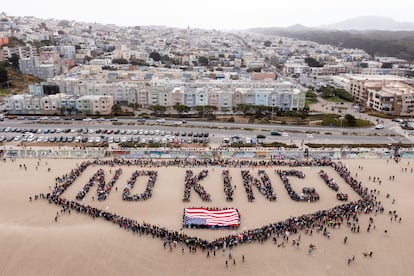

The No Kings movement is gearing up for a new national day of protests on March 28, with more than 3,000 events scheduled across the United States and the expectation of bringing together millions of people in what could become one of the largest days of political mobilization in the country’s history.
Driven by progressive organizations, labor unions, and civil rights groups, the movement has grown since its first demonstrations in 2025 to become one of the main expressions of opposition to President Donald Trump’s administration.
What is the No Kings movement?
No Kings is an initiative that emerged in response to what its organizers describe as authoritarian tendencies in the government. Since its inception, the movement has championed the central idea that there are no kings in their country. “America does not belong to strongmen, greedy billionaires, or those who rule through fear. It belongs to us, the people,” the organizers state.
The movement is driven by groups such as Indivisible, progressive organizations, labor unions, and civil rights groups that have coordinated nationwide protests since 2025.
When and where will the protests take place?
Protests are scheduled across all 50 states, with thousands of events taking place in major cities as well as in rural and suburban areas. In fact, organizers have noted that more than 3,000 local events are planned for Saturday.
One of the main events will take place in St. Paul, Minnesota, a state that has become a focal point of the movement following the immigration raids carried out since the beginning of this year, in which two U.S. Citizens died, sparking protests, tensions with local authorities, and a strong public backlash.
Meanwhile, in Washington, D.C., the march will begin at 10:00 a.m. And pass by iconic landmarks such as the Lincoln Memorial and the Washington Monument, before culminating in a rally scheduled between 1:30 p.m. And 4:00 p.m.
The official No Kings website features a map where people can find their nearest event.
Why are the protesters demonstrating?
The protests are driven by immigration policies, economic concerns, and international conflicts, such as the recent offensive launched by the Administration against Iran. Randi Weingarten, president of the American Federation of Teachers, stated that “America is at an inflection point. Our communities are hurting. People are afraid, and they can’t afford basic necessities.”
Organizers also directly criticize the government’s actions on immigration, noting that this Administration “is sending masked agents into our streets, terrorizing our communities,” and that “they are targeting immigrant families, profiling, arresting, and detaining people without warrants.”
How many people might participate?
With each demonstration, the movement has drawn larger crowds. More than 5 million people participated in June 2025 and 7 million in October of the same year, according to the organizers. For this new event, some estimates suggest that March 28 could become the day with the highest number of national political demonstrations in history.
What rights do protesters have?
Organizations such as the ACLU point out that protesters have rights protected by the Constitution, albeit with certain limitations. Among these is the right to “speak out in ‘traditional public forums’ such as streets, sidewalks, parks and plazas… as long as you are not blocking access.”
Protesting on private property is also permitted, provided the owner gives permission, and the police cannot restrict the content of the message based on their stance. Additionally, participants may photograph “anything in plain view, including federal buildings and the police, as long as you’re lawfully present in a public space.”
In the event of clashes or tensions, authorities may intervene to maintain order. According to the ACLU, “Police can separate protesters and counter protesters, but they ‘should allow them to be within sight and sound of each other,’” which seeks to balance safety with the right to free speech.
These rules apply to both protesters and counter-protesters and are part of the legal framework governing public protests in the United States.
Sign up for our weekly newsletter to get more English-language news coverage from EL PAÍS USA Edition
Tu suscripción se está usando en otro dispositivo
¿Quieres añadir otro usuario a tu suscripción?
Si continúas leyendo en este dispositivo, no se podrá leer en el otro.
FlechaTu suscripción se está usando en otro dispositivo y solo puedes acceder a EL PAÍS desde un dispositivo a la vez.
Si quieres compartir tu cuenta, cambia tu suscripción a la modalidad Premium, así podrás añadir otro usuario. Cada uno accederá con su propia cuenta de email, lo que os permitirá personalizar vuestra experiencia en EL PAÍS.
¿Tienes una suscripción de empresa? Accede aquí para contratar más cuentas.
En el caso de no saber quién está usando tu cuenta, te recomendamos cambiar tu contraseña aquí.
Si decides continuar compartiendo tu cuenta, este mensaje se mostrará en tu dispositivo y en el de la otra persona que está usando tu cuenta de forma indefinida, afectando a tu experiencia de lectura. Puedes consultar aquí los términos y condiciones de la suscripción digital.