Michel Houellebecq: the prophet of decadence returns to music
The award-winning and controversial author of ‘The Elementary Particles’ surprises fans with a new album due for release on Friday, as well as a series of concerts in France
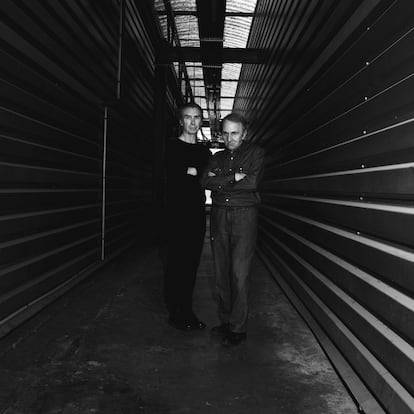
Visionary, dystopian, and controversial, Michel Houellebecq is beyond good and evil. Or at least he seems to be: his audience spans the entire ideological spectrum, and his novels matter as much to his passionate readers as to his detractors. But the French writer also transcends the literary realm: his resume reveals him as an occasional participant in artistic performances (with the Masbedo collective), a competent actor (The Kidnapping of Michel Houellebecq, Near Death Experience, Thalasso), and an accomplished musical performer.
His new work, Souvenez-vous de l’homme (Remember Man), falls within this latter category. This album, recorded in collaboration with musician Frédéric Ló, will be released on March 6 via the independent French label Modulor. The title is related—perhaps coincidentally—to that of his previous album, Présence humaine, an electronica recording made in 2020 in collaboration with Bertrand Burgalat, who was Nick Cave’s producer and arranger at the time. That work contained songs such as Playa blanca (an allusion to a setting in his novella Lanzarote) and the spoken-word piece Célibataires. With that repertoire, he paraded his gaunt figure and Gainsbourg-like voice on television programs in his country, and even performed for an indie audience in Spain at the Benicàssim Festival. A quarter of a century later, with new material, Houellebecq has announced a French tour that includes 10 consecutive nights at La Scala in Paris next May.
Houellebecq’s fondness for recording studios is neither new nor unusual. It began with Le sens du combat (The Purpose of the Struggle), an album of poems recorded in 1996 for France Culture Radio—“I belong to a current of poetry that is meant to be read in public,” he said at the time—and later came another album in the same vein called Établissement d’un ciel d’alternance (Establishment of a Sky of Alternation), also released under the commercial radar, in 2007. “During the 19th and early 20th centuries, there was a great concentration of magnificent poets, such as Rimbaud, Baudelaire, Mallarmé, Apollinaire... But in the mid-20th century, poetry lost its function. Lyrical talent shifted to song, and that is why there are no great 20th-century poets,” he said at the time, explaining his fondness for music.
But this taste also aesthetically suits his persona. In another collaboration with Téléphone’s singer, Jean-Louis Aubert, back in 2014, we saw a thin, disheveled Houellebecq with a wasted appearance reminiscent of Iggy Pop. And this wasn’t a coincidence: the Frenchman and the godfather of punk became such good friends that the latter recited a long excerpt from The Possibility of an Island on his own 2009 album Préliminaires, based on his reading of a novel that the Michigan native found “intensely pleasurable and similar” to his own experience.
Musical references also show up in Houellebecq’s books, which is logical in authors who write about contemporary life. In The Possibility of an Island—the author’s foray into science fiction with a story of loneliness, cloning and transhumanism—there were references to Björk (“conventional and mannered beyond belief”), Keith Richards (“he had a Bentley, like all important rock stars”), and, surprisingly, Spanish singer David Bisbal, whose music Houellebecq must have heard during his time living in Cabo de Gata, in Almería province. Other references to the greats of rock—Hendrix, Rolling Stones—are explicit in The Elementary Particles. Regarding The Map and the Territory, the author himself has stated that “it’s like a Pink Floyd song where the melody starts before you realize it’s started.”
All of this helps to perceive Michel Houellebecq as a pop figure, or a pop star even. Protected by his enfant terrible status (even at age 67) and after embarrassing incidents like his murky appearance—which he claims was under duress—in pornographic recordings, this outsider aura suits a character who likes to give the impression that he’s seen it all, and perhaps he has. Like the figure of the royal jesters, he seems compelled to say what no one else dares (“We could have a civil war; it’s been a long time since there’s been one in Europe,” he recently declared); beyond that, he can break the rules of the game from time to time. Somehow, he gives the impression of enjoying his empty and disillusioned persona.
This character re-emerges in the new album with 12 raw songs, layered with electronics and adorned with piano, that question the past and reflect on the future of humanity (if such a thing exists, it seems to add). Among these are titles such as Le dialogue des machines, Le lendemain de l’explosion, and En attendant l’envahisseur (The Dialogue of the Machines, The Day After the Explosion, and Waiting for the Invader).
Readers eager for a new novel will have to wait a little longer: if, as José Carlos Rodrigo, author of the recent essay Michel Houellebecq. The Corrosion of the Human, every author has a project, the Frenchman’s is to “immortalize the solitude of existence” through any form of mass media, including, of course, music. In his novels, essays, films, and albums, the Frenchman remains the same unsettling chronicler, prophet of the decline of Europe (no: of the entire West). Whatever he does, it is impossible to look away from his devastating prose.
Sign up for our weekly newsletter to get more English-language news coverage from EL PAÍS USA Edition
Tu suscripción se está usando en otro dispositivo
¿Quieres añadir otro usuario a tu suscripción?
Si continúas leyendo en este dispositivo, no se podrá leer en el otro.
FlechaTu suscripción se está usando en otro dispositivo y solo puedes acceder a EL PAÍS desde un dispositivo a la vez.
Si quieres compartir tu cuenta, cambia tu suscripción a la modalidad Premium, así podrás añadir otro usuario. Cada uno accederá con su propia cuenta de email, lo que os permitirá personalizar vuestra experiencia en EL PAÍS.
¿Tienes una suscripción de empresa? Accede aquí para contratar más cuentas.
En el caso de no saber quién está usando tu cuenta, te recomendamos cambiar tu contraseña aquí.
Si decides continuar compartiendo tu cuenta, este mensaje se mostrará en tu dispositivo y en el de la otra persona que está usando tu cuenta de forma indefinida, afectando a tu experiencia de lectura. Puedes consultar aquí los términos y condiciones de la suscripción digital.