‘It’s a trompe-l’œil, it can’t even turn you on’: Have on-screen bodies become too unrealistic?
There is more and more sex and nudity on screen, but according to audiences, sexologists, and analysts, there is less and less eroticism. ‘Heated Rivalry’ and ‘Wuthering Heights’ are the latest examples
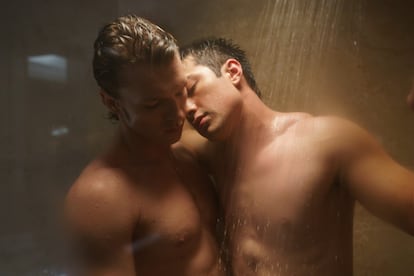

Panting, tussling, elaborate catalogs of positions, and flirtations with dominance and submission. February has been an intense month for film and television. It began on television: Heated Rivalry turned the relationship between two professional hockey players into a social earthquake. Then came Wuthering Heights in cinemas, a libidinous reinterpretation of Emily Brontë’s classic that drew audiences en masse. Yet amid the feverish fandom, critical voices have also emerged around both phenomena — especially regarding their portrayal of sexuality.
Wuthering Heights was the first to spark debate among professional critics. “It’s quasi-erotic, pseudo-romantic and then ersatz-sad, a club night of mock emotion,” wrote Peter Bradshaw, critic for the British newspaper The Guardian.
As for Heated Rivalry, it was comedian Jordan Firstman — known for his role in I Love LA — who questioned its intimate scenes. “It’s not how gay people fuck. There’s so few things that actually show gay sex,” he said in an interview with Vulture. His comments created a rift within the series’ growing legion of fans.
The conflict is paradoxical. At a time when uninhibited sexual scenes seem omnipresent and are conquering previously untouched territories — from the testosterone‑charged world of Canadian sports to the desolate moors of Yorkshire — critics argue that these portrayals, with their unattainable bodies and choreographed encounters, sit miles away from genuine eroticism. Are sex and the body more idealized than ever? And above all, is this idealization killing the audience’s interest? We asked academics, sexologists, and viewers.

Recent studies already point to this growing sense of audience fatigue — at least among younger viewers, who are major consumers of this type of content. UCLA, the Los Angeles university that has trained many of Hollywood’s biggest talents, has been tracking Generation Z’s disconnect from sex scenes for years in its annual media‑consumption report. The 2025 Teens & Screens report revealed that nearly 50% of the young people surveyed felt there was too much sex in films and series, and 60% said they wanted stories that focused more on couples’ friendships than on the sex they were having. The backlash stems from a clear trend in film and television, but the real question is: where does the industry’s obsession with these scenes comes from?
Adrián Chico, psychologist, sexologist, and author of Surviving in the Gay World, argues that the need to bombard viewers with sex is closely tied to digital overstimulation. “Sex in fiction no longer aims only to portray intimacy — it seeks to create visual impact, an impact that must keep increasing because of the intensity of stimuli we’re used to from porn and social media,” he explains. “It’s shown with more visibility, more explicitness, more presence, but also with less depth, less connection, and far less imperfection. It appears like synchronized swimming: coordinated, successful, intense, easy, a perfect fusion without mistakes — when the reality is clumsiness, nerves, good moments and not‑so‑good ones, but above all, connection.”
Specifically regarding the Heated Rivalry phenomenon — which Chico has already discussed with some of his patients — he questions the way the series depicts its characters’ nudity: “The plot is great, but would just as many people watch it if the men didn’t have those bodies? We’re living through a cult of the hyper‑muscular male body: defined, low‑fat, and completely hairless.”
This idealized physical perfection demanded by fiction, among many other spaces, is at times exaggerated by the rise of artificial intelligence. “AI doesn’t create the beauty standard, but it amplifies it,” says Chiro. “We’re beginning to consume hyper‑perfected images, without pores, without imperfections, without asymmetries. That raises the threshold of what we consider normal, and we’re increasingly distorting reality.”
Representation of bodies
Nudity brings up a fundamental question for understanding the reaction to sex scenes: can bodies that perfect end up killing genuine interest and eroticism? “Yes,” says Chico. “And this is very interesting. For me, eroticism needs vulnerability, imperfection, humanity, even a touch of endearing insecurity. When the body is too perfect, it becomes more of an object than a real, imperfect person you can connect with.”
But this point is debatable. Professor Santiago Fouz Hernández, chair of film studies at Durham University, a specialist in on‑screen masculinities and author of Cuerpos de cine (Bodies of Cinema), prefers not to assume that notion of a perfect body. “It’s a very subjective concept. There are dominant trends, but also tastes as varied as the viewers themselves. Many people will feel put off by the type of body you describe; others will find it attractive,” he explains.
To test this, it’s enough to ask the very same Gen Z referenced in the studies. We posed the question to a group of young people who practically use Letterboxd — a cinephile app — as their social network of choice. “I think the goal is no longer to eroticize or to represent reality. What they’re looking for is just an aesthetic stimulus for the eye. It’s like a trompe‑l’oeil that can’t even turn you on,” argues Carmela R., 26.
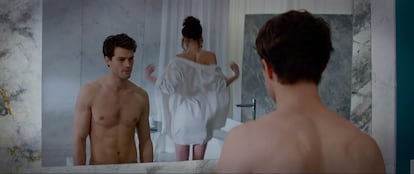
For Pedro E., 27, these bodies provoke a more contradictory reaction: “There’s something that impulsively attracts me to those bodies — it’s been drilled into our heads. But the hypersexualization pushes me away; I don’t feel represented. Sex is much more complex than looking at a big butt.”
“The problem isn’t the muscular guys or the huge breasts, it’s how sex scenes are shown,” adds Clara F., 22. “I feel like I’m watching a movie, and suddenly it cuts to a Calvin Klein ad. Nothing is suggested. I understand why it turns people on, but it doesn’t for me.”
Regardless of personal taste, Professor Fouz Hernández acknowledges that the bodies seen in today’s fiction — especially male bodies — confirm the final triumph of bodybuilding aesthetics: “Something that was once considered a purely exceptional spectacle — I’m thinking of Eugene Sandow, the father of bodybuilding who performed in circuses at the start of the last century — has now become widespread.”
Spectacular bodies are nothing new in cinema, and their rise can be traced back to the 1970s. Even then, he notes, there was a stark contrast between the Hercules played by bodybuilder Steve Reeves in the peplum films and Kirk Douglas in Spartacus, and the so‑called “toga fear” emerged among certain stars — “some Hollywood actors in the 1960s whose somewhat slight physiques didn’t meet the demands of the script.”
However, the reign of these sculpted bodies didn’t fully arrive until the early 21st century with the boom of heroes and superheroes — from Brad Pitt in Troy to Chris Hemsworth in Thor or Henry Cavill in Man of Steel. “Now this is taken as the standard for certain contemporary masculinities, and people ignore the fact that actors’ physical preparation is only for specific roles. The popularization of gym routines followed by some of these actors for specific films is a good example of this obsession with physique, which can become a kind of burden,” he explains.
Heated Rivalry has, in fact, sparked the viral spread of the glute‑training routines followed by actors Hudson Williams and Connor Storrie. Although Fouz Hernández warns of the risks of promoting these body standards, he also praises the series’ boldness in portraying homosexuality in sports and is convinced that, slowly, that diversity will begin to appear in the bodies on screen as well. Throughout history, he argues, no aesthetic canon is eternal. “I trust that we’ll return to more realistic references, as almost always happens. Everything gets old, and audiences have more discernment than they’re sometimes given credit for.”
Until then, Chico recommends taking sexual doubts and fantasies to therapy rather than to the cinema. “The problem isn’t watching fiction, but rather not educating young people, and everyone, really, to learn to differentiate between reality and fantasy,” he says.
One clue to start with? Cinema always lies, and when it comes to matters of the bedroom, even more so.
Sign up for our weekly newsletter to get more English-language news coverage from EL PAÍS USA Edition
Tu suscripción se está usando en otro dispositivo
¿Quieres añadir otro usuario a tu suscripción?
Si continúas leyendo en este dispositivo, no se podrá leer en el otro.
FlechaTu suscripción se está usando en otro dispositivo y solo puedes acceder a EL PAÍS desde un dispositivo a la vez.
Si quieres compartir tu cuenta, cambia tu suscripción a la modalidad Premium, así podrás añadir otro usuario. Cada uno accederá con su propia cuenta de email, lo que os permitirá personalizar vuestra experiencia en EL PAÍS.
¿Tienes una suscripción de empresa? Accede aquí para contratar más cuentas.
En el caso de no saber quién está usando tu cuenta, te recomendamos cambiar tu contraseña aquí.
Si decides continuar compartiendo tu cuenta, este mensaje se mostrará en tu dispositivo y en el de la otra persona que está usando tu cuenta de forma indefinida, afectando a tu experiencia de lectura. Puedes consultar aquí los términos y condiciones de la suscripción digital.