‘Comma by comma, a change here, a change there’: The passage of Venezuela’s amnesty law
In the National Assembly, the opposition bloc debated changes they considered essential with Chavista lawmakers until the last minute


Up until the final minutes before approval of the Venezuelan National Assembly’s amnesty law, opposition lawmakers debated over additions they considered essential. The process was a seven-hour marathon of closed-door discussions, with two hours of debate on the Assembly floor, and a nighttime visit to Miraflores Palace, the seat of government, to deliver the final law to the acting President Delcy Rodríguez. Despite its limitations and omissions, the law allows the Venezuelan government to make a case that it will be allowing greater political freedom after the capture of Nicolás Maduro by the U.S. Government.
“Comma by comma, a change here, a change there.” That’s how opposition lawmaker Antonio Ecarri describes the final hours of the debate, which included tense exchanges with the National Assembly President Jorge Rodríguez. “It has been an extremely hard and extremely long discussion. Some things did manage to become public, after an intense battle,” says Ecarri.
Rodríguez ordered him to stop talking at one point because, in his opinion, Ecarri was out of order. On February 19, Ecarri was also chastened for calling out how “corrupt officials and judges” caused “disasters” in “very important matters.” Rodríguez said he had to present proof of his accusations.
Beyond the parliamentary wrangling, one article the opposition views as a victory is Article Seven. Discussion raged over the clause for an entire week. The provision requires those seeking amnesty to submit themselves to the justice system in order to benefit from it. The measure is geared towards those who were imprisoned for political reasons, rather than for acts that constitute crimes. But in the opinion of some advocates, it could lead to revictimization, and has generated enormous mistrust among countless exiles, who have fled to country precisely to avoid a prison sentence.
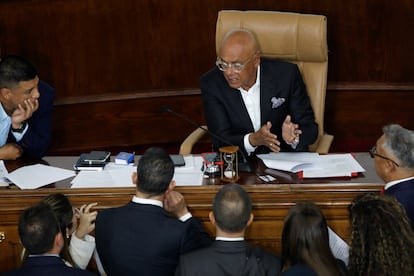
The opposition succeeded in ensuring that those outside the country can begin their amnesty proceedings through a legal representative, and that no one can be detained once they have initiated the process. Putting that guarantee in writing, opposition lawmakers argue, is a substantial safeguard, as is the possibility of a second hearing: if one court denies amnesty, the decision can be appealed before another.
Though Chavismo did not concede to all demands, the regime did negotiate its way to unanimous approval of the bill’s 16 articles. This was largely a symbolic achievement, given that opposition votes were numerically unnecessary. The United Socialist Party of Venezuela (PSUV) has a majority in the National Assembly, but current lawmakers were elected in 2025 amid widespread repression and under conditions even less transparent than previous elections. The main opposition forces aligned with leader María Corina Machado called for abstention.
The 12 opposition lawmakers in the Libertad bloc represent just 3% of the National Assembly’s 285 seats. On the day the first draft was brought to its initial discussion three weeks ago, Rodríguez summoned Stalin González, the bloc’s leader, to the dais and told him they would allow four of their deputies onto the commission. Nora Bracho — who negotiated her way to becoming the committees vice-president — Pablo Pérez, Antonio Ecarri and Luis Florido joined. “I think they included us because most of the political prisoners have ties to us,” says Florido.
The four were joined by González and Alejandro Rodríguez, and their presence means that half of the opposition bench is now on the committee. “We do not feel like a minority, and we represent the people who have wanted change since [the 2024 election on] July 28,” says Florido. The group will have to push to address the large number of cases that are not covered by the amnesty law.
The monitoring committee, which was established by the law’s Article 15, will be tasked with ensuring compliance with the bill, and constitutes the second small victory achieved by the opposition. In the debate’s final minutes, they managed to incorporate the word “expeditious” to describe the alternative measures that the commission may request to achieve amnesty in cases not covered by the law.
In addition to Chavista lawmakers, representatives of the public powers — including Attorney General Tarek William Saab, accused of responsibility for many of the detentions — took part in the debates. Several lawmakers said they laid out before them the serious failings of the judicial system. “We have said what is clear here: that justice was used as a tool to punish Venezuelans who thought differently. And that for Venezuela to change, and for the amnesty to achieve anything at all, all powers must be reinstitutionalized,” Florido said.
For the first time in a very long time, NGOs that have documented human rights violations — and have been increasingly targeted by the government in recent years — were also heard.
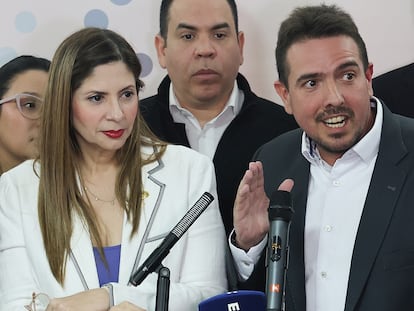
Florido has had a long trajectory as a member of the National Assembly. He himself was forced into exile and received a pardon from Nicolás Maduro in 2020, but he has been barred from leaving the country for nine years, his accounts in public banks are frozen, and several legal cases against him remain in limbo.
His own case should be subject to review, which is why he says that “the battle is just beginning.” “Let’s not burden the amnesty law with solving all of Venezuela’s problems,” he says. Florido notes that he witnessed “a parliamentary working environment” once again. He describes the process as follows: “There were proposals and counterproposals on the part of the Socialist Party and Libertad. Article 7 took about two hours to get through, two hours in which we never put down our pencils and paper. We saw the climate of this political moment, in which we must lower the spirit of pugnacity.”
The commission’s president, Chavista lawmaker Jorge Arreaza, was respectful and did not deny anyone the right to speak, according to those who formed part of the discussions. However, on social media, he warned amnesty recipients “not to repeat insurrectionary behavior.”
Debate was intense and fast-paced, in part due to pressure from family members who have been protesting in front of prisons since the beginning of January. In Zone 7, the National Bolivarian Police ended a hunger strike on February 19, after celebrating the law’s passage, while in other prisons, there was criticism of its shortcomings.
Four failed articles
The opposition proposed four additional articles that were left out of the final law. They dealt with lifting administrative disqualifications imposed by the Comptroller’s Office, repealing repressive laws, and introducing a labor amnesty, since political persecution in Venezuela has also involved unjustified dismissals and administrative sanctions.
Chavismo, for its part, managed at the last moment to exclude from the law’s protection anyone who had “incited armed actions” from abroad against the country’s territory and sovereignty — an accusation frequently leveled at María Corina Machado and her team. “In our view, that addition was unnecessary; we didn’t see it as being aimed at anyone in particular. It’s something that’s obvious to Venezuelans. We didn’t oppose it because we don’t want events like those of January 3 to happen again,” Florido says.
Sign up for our weekly newsletter to get more English-language news coverage from EL PAÍS USA Edition
Tu suscripción se está usando en otro dispositivo
¿Quieres añadir otro usuario a tu suscripción?
Si continúas leyendo en este dispositivo, no se podrá leer en el otro.
FlechaTu suscripción se está usando en otro dispositivo y solo puedes acceder a EL PAÍS desde un dispositivo a la vez.
Si quieres compartir tu cuenta, cambia tu suscripción a la modalidad Premium, así podrás añadir otro usuario. Cada uno accederá con su propia cuenta de email, lo que os permitirá personalizar vuestra experiencia en EL PAÍS.
¿Tienes una suscripción de empresa? Accede aquí para contratar más cuentas.
En el caso de no saber quién está usando tu cuenta, te recomendamos cambiar tu contraseña aquí.
Si decides continuar compartiendo tu cuenta, este mensaje se mostrará en tu dispositivo y en el de la otra persona que está usando tu cuenta de forma indefinida, afectando a tu experiencia de lectura. Puedes consultar aquí los términos y condiciones de la suscripción digital.