US pressure to strangle Cuba reaches the hospitals of Calabria
The southern Italian region defends the hiring of 400 Cuban doctors, who arrived three years ago to address the shortage of specialists
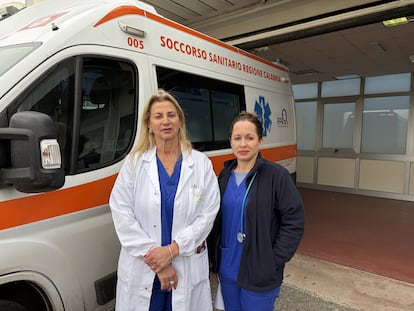
Lucia Orlando Settembrini, sitting in an office at the hospital where she works, is emphatic: “Without them, we couldn’t keep the Emergency Room open. It simply wouldn’t exist.” “They” are the 12 Cuban doctors under her supervision, who, for the past three years, have allowed the ER at the John Paul II Hospital in Lamezia Terme, Calabria, in southern Italy, to function. They are part of a contingent that arrived in 2022 in this region, one of the poorest in Europe, which has resorted to the exceptional hiring of doctors from Cuba to address a chronic shortage that was forcing the closure of entire hospital units. “I think we have helped to lighten the workload in the ER, since there are thousands of admissions. Calabrian people are very similar to Latinos. With our Italian colleagues, we have been able to work well together in a job that is not easy,” says Miladis Hernández Velázquez, who for a few minutes switches back to her native language and leaves behind the Italian she has learned to speak fluently.
Calabria is not her first posting abroad. She previously spent two years in Venezuela — on one of those international missions that for decades have been a source of foreign currency and soft power for Cuba — and which, with the escalating pressure from the United States to increase the economic strangulation of the island, have once again come under scrutiny from the Trump administration. So much so that the U.S. Chargé d’affaires in Cuba, Mike Hammer, traveled to Calabria last Monday to discuss the matter with the region’s president, Roberto Occhiuto, in a visit reported days earlier by Bloomberg and which has caused quite a stir.
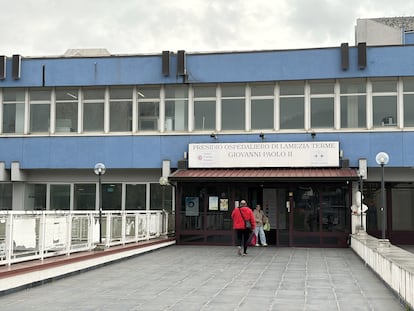
Occhiuto, a prominent leader of Forza Italia, the party founded by Silvio Berlusconi, made the decision to hire Cuban doctors after receiving little response to calls for professionals. The situation was critical: the region’s healthcare system had been under central government intervention for 15 years due to its disastrous financial situation. To alleviate the emergency — and recalling how Cuban doctors had been employed in northern Italy during the Covid-19 pandemic — the president had a hunch, or, as a spokesperson for his administration put it, “opted for a desperate move”: to introduce new vital resources through an agreement with the Cuban Medical Services Marketing Company, which is controlled by the Cuban government. The agreement was signed in August 2022, and the first 51 doctors arrived on December 28 of that year. “Calabrians will be happy to welcome you because they know your professional qualities and the quality of Cuban medical services,” Occhiuto said that day, receiving the newcomers amid applause.
Calabria had planned to attract 1,000 Cuban doctors by the end of 2026. However, the regional government launched a new call for applications in January to recruit professionals from EU and third countries. The region denies that the call is due to U.S. Pressure and attributes it to the worsening situation in Cuba, which could jeopardize further arrivals. “It is inappropriate to speak of U.S. Pressure on Calabria to end its collaboration with Cuban doctors. The U.S. Administration, even during Joe Biden’s presidency, has never hidden its lack of enthusiasm for this initiative, but it cannot be considered interference or imposition,” Occhiuto stated in response to this newspaper.
Regarding his meeting with Hammer, he adds: “I explained frankly that the Cuban doctors present today are indispensable for keeping hospitals and emergency rooms operational. I clarified that our healthcare system is open to professionals of all nationalities.” He emphasizes that “the U.S. State Department has expressed its willingness to provide concrete assistance in the process of hiring doctors.” The specifics of this support have not been disclosed. However, the 400 doctors who have already arrived will remain at least until 2027. Without them, the region says, “all the hospitals would have to close.”
“In a region that still lacks a specialized emergency medicine school, having trained doctors is an irreplaceable resource,” says General Antonio Battistini, former head of the Italian Army Medical Corps and, for the past three years, extraordinary commissioner for health in the province of Catanzaro, where the Lamezia hospital is located. Around 20 Cuban doctors are currently working there. A total of 48 doctors have arrived in the province, and 45 remain after three left the program. Initially, the agreement stipulated that of the €4,700 gross salary, approximately €1,200 would go directly to the doctors and the remainder to the Cuban government agency. However, this was changed two months later, and now the doctors receive a lump sum payment, which they then send back to Cuba.
Battistini oversaw the selection of the professionals, whose hiring, without requiring the validation of their academic degrees, was made possible by the extension of a regulation adopted during the pandemic to allow the arrival of foreign personnel. “I evaluated their resumes, their professional experience, and I also studied the Cuban healthcare system, which is very similar to ours,” the general commented, emphasizing the “clinical competence” of the Cuban doctors.
“I was skeptical at first because the system is very complex. However, after a period of physiological adaptation, their contribution has been noticeable not only quantitatively, but also qualitatively,” acknowledges Gerardo Mancuso, head of Internal Medicine at the Lamezia Terme hospital.
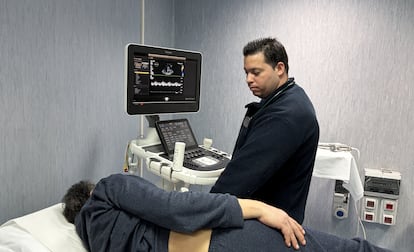
At this facility, they don’t even want to imagine their possible departure. “They never miss a day, they don’t ask for vacations or sick days. They are an example of dedication and work ethic. If they weren’t here, we would miss the people first. Then, as professionals, we would have more problems,” adds Roberto Ceravolo, head of Cardiology. Dr. José Adrián Fernández reports to him. Before working in Calabria, he was in Panama during the pandemic. “It definitely represents an important contribution from a personal point of view, but obviously the most important aspect, at least for me, is professional, always with the goal of providing extra help to a healthcare system in this country that needed medical assistance,” says Fernández, in the room where he performs echocardiograms. When asked about the situation in Cuba, he comments: “The situation in Cuba is complex because of what is happening internationally. Life in the world is complex.”
The professionals are uncomfortable with the attention they have received in recent weeks. “I think we’ve done something good here. Politics isn’t important to us. If we attract attention, let it be for good things,” says Dr. Hernández Velázquez. Battistini acknowledges that there has been “concern” among the Cuban doctors about not being able to continue this work. The pressure exerted by Washington — Secretary of State Marco Rubio announced last February a restriction on visas for officials of foreign governments involved in what the U.S. Defines as “forced labor” — has already had an effect: Honduras has just announced that it will close the program, as countries like Guatemala, Paraguay, and the Bahamas have already done.
Sign up for our weekly newsletter to get more English-language news coverage from EL PAÍS USA Edition
Tu suscripción se está usando en otro dispositivo
¿Quieres añadir otro usuario a tu suscripción?
Si continúas leyendo en este dispositivo, no se podrá leer en el otro.
FlechaTu suscripción se está usando en otro dispositivo y solo puedes acceder a EL PAÍS desde un dispositivo a la vez.
Si quieres compartir tu cuenta, cambia tu suscripción a la modalidad Premium, así podrás añadir otro usuario. Cada uno accederá con su propia cuenta de email, lo que os permitirá personalizar vuestra experiencia en EL PAÍS.
¿Tienes una suscripción de empresa? Accede aquí para contratar más cuentas.
En el caso de no saber quién está usando tu cuenta, te recomendamos cambiar tu contraseña aquí.
Si decides continuar compartiendo tu cuenta, este mensaje se mostrará en tu dispositivo y en el de la otra persona que está usando tu cuenta de forma indefinida, afectando a tu experiencia de lectura. Puedes consultar aquí los términos y condiciones de la suscripción digital.